CM Fadnavis Hails India's Defence Strength at Kargil Tribute Event
Synopsis
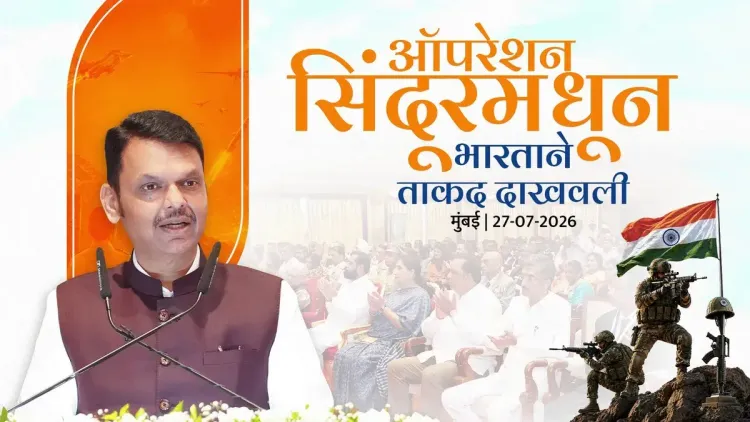
Maharashtra CM Devendra Fadnavis, at a Mumbai ceremony honouring soldiers and war widows on 27 July 2026, credited PM Narendra Modi's leadership for India's growing defence strength and said Operation Sindoor demonstrated India's military power to the world.
Key Takeaways
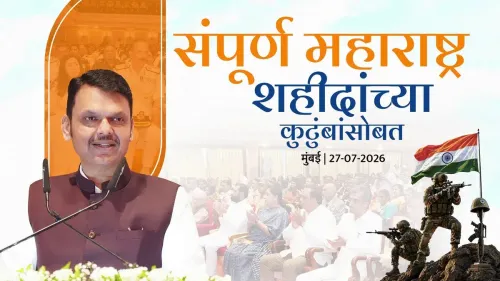
CM Devendra Fadnavis made the remarks at a gratitude felicitation ceremony for brave soldiers and their families in Mumbai on 27 July 2026 .
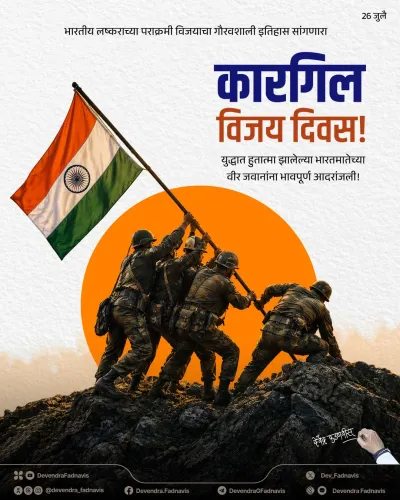
The event was held a day after Kargil Vijay Diwas , India's annual commemoration of its 1999 Kargil War victory.
Fadnavis credited Prime Minister Narendra Modi 's leadership for making India 'more capable in the defence sector.' He stated that Operation Sindoor showed the world India's military strength.
The ceremony honoured both active soldiers and the widows of those who died in service — key welfare beneficiaries of state outreach programmes.
The event reflects the BJP-led Maharashtra government 's broader strategy of aligning state veteran-welfare events with the Centre's national security narrative.
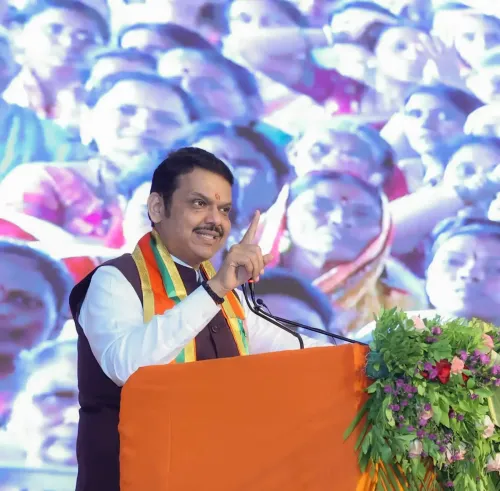
Maharashtra Chief Minister Devendra Fadnavis, speaking at a gratitude felicitation ceremony for brave soldiers and their families in Mumbai on 27 July 2026, declared that India has grown significantly stronger in defence under Prime Minister Narendra Modi's leadership, and that Operation Sindoor showed the world India's military might.
Context
The event — titled Veersainik va Veersainikaanchya Veerpatnincha Kritajnata Sanman Sohala (Gratitude Felicitation Ceremony for Brave Soldiers and the Brave Wives of Brave Soldiers) — was held in Mumbai on 27 July 2026, a day after Kargil Vijay Diwas, the annual commemoration of India's victory in the 1999 Kargil conflict with Pakistan. The ceremony honoured serving and veteran soldiers along with the families of those who sacrificed their lives in service of the nation.
Fadnavis, posting on X, quoted himself in both Marathi and Hindi: 'मा. पंतप्रधान नरेंद्र मोदी यांच्या नेतृत्वात भारत संरक्षण क्षेत्रात अधिक सक्षम बनला असून, ऑपरेशन सिंदूरमधून जगाने भारताची ताकद पाहिली आहे.' ('Under the honourable Prime Minister Narendra Modi's leadership, India has become more capable in the defence sector, and through Operation Sindoor, the world has seen India's strength.')
Policy Backdrop
India's defence posture has undergone a significant shift since 2014, with successive policy pushes under the Atmanirbhar Bharat initiative aimed at reducing import dependence and boosting domestic arms production. Capital procurement budgets have been progressively directed toward Indian manufacturers, and defence exports have grown substantially over the past decade.
The 1999 Kargil War itself was a watershed moment — the subsequent Kargil Review Committee recommendations triggered sweeping reforms in defence procurement, intelligence coordination, and border management. The 2016 surgical strikes across the Line of Control and the 2019 Balakot airstrike further established a pattern of calibrated military responses that the current government has cited as evidence of a more assertive national security doctrine.
Stakeholders and Impact
At the centre of Monday's ceremony were defence personnel, veterans, and war widows — constituencies that carry deep political and social significance in Maharashtra, a state with a large military recruitment base. Such felicitation events serve both as welfare outreach and as public affirmations of the state government's commitment to the armed forces community.
For the BJP-led Maharashtra government, aligning state-level veteran-welfare initiatives with the Centre's national security narrative reinforces a unified political message ahead of continued policy discussions on defence budgets and veteran rehabilitation packages. Families of soldiers killed or injured in active operations are typically the primary beneficiaries of such gratitude ceremonies.
What's Next
Parliamentary deliberations on India's next defence budget and the rollout of new indigenous equipment programmes are expected to keep national security in the policy spotlight. Kargil Vijay Diwas commemorations across states are likely to continue serving as platforms where both central and state leaders articulate India's evolving military doctrine to domestic and international audiences.
As Maharashtra continues to hold such felicitation ceremonies, attention will turn to whether new veteran welfare packages — covering healthcare, education support for soldiers' children, and employment assistance for war widows — are announced at the state level in the months ahead.
Point of View
He draws a rhetorical line connecting the 1999 military victory to present-day assertiveness, reinforcing a continuity-of-strength narrative. For Maharashtra, a state with a significant defence recruitment footprint, this framing also carries electoral utility, making soldiers and their families a visible constituency. The bilingual Marathi-Hindi delivery signals an attempt to speak simultaneously to regional identity and national pride.
NationPress
27 Jul 2026
Frequently Asked Questions
What did CM Devendra Fadnavis say about Operation Sindoor?
CM Fadnavis said that through Operation Sindoor, the world witnessed India's military strength, and that India has become more capable in the defence sector under PM Narendra Modi's leadership.
What was the Mumbai soldier ceremony on 27 July 2026?
It was a gratitude felicitation ceremony — Veersainik va Veersainikaanchya Veerpatnincha Kritajnata Sanman Sohala — held in Mumbai on 27 July 2026 to honour brave soldiers and the wives of soldiers who sacrificed their lives in service.
What is Kargil Vijay Diwas and why is it observed on 26 July?
Kargil Vijay Diwas is observed every year on 26 July to mark India's victory in the 1999 Kargil conflict with Pakistan. The date commemorates the day Indian forces declared the recapture of all occupied positions.
What is Operation Sindoor?
Operation Sindoor is referenced by CM Fadnavis as a demonstration of India's defence capabilities on the world stage. Specific operational details fall outside currently verifiable public information.
How has India's defence policy changed under PM Modi?
Since 2014, India has pursued defence indigenisation under the Atmanirbhar Bharat initiative, increased capital procurement from domestic manufacturers, and adopted a more assertive military posture, including the 2016 surgical strikes and the 2019 Balakot airstrike.