Haryana CMO Highlights India's First Hydrogen Train at Jind
Synopsis
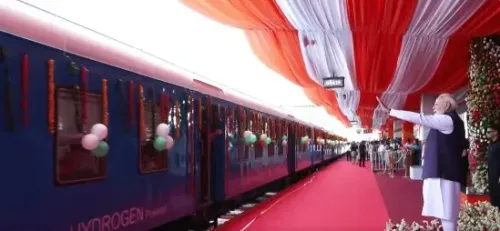
The Chief Minister's Office of Haryana has highlighted India's first indigenously developed hydrogen fuel-cell train, which emits only water vapour, and the country's first dedicated hydrogen storage and refueling facility established at Jind, framing the project as a milestone in PM Modi's clean-energy and self-reliance agenda.
Key Takeaways
The Chief Minister's Office of Haryana posted on 27 July 2026 about India's indigenous hydrogen fuel-cell train project.
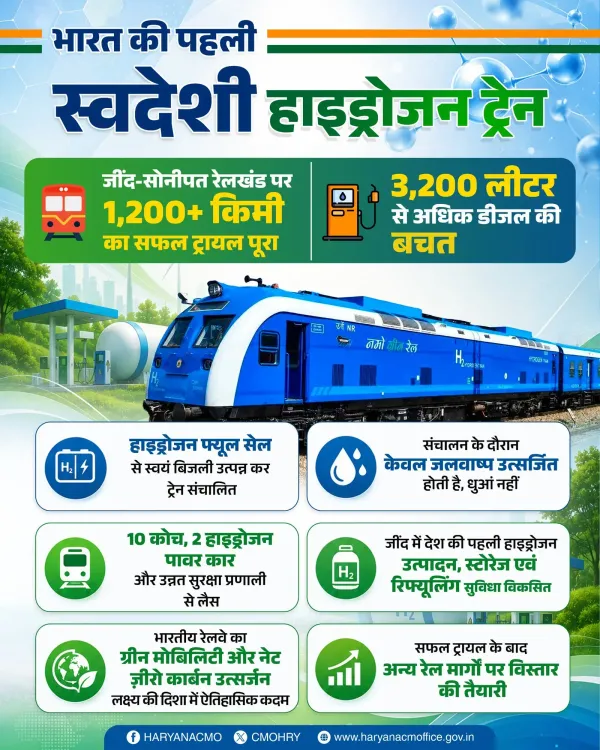
The train generates electricity via hydrogen fuel cells and emits only water vapour , making it zero-emission at the point of use.
Jind, Haryana now hosts India's first dedicated hydrogen storage and refueling facility for rail operations.
The project is developed using indigenous technology under the Atmanirbhar Bharat framework.
It aligns with the National Green Hydrogen Mission (2023) and Indian Railways' net-zero target for 2030 .
Expansion of hydrogen refueling infrastructure to other rail corridors is the key variable for scaling the technology.
The Chief Minister's Office of Haryana on Monday, 27 July 2026 highlighted India's indigenous hydrogen fuel-cell train project, crediting Prime Minister Narendra Modi's leadership for the country's advances in green energy, innovation, and self-reliance. The post drew attention to Jind, Haryana, which now hosts the country's first dedicated hydrogen storage and refueling facility built to support the new train technology.
The CMO's post, written in Hindi, stated: 'Swadeshi takneek se viksit yah train hydrogen fuel cell ke madhyam se bijli utpann karti hai tatha keval jalvaashp utsar jit karti hai' — ('This indigenously developed train generates electricity through hydrogen fuel cells and emits only water vapour'). The statement underscores the zero-emission character of the technology, which produces no greenhouse gases at the point of use.
Context
India's push into hydrogen-based rail mobility is part of a broader national strategy to decarbonise heavy transport. The CMO's post specifically noted that the train is equipped with 'state-of-the-art safety systems' and that the Jind facility is the first dedicated hydrogen storage and refueling station in the country. The post described the project as 'a new chapter in clean, safe and future-ready rail operations.'
Indian Railways has set a net-zero carbon target for 2030, and hydrogen fuel-cell propulsion is among the pilot technologies being evaluated to replace diesel traction on non-electrified routes. The Jind project represents a concrete infrastructure milestone in that roadmap.
Policy Backdrop
The project sits within the framework of the National Green Hydrogen Mission, launched in 2023, which aims to scale up the production, storage, and end-use of green hydrogen across sectors including transport, industry, and power. Railways were identified as a priority early-adoption sector given their high energy consumption and long asset lifecycles.
The broader Atmanirbhar Bharat (self-reliant India) programme has pushed domestic development of critical technologies rather than reliance on imports. The CMO's emphasis on 'swadeshi takneek' ('indigenous technology') directly echoes that policy framing, positioning the hydrogen train as both a climate and a manufacturing achievement.
Stakeholders and Impact
Railway passengers stand to benefit from cleaner, quieter rolling stock if the technology scales beyond the pilot phase. The renewable energy sector, particularly green hydrogen producers and electrolyser manufacturers, gains a high-visibility demonstration project that could unlock further public procurement.
Haryana benefits directly as the host state: the Jind refueling facility positions the district as a node in emerging hydrogen infrastructure, with potential spillover effects for local employment and industrial investment. The state government's decision to amplify the project signals political ownership of the green-transition narrative.
What's Next
Attention will now turn to whether the Jind facility's model is replicated on other rail corridors and how upcoming railway budget allocations treat additional hydrogen fuel-cell train rakes. The expansion of refueling infrastructure is widely seen as the binding constraint on scaling hydrogen rail beyond demonstration projects.
If performance data from the Jind pilot meets operational benchmarks, it could accelerate procurement decisions and position India as a reference market for hydrogen rail technology in the Global South.
Point of View
The state positions itself as an active partner — not merely a beneficiary — of India's green transition. The choice of Jind as the host site for the country's first hydrogen refueling station gives Haryana a concrete, durable claim in the emerging hydrogen economy narrative. Framing the project through the twin lenses of Atmanirbhar Bharat and clean energy allows the ruling establishment to simultaneously address industrial-policy and climate audiences. The timing, well ahead of any formal operational announcement, suggests the communication strategy is as much about shaping public perception of hydrogen rail as it is about reporting a fait accompli.
NationPress
26 Oct 2026
Frequently Asked Questions
What is India's hydrogen fuel-cell train and where is it based?
India's hydrogen fuel-cell train is an indigenously developed locomotive that generates electricity through hydrogen fuel cells and emits only water vapour. Its supporting infrastructure — the country's first dedicated hydrogen storage and refueling facility — is located at Jind in Haryana.
What is the National Green Hydrogen Mission?
The National Green Hydrogen Mission was launched in 2023 by the Government of India to scale up the production, storage, and use of green hydrogen across sectors including transport, industry, and energy, with railways identified as a priority early-adoption sector.
What is Indian Railways' carbon target?
Indian Railways has announced a target to achieve net-zero carbon emissions by 2030 , with hydrogen fuel-cell trains among the pilot technologies being evaluated to replace diesel traction on non-electrified routes.
Why was Jind in Haryana chosen for the hydrogen refueling facility?
Jind was selected as the site for India's first dedicated hydrogen storage and refueling facility to support the hydrogen fuel-cell train pilot. The research does not specify the precise operational criteria used for the selection beyond its role as the demonstration project's base.
How does a hydrogen fuel-cell train work?
A hydrogen fuel-cell train uses compressed hydrogen gas to generate electricity through a chemical reaction in a fuel cell; the only by-product released into the atmosphere is water vapour , making it a zero-emission propulsion system at the point of use.