Pralhad Joshi hails India's first Hydrogen Fuel Cell Train launch

Synopsis
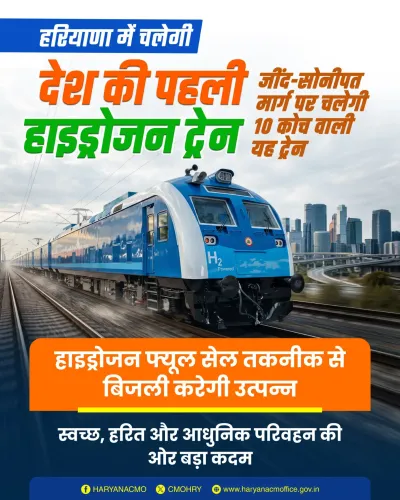
Union Minister Pralhad Joshi announced the imminent inauguration of India's first indigenously developed Hydrogen Fuel Cell Train — a 10-coach, 1,200 kW system — on the Jind–Sonipat section in Haryana, marking a pivotal step in India's clean-transport and green hydrogen ambitions.
Key Takeaways
Union Minister Pralhad Joshi announced the inauguration of India's first indigenously developed Hydrogen Fuel Cell Train on 16 July 2026 .
The train comprises 10 coaches and runs on a 1,200 kW hydrogen fuel cell propulsion system built domestically.
The pilot route is the Jind–Sonipat section in Haryana .
The project is linked to the National Green Hydrogen Mission , which targets 5 MT of green hydrogen production annually by 2030 .
Indian Railways first declared its intent to develop hydrogen trains in 2021 as part of its net-zero emissions roadmap.
Successful deployment could accelerate hydrogen train rollouts on other non-electrified corridors and boost India's domestic green hydrogen industry.
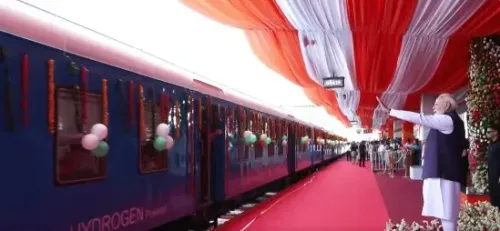
Union Consumer Affairs Minister Pralhad Joshi on Thursday, 16 July 2026, lauded the forthcoming inauguration of India's first indigenously developed Hydrogen Fuel Cell Train, calling it a new era of green mobility under the leadership of Prime Minister Narendra Modi. The 10-coach train, powered by a 1,200 kW hydrogen fuel cell propulsion system, is set to operate on the Jind–Sonipat section in Haryana.
Context
Joshi's post describes the train as a 'major milestone in India's journey towards clean, sustainable and self-reliant transportation.' The Jind–Sonipat corridor in Haryana has been selected as the demonstration route for this pilot, placing the state at the centre of what the government is positioning as a landmark moment for domestic railway technology. The minister's framing explicitly ties the project to the broader Atmanirbhar Bharat vision, underscoring that the propulsion system has been developed indigenously.
The announcement arrives as Indian Railways continues its push toward decarbonisation. The state-owned operator had signalled its intent to develop hydrogen fuel-cell trains as early as 2021, as part of a long-term net-zero emissions roadmap. This inauguration, if it proceeds as described, would mark the first tangible operational outcome of that multi-year effort.
Policy Backdrop
The train's launch is closely linked to the National Green Hydrogen Mission, approved by the Union Cabinet in January 2023. The mission targets an annual green hydrogen production capacity of 5 million tonnes (MT) by 2030, with transport identified as one of its core application sectors. Hydrogen fuel-cell technology in rail fits squarely within that framework, offering a pathway to eliminate diesel dependency on non-electrified or partially electrified routes.
India has also committed to achieving net-zero emissions by 2070, a target that requires deep decarbonisation across heavy transport. Rail, which accounts for a significant share of freight and passenger movement, is seen as a critical lever. Parallel pilot programmes for hydrogen-powered buses and stationary power applications are also under development, suggesting a coordinated sectoral push rather than an isolated project.
Stakeholders and Impact
The most immediate beneficiaries are railway passengers on the Jind–Sonipat route in Haryana, who would experience the first commercial-grade hydrogen train service in the country. Beyond commuters, the project carries significant implications for India's renewable energy industry: successful deployment would validate domestic hydrogen propulsion technology and potentially open a large domestic market for manufacturers and component suppliers.
Indian Railways' R&D units stand to gain credibility and further funding if the pilot demonstrates operational viability. For the broader clean-energy ecosystem, a working hydrogen train on an Indian route would strengthen the investment case for green hydrogen infrastructure — electrolysers, storage, and refuelling — along rail corridors. It also reduces dependence on imported fossil fuels, a strategic priority that successive Union Budgets have reinforced.
What's Next
Attention will now turn to whether the Jind–Sonipat pilot leads to route expansions and how quickly the government moves on technology transfer agreements with domestic manufacturers. Analysts will also watch the next Union Budget for fresh allocations under the National Green Hydrogen Mission, particularly incentives tied to rail applications. If the inaugural run meets performance benchmarks, Indian Railways could accelerate the rollout of hydrogen trains on other non-electrified sections across the country, making today's announcement the starting point of a larger green-mobility transformation.
Point of View
Maximising political capital from a years-in-the-making R&D investment. By anchoring the announcement to both Atmanirbhar Bharat and the National Green Hydrogen Mission, the BJP is weaving a single narrative thread from domestic manufacturing to climate ambition — a framing that serves both domestic and international audiences. The choice of Haryana, a politically significant state, as the launch corridor is unlikely to be incidental. If the pilot succeeds operationally, it hands the government a replicable template; if it stumbles, the limited single-route scope provides insulation from broader criticism.
NationPress
15 Oct 2026
Frequently Asked Questions
What is India's first Hydrogen Fuel Cell Train?
It is a 10-coach train powered by a 1,200 kW hydrogen fuel cell propulsion system, developed indigenously by Indian Railways, set to run on the Jind–Sonipat section in Haryana.
Where will India's hydrogen train run?
The train will operate on the Jind–Sonipat railway section in Haryana, chosen as the pilot corridor for this inaugural demonstration.
What is the National Green Hydrogen Mission?
It is a Union Cabinet-approved programme launched in January 2023 that targets 5 million tonnes of annual green hydrogen production capacity by 2030, with transport among its key application sectors.
Why is a hydrogen train significant for Indian Railways?
A hydrogen fuel-cell train eliminates diesel emissions on non-electrified routes, supporting Indian Railways' net-zero emissions roadmap and reducing dependence on imported fossil fuels.
What did Minister Pralhad Joshi say about the hydrogen train?
Joshi said India is set to 'usher in a new era of green mobility' with the inauguration, calling it a major milestone in the country's journey towards clean, sustainable and self-reliant transportation.