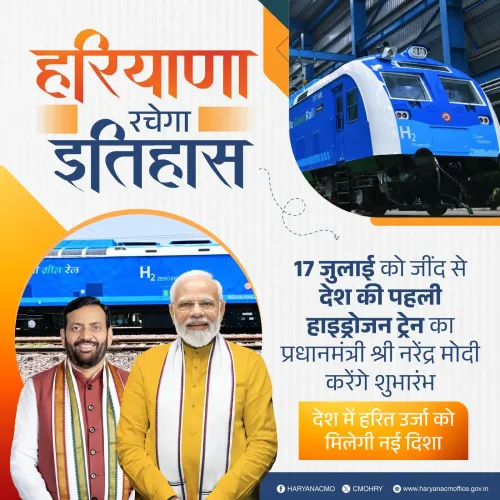
CM Haryana: India's first hydrogen train to run on Jind-Sonipat route
Synopsis
The Chief Minister's Office of Haryana has announced that India's first hydrogen-powered train will operate on the Jind-Sonipat route. The 10-coach train will generate electricity through hydrogen fuel-cell technology, marking a milestone in India's green rail mobility push under the National Green Hydrogen Mission.
Key Takeaways
The Chief Minister's Office of Haryana announced India's first hydrogen-powered train on 27 May 2026 .
The train will run on the Jind-Sonipat route in Haryana.
It will have 10 coaches and generate electricity using hydrogen fuel-cell technology , emitting only water vapour.
The pilot aligns with Indian Railways' net-zero target by 2030 and the National Green Hydrogen Mission launched in 2023 .
A successful pilot could serve as a national template for decarbonising diesel-dependent rail corridors across India.
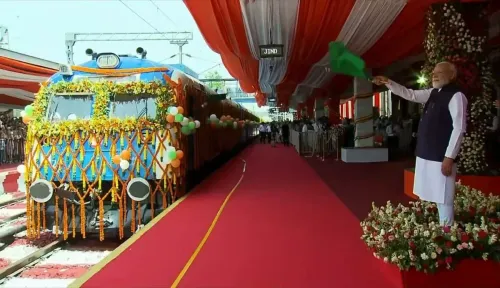
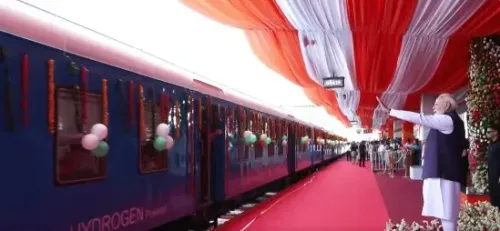
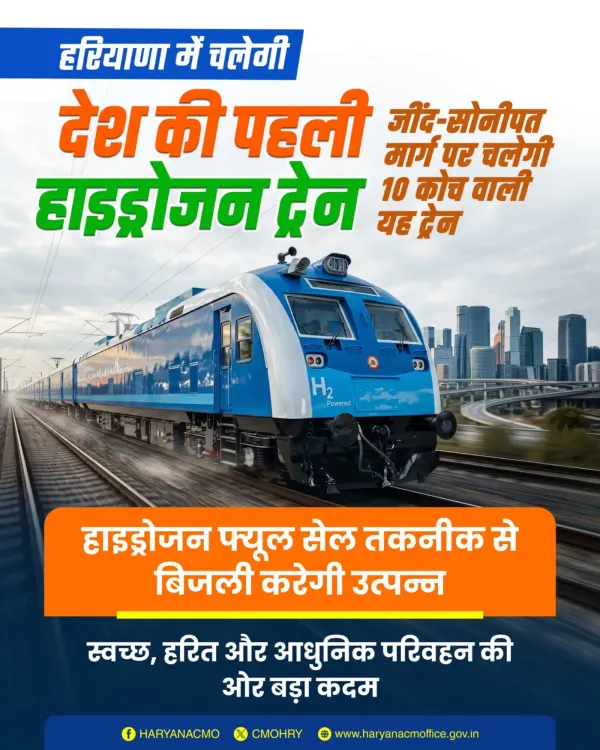
The Chief Minister's Office of Haryana announced on Wednesday, 27 May 2026 that India's first hydrogen-powered train will operate in Haryana, running on the Jind-Sonipat route with a 10-coach configuration powered by hydrogen fuel-cell technology.
The post, shared by the official CMO Haryana handle, stated: 'हरियाणा में चलेगी देश की पहली हाइड्रोजन ट्रेन' ('India's first hydrogen train will run in Haryana'), adding that the train will generate electricity through hydrogen fuel-cell technology.
Context
The announcement positions Haryana as the launch state for what is being described as India's first hydrogen train. The Jind-Sonipat corridor — an existing railway route linking two key districts in the state — has been identified as the pilot track for this initiative. The 10-coach train will not rely on overhead electric lines or diesel engines; instead, it will generate onboard electricity through hydrogen fuel cells.
Hydrogen fuel-cell propulsion works by converting hydrogen gas into electricity through an electrochemical reaction, emitting only water vapour as a byproduct. This makes it a zero-direct-emission alternative to diesel traction, which still powers a significant share of India's non-electrified rail network.
Policy Backdrop
Indian Railways declared a net-zero carbon emissions target by 2030 back in 2021, setting the institutional framework for alternative-propulsion experiments. The National Green Hydrogen Mission, launched by the central government in 2023, further outlined pilot programmes for hydrogen-powered trains as part of a broader push to scale green hydrogen use across transport and industry.
The 2023 Union Budget specifically referenced hydrogen train pilots as part of India's green-mobility agenda. Haryana's selection for the inaugural route reflects the centre-state coordination model that has been used to roll out other flagship rail projects, including Vande Bharat express corridors across the country.
India has committed to achieving net-zero emissions by 2070, and integrating hydrogen fuel-cell technology into railways is seen as a critical lever for reducing the network's dependence on diesel, particularly on routes that have not yet been electrified.
Stakeholders and Impact
The most immediate beneficiaries are daily rail commuters on the Jind-Sonipat corridor, who stand to gain from cleaner, quieter train operations. Broader stakeholders include Haryana's industrial and agricultural districts, which rely heavily on rail connectivity, as well as environmental groups tracking India's transport decarbonisation commitments.
For Indian Railways as an organisation, a successful hydrogen pilot on this route would provide operational data — on refuelling logistics, fuel-cell durability, and passenger safety — that could inform decisions about scaling the technology to other non-electrified corridors nationwide. Domestic hydrogen technology developers and public-sector undertakings involved in green hydrogen production also stand to benefit from a high-profile state-level deployment.
What's Next
Key milestones to watch include the formal inauguration date for the train's commercial or trial run, safety certifications from the Commissioner of Railway Safety, and any hydrogen refuelling infrastructure that will need to be established along the Jind-Sonipat corridor. Future rail budget announcements may indicate whether additional Haryana routes — or routes in other states — are being considered for hydrogen-train expansion.
If the pilot delivers on its technical and operational promises, it could accelerate India's timeline for deploying hydrogen traction across the roughly one-third of the rail network that remains diesel-dependent, turning Haryana's corridor into a national template for green rail mobility.
Point of View
Lending political visibility to a central government policy — the National Green Hydrogen Mission — that has so far been stronger on intent than on operational milestones. Choosing the Jind-Sonipat corridor, a relatively short and manageable route, is a textbook approach to de-risking a first-of-its-kind deployment before any national scale-up. The timing, ahead of what could be a significant rail budget cycle, suggests both Haryana and the Centre are keen to show tangible hydrogen-economy progress. Whether the pilot translates into a replicable model will depend heavily on the refuelling infrastructure and safety certification timelines that have yet to be publicly detailed.
NationPress
11 Oct 2026
Frequently Asked Questions
Where will India's first hydrogen train run?
India's first hydrogen train is set to run on the Jind-Sonipat route in Haryana , as announced by the Chief Minister's Office of Haryana on 27 May 2026.
How does a hydrogen fuel-cell train work?
A hydrogen fuel-cell train generates onboard electricity by converting hydrogen gas through an electrochemical reaction, emitting only water vapour — making it a zero-direct-emission alternative to diesel traction.
How many coaches will the Haryana hydrogen train have?
The hydrogen train announced for the Jind-Sonipat route will have 10 coaches , according to the Chief Minister's Office of Haryana.
What is the National Green Hydrogen Mission?
The National Green Hydrogen Mission is a central government scheme launched in 2023 to scale green hydrogen production and deployment across sectors including transport, and it provides the policy framework for hydrogen train pilots in India.
Why is Indian Railways experimenting with hydrogen trains?
Indian Railways has a net-zero carbon emissions target by 2030 and is exploring hydrogen fuel-cell technology to reduce diesel dependence on non-electrified routes, in line with India's broader 2070 net-zero commitment.