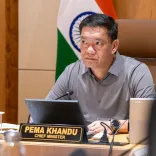
Kejriwal: Modi Govt Arrested Editor Covering Haryana Drug Trade
Synopsis
AAP convenor Arvind Kejriwal accused the Modi government of ordering Haryana Police to arrest Hindi Khabar and Living India Group editor-in-chief Atul Aggarwal, claiming the channel was targeted for covering Haryana's drug trade. Kejriwal called it an undeclared Emergency and a sign of democracy's collapse.
Key Takeaways
Arvind Kejriwal alleged on 11 October 2026 that the Modi government had Atul Aggarwal , Editor-in-Chief of Hindi Khabar and Living India Group , arrested by Haryana Police .
Kejriwal claims the arrest was retaliation for the channel's sustained coverage of a drug trade spreading in Haryana .
He invoked the word aapatkaal (Emergency), drawing a direct parallel to India's 1975-77 press censorship era .
Kejriwal called the conduct 'extremely shameful' and declared it 'a sign that democracy is ending.' NationPress has not independently verified the details of the arrest or the government's role; no official response was on record at the time of publication.
A media owner behind bars for covering a drug story — that is the charge AAP convenor Arvind Kejriwal levelled against the Modi government on Sunday, 11 October 2026, calling it proof that an undeclared Emergency is already in force across India.
Kejriwal's post states that Atul Aggarwal, Editor-in-Chief of Hindi Khabar and the Living India Group, was arrested by Haryana Police at the direction of the Centre. The AAP convenor claims Aggarwal's channel had been running sustained coverage of a drug trade spreading across Haryana in recent days — and that the arrest followed directly from that reporting.
The Allegation: Journalism Punished, Not Protected
In his post, Kejriwal wrote — 'मोदी जी ने देश में आपातकाल लागू कर दिया है' — translated: 'Modi has imposed an Emergency in the country.' He went further, asserting that 'even owners of media organisations are no longer safe,' framing the arrest of a proprietor-editor as a step beyond silencing journalists and into silencing the institutions themselves.
The specific trigger, Kejriwal alleges, was Living India Group's ongoing coverage of a drug racket operating inside Haryana. The implication is pointed: a state governed under BJP's national umbrella allegedly used its police machinery to suppress reporting inconvenient to those in power.
Haryana Drug Trade — the Backdrop to the Arrest Claim
Haryana has repeatedly surfaced in public debate as a transit and consumption zone for narcotics, with its proximity to Punjab — itself grappling with a well-documented drug crisis — drawing repeated scrutiny. If Aggarwal's channel was tracking a live drug story in the state, the editorial stakes were real. The research block for this story carries no independent verification of the arrest or its specific circumstances, and NationPress has not independently confirmed the details Kejriwal has cited.
Kejriwal's 'Emergency' Frame — and Why It Lands Hard
The word aapatkaal (Emergency) is not incidental in Indian politics — it carries the full weight of 1975-77, when press censorship and mass detentions defined Indira Gandhi's darkest chapter. Opposition leaders invoking it are making a precise historical comparison, not a casual one. Kejriwal called the government's conduct 'extremely shameful' and 'a sign that democracy is ending' — language calibrated to maximise political pressure rather than legal argument.
AAP has consistently positioned press freedom as a differentiator in its political identity, particularly since Kejriwal's own legal troubles over the past two years. A case involving a regional media group's editor gives the party a fresh, concrete hook for that long-running narrative.
If the arrest is confirmed and the editorial-retaliation link holds scrutiny, the case would join a growing list of press-freedom flashpoints that civil-society groups, bar associations, and international journalism bodies have flagged in India. If the facts are murkier, the political charge will outlast the legal one — it almost always does.
Point of View
Moving from individual reporters to media ownership itself. Kejriwal's 'Emergency' framing is a deliberate historical callback designed to broaden the opposition coalition against the BJP ahead of an already charged political season. AAP's sustained focus on press freedom since 2024 reflects its calculation that the issue resonates beyond its urban base, particularly with the middle class that consumes regional news channels like Living India. How the BJP-led Haryana government responds — and whether the legal grounds for the arrest hold independent scrutiny — will determine whether this remains a political allegation or becomes a genuine constitutional moment.
NationPress
11 Oct 2026
Frequently Asked Questions
Who is Atul Aggarwal and why was he arrested according to Kejriwal?
Atul Aggarwal is the Editor-in-Chief of Hindi Khabar and the Living India Group. Kejriwal alleges he was arrested by Haryana Police because his channel was covering an ongoing drug trade in Haryana, and that the Modi government ordered the arrest to suppress that reporting.
What is Living India Group?
Living India Group is a regional media organisation that operates the Hindi Khabar news channel, primarily covering news across northern India including Haryana and Punjab.
Why did Kejriwal use the word 'Emergency' in his post?
Kejriwal used the word aapatkaal (Emergency) to draw a deliberate parallel to India's 1975-77 period, when press censorship and political detentions were widespread. The term carries heavy constitutional weight in India's political vocabulary.
Has the Modi government or Haryana Police responded to Kejriwal's allegations?
No official response from the BJP-led central government or Haryana Police was on record at the time of publication. NationPress has not independently verified the circumstances of the arrest.
What is the drug trade situation in Haryana that the channel was reportedly covering?
Haryana has been cited as a significant transit and consumption zone for narcotics, partly due to its proximity to Punjab which has faced a longstanding drug crisis. The specific drug-trade investigation Aggarwal's channel was running has not been independently detailed beyond Kejriwal's post.