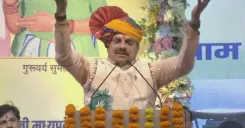
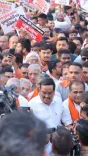
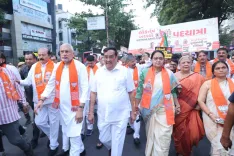
CR Paatil joins Surat padyatra in 'Save Democracy' drive
Synopsis
Union Jal Shakti Minister C. R. Paatil marched with citizens in Surat on 26 October 2026 under the BJP's 'Save Democracy, Remove Anarchy' padyatra campaign, pledging to uphold democratic values at the grassroots level.
Key Takeaways
Paatil , Union Jal Shakti Minister and former BJP Gujarat president, participated in a padyatra in Surat on 26 October 2026 .
The march was held under the 'Loktatntra Bachao, Arajkata Hatao' ('Save Democracy, Remove Anarchy') campaign.
Paatil publicly pledged to protect democratic values alongside Surat's citizens.
Surat is a long-standing BJP stronghold and major urban centre in Gujarat .
Padyatras on democracy and governance themes are a recurring BJP mobilisation tool in Gujarat.
No opposition response to the campaign's framing had been issued at the time of the post.
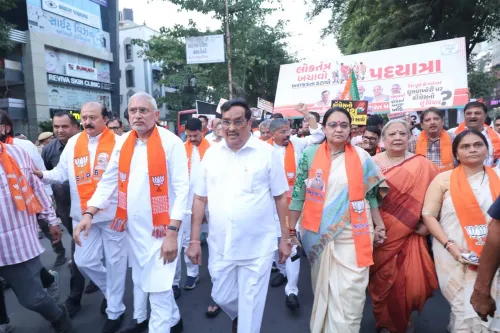
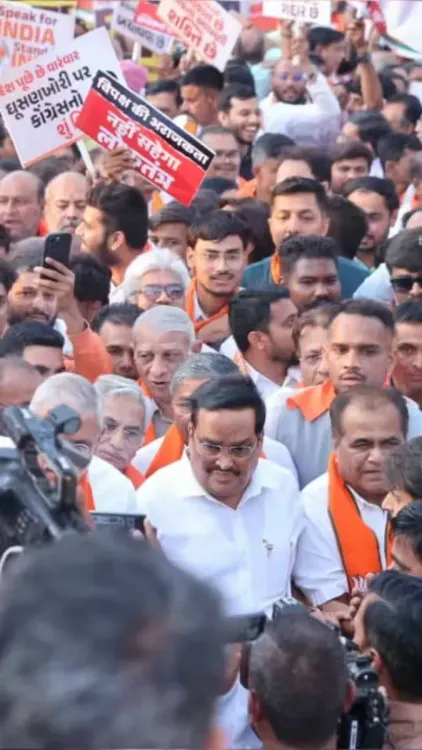
Thousands of footsteps echoed through the streets of Surat as Union Jal Shakti Minister C. R. Paatil joined citizens in a padyatra — a public march on foot — organised under the 'Loktatntra Bachao, Arajkata Hatao' (લોકતંત્ર બચાવો, અરાજકતા હટાવો) campaign, meaning 'Save Democracy, Remove Anarchy,' on Monday, 26 October 2026.
'Save Democracy, Remove Anarchy' — what the march stood for
Paatil, posting a video glimpse of the event on X, said he 'expressed a pledge to protect democratic values alongside citizens' at the Surat Mahanagar march. The campaign frames democratic institutions as something that must be actively defended — not merely inherited — and positions anarchy as a live threat to civic order. For a senior Union minister to anchor himself in a street-level march rather than a podium address signals a deliberate choice to put boots on pavement alongside ordinary voters.
Surat as a BJP stronghold and political stage
Surat, Gujarat's commercial capital and a city the BJP has long dominated, regularly serves as a launch pad for large-scale party mobilisation drives. The city's dense urban electorate and strong RSS organisational network make it a natural venue for campaigns intended to radiate outward. C. R. Paatil — a former president of the BJP Gujarat unit — carries deep roots in the state's political machinery, giving his presence here far more weight than a routine ministerial visit.
Padyatras on themes of democracy and governance have become a recurring instrument in the BJP's Gujarat playbook, blending street-level energy with ideological messaging. The 'Save Democracy' framing, in particular, sets up a pointed contrast with unnamed adversaries — a rhetorical structure designed to consolidate base sentiment while drawing sharp lines ahead of any upcoming electoral cycle.
The campaign's next moves
Whether the drive stays anchored in Surat or rolls through other Gujarat cities remains to be watched. Opposition parties in the state are yet to formally respond to the campaign's framing. What is clear is that a Union minister — not a local functionary — chose to lead from the front in this march, lending the event a national profile it would otherwise lack. That is rarely an accident.
Point of View
Remove Anarchy' framing is a textbook mobilisation device: it positions the ruling party as the custodian of order while implicitly casting opponents as destabilising forces, a narrative the BJP has deployed effectively in Gujarat across multiple electoral cycles. Paatil's dual identity as a Union minister and former Gujarat BJP president makes him an ideal bridge between national messaging and local organisational muscle. The campaign's success will hinge on whether it generates enough momentum to spread beyond Surat and force a substantive response from the opposition.
NationPress
26 Oct 2026
Frequently Asked Questions
What is the 'Loktatntra Bachao, Arajkata Hatao' campaign?
'Loktatntra Bachao, Arajkata Hatao' translates to 'Save Democracy, Remove Anarchy' — a BJP-led public awareness and mobilisation campaign in Gujarat centred on pledging to protect democratic institutions and civic order.
Why did CR Paatil join the Surat padyatra?
As Union Jal Shakti Minister and former BJP Gujarat president, C. R. Paatil participated in the Surat march to express solidarity with citizens and reinforce the party's grassroots democratic messaging.
What is a padyatra in Indian politics?
A padyatra is a political or social march on foot, used by leaders to connect directly with citizens at the street level, combining symbolic visibility with community outreach.
What is CR Paatil's political background in Gujarat?
C. R. Paatil is a senior BJP leader who previously served as president of the BJP Gujarat unit before being inducted into the Union Cabinet as Minister of Jal Shakti.
Will the 'Save Democracy' campaign expand beyond Surat?
As of the campaign's Surat leg, no official announcement about extension to other Gujarat cities has been confirmed, though such drives typically roll out across multiple urban centres in the state.