Ramaswamy Pushes Hard on Sanctuary Cities, Rule of Law
Synopsis
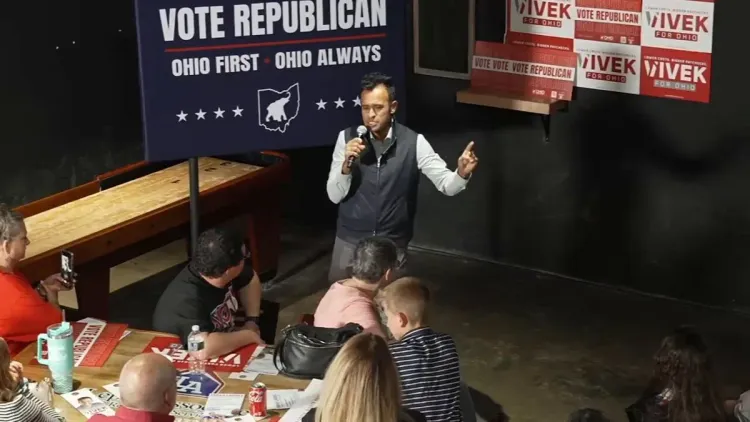
Entrepreneur Vivek Ramaswamy posted a sharp call to 'restore the rule of law and end sanctuary cities' on October 26, 2026, reigniting the long-running Republican push to force local US jurisdictions into compliance with federal immigration enforcement.
Key Takeaways
Vivek Ramaswamy called to 'restore the rule of law and end sanctuary cities' in an October 26, 2026 post on X.
Sanctuary cities are jurisdictions that limit local cooperation with ICE detainer requests — a contested policy since the 1980s .
The Trump administration issued Executive Order 13768 in 2017 to withhold federal grants from non-compliant jurisdictions; courts partially blocked it.
Ramaswamy, as former co-lead of the DOGE advisory effort and a 2024 Republican presidential candidate, occupies a high-visibility lane in this debate.
Potential next steps include new executive orders, DOJ legal challenges, and congressional funding conditions targeting sanctuary jurisdictions.
One of America's most vocal advocates for hardline immigration enforcement just turned up the volume. Entrepreneur Vivek Ramaswamy — founder of Strive Asset Management, former co-lead of the US Department of Government Efficiency (DOGE) advisory effort, and 2024 Republican presidential candidate — posted a pointed two-line call to action on X on Monday, October 26, 2026: 'Restore the rule of law and end sanctuary cities. Fight for what's right.'
What sanctuary cities are — and why they keep igniting Washington
Sanctuary cities are local jurisdictions — typically counties or municipalities — that formally limit their cooperation with federal immigration enforcement agencies, particularly Immigration and Customs Enforcement (ICE). Dozens of American cities, including San Francisco, Chicago, and New York, have adopted such policies, instructing local police not to honour ICE detainer requests or share immigration status information with federal authorities.
The debate is not new. The policy has been contested since the 1980s, but it reached a sharp legal and political inflection point in 2017 when the Trump administration issued Executive Order 13768, directing federal agencies to withhold grants from jurisdictions refusing to comply with ICE detainers. Courts partially blocked that order, but the fight over federal funding leverage versus local autonomy has never really stopped.
Ramaswamy's place on this fault line
Ramaswamy has consistently positioned himself on the federal-supremacy side of the immigration debate — arguing that local jurisdictions cannot simply opt out of national law. His call to 'restore the rule of law' echoes the core Republican argument: that sanctuary ordinances are not compassionate local governance but a direct challenge to congressional and executive authority over immigration.
That argument has resurfaced in every election cycle since 2016, appearing in party platforms, congressional funding fights, and multiple Supreme Court battles. The political energy Ramaswamy channels is real and recurring — Republican candidates at the state and federal level have made sanctuary city opposition a reliable red-meat issue, particularly in cycles where immigration tops voter-concern polls.
The stakes heading into the next congressional session
What makes the post timely is the policy machinery it points toward. Watchpoints include potential new executive orders conditioning federal grants on ICE cooperation, Department of Justice legal challenges to specific city ordinances, and congressional riders that could strip funding from non-compliant jurisdictions. Each lever has precedent; each has also faced injunctions from federal courts that have historically been reluctant to coerce local governments wholesale.
The communities most directly in the crosshairs are immigrant populations in sanctuary jurisdictions, local law-enforcement agencies caught between state directives and federal pressure, and the municipal governments themselves, for whom federal grants can represent billions of dollars in annual revenue.
Ramaswamy's post is short. The policy war it references is not.
Point of View
Creates a binary frame (law versus lawlessness), and forces Democratic-aligned mayors onto defence. The post's real audience is likely primary voters and donor networks, not policy officials. Whether it translates into concrete legislative or executive action depends on the political calendar — but the fact that this argument keeps returning every cycle suggests it has not yet found a durable legal resolution.
NationPress
26 Oct 2026
Frequently Asked Questions
What are sanctuary cities in the US?
Sanctuary cities are local jurisdictions — cities or counties — that limit their cooperation with federal immigration enforcement, particularly by refusing to honour ICE detainer requests or share residents' immigration status with federal agents.
Why does Vivek Ramaswamy oppose sanctuary cities?
Ramaswamy argues, consistent with mainstream Republican positions, that local jurisdictions cannot opt out of federal immigration law, and that sanctuary policies undermine the rule of law and federal supremacy in immigration enforcement.
What did the Trump administration do about sanctuary cities?
In 2017 , the Trump administration issued Executive Order 13768 , directing federal agencies to withhold grants from jurisdictions that refused to comply with ICE detainer requests. Federal courts partially blocked the order.
What is Vivek Ramaswamy's role in US politics?
Ramaswamy is the founder and executive chairman of Strive Asset Management , a former co-lead of the Department of Government Efficiency (DOGE) advisory effort, and a 2024 Republican presidential candidate.
Can the federal government force cities to cooperate with ICE?
Federal courts have generally limited Washington's ability to directly coerce local governments, though Congress can condition federal grants on ICE cooperation — a lever that remains legally contested and politically active.