Vivek Ramaswamy Vows to End Sanctuary Cities in Ohio

Synopsis
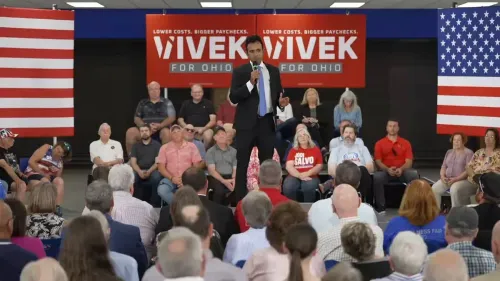
Entrepreneur Vivek Ramaswamy vowed on 27 June 2026 to end sanctuary city policies across Ohio if elected, invoking the rule of law. The pledge mirrors Republican preemption efforts in Texas and Florida and sets up a likely clash with Ohio municipalities over local immigration enforcement autonomy.
Key Takeaways
Vivek Ramaswamy posted on 27 June 2026 that he will end sanctuary city policies in Ohio 'full stop' if elected.
Sanctuary city policies, which limit local cooperation with ICE detainer requests, have existed in US jurisdictions since the 1980s .
Similar state preemption laws were passed in Texas (SB 4, 2017) and Florida (2023) , both of which faced federal court challenges.
The Trump administration's 2017 executive order previously sought to withhold federal grants from non-cooperating jurisdictions.
Implementation would likely require action by the Ohio General Assembly and could trigger Tenth Amendment litigation.
Ramaswamy is founder of Strive Asset Management and former co-lead of the DOGE advisory effort, giving the state pledge national visibility.
Entrepreneur Vivek Ramaswamy pledged on Saturday, 27 June 2026 to eliminate sanctuary city policies across Ohio if elected, framing the move as a defence of the rule of law. The post, shared on his official X account, drew immediate attention from immigration-policy watchers and state-level governance advocates.
Context
Ramaswamy wrote: 'I'll end the practice of sanctuary cities in Ohio after I'm elected, full stop. The rule of law is fundamental to our country and we can't abandon it in our cities.' The statement is an unambiguous campaign commitment, setting the elimination of local non-cooperation policies with federal immigration authorities as a first-order governance priority.
Sanctuary city policies — which limit local law-enforcement cooperation with US Immigration and Customs Enforcement (ICE), including the honouring of ICE detainer requests — have existed in various American jurisdictions since the 1980s. Several Ohio municipalities have adopted such policies, placing them in tension with federal immigration enforcement objectives.
Policy Backdrop
The pledge echoes a well-established Republican policy lineage. The Trump administration's 2017 executive order directed the withholding of federal grants from jurisdictions that refused to cooperate with ICE detainers, a move that triggered years of federal litigation over funding conditions and the limits of executive power.
State-level preemption of sanctuary ordinances has precedent in Texas, where Senate Bill 4 (2017) prohibited local governments from limiting immigration enforcement cooperation, and in Florida, which passed similar legislation in 2023. Ramaswamy's pledge signals an intent to pursue an analogous statutory framework in Ohio, potentially through the Ohio General Assembly.
The constitutional debate centres on the balance between federal supremacy in immigration matters and the Tenth Amendment principle of local control over policing priorities — a tension that has produced conflicting federal court rulings across multiple circuits.
Stakeholders and Impact
City officials in Ohio municipalities with sanctuary-adjacent policies would face direct pressure under any state preemption law, potentially altering how local police departments allocate resources and interact with federal agencies. Civil-liberties groups have historically argued that such cooperation undermines community trust in law enforcement and discourages immigrant communities from reporting crimes.
State law-enforcement agencies, by contrast, have generally supported closer coordination with ICE, arguing that it strengthens public safety by ensuring individuals with outstanding federal immigration holds are not released back into communities. Ramaswamy's framing — anchoring the argument in 'the rule of law' rather than border security alone — is consistent with the broader Republican shift toward a constitutional-supremacy argument over a purely crime-and-security one.
Ramaswamy, as founder and executive chairman of Strive Asset Management and a former co-lead of the Department of Government Efficiency (DOGE) advisory effort under the Trump administration, brings a national profile to what is formally a state-level race, lending the pledge outsized visibility beyond Ohio.
What's Next
Should Ramaswamy win election, the practical mechanism for ending sanctuary policies would most likely be a preemption bill through the Ohio General Assembly, potentially accompanied by state-funding conditions mirroring the federal model. Any such legislation would be expected to face immediate legal challenges on Tenth Amendment and anti-commandeering grounds, following the pattern set by litigation in Texas and Florida.
Observers will also watch whether the pledge draws a formal response from mayors of Columbus, Cleveland, or other Ohio cities that have adopted non-cooperation stances, and whether the Ohio Democratic Party makes local immigration authority a central counter-argument in the campaign ahead.
Point of View
Rather than the older crime-and-security framing. It positions him as a governance-first candidate, drawing on his DOGE credential to signal administrative will alongside legal authority. The pledge also forces Ohio's Democratic-leaning urban mayors into a defensive posture before any legislation is even drafted. Whether it translates into governing policy or remains a campaign signal will depend heavily on the composition of the Ohio General Assembly after the election.
NationPress
25 Sept 2026
Frequently Asked Questions
What are sanctuary cities and why does Ramaswamy want to end them in Ohio?
Sanctuary cities are jurisdictions that limit local law-enforcement cooperation with federal immigration authorities such as ICE. Ramaswamy argues they undermine the rule of law and has pledged to eliminate such policies in Ohio if elected.
Does Ohio have sanctuary cities?
Several Ohio municipalities have adopted policies that restrict cooperation with ICE detainer requests, placing them in tension with federal immigration enforcement priorities.
How would Ramaswamy end sanctuary city policies in Ohio?
The most likely mechanism would be a state preemption bill through the Ohio General Assembly, potentially paired with state-funding conditions, following models used in Texas and Florida.
What happened when other states tried to ban sanctuary cities?
Texas passed Senate Bill 4 in 2017 and Florida enacted similar legislation in 2023; both faced significant federal court challenges on Tenth Amendment and anti-commandeering grounds.
Who is Vivek Ramaswamy?
Vivek Ramaswamy is an entrepreneur, founder and executive chairman of Strive Asset Management, a former co-lead of the DOGE advisory effort, and a 2024 Republican presidential candidate who is now seeking elected office in Ohio.