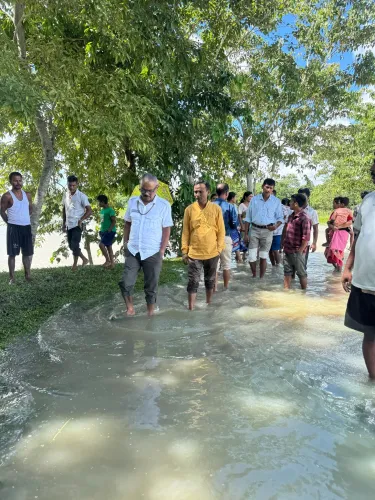
CM Himanta Mobilises NDRF as Assam Battles Unprecedented Floods

Synopsis
Assam Chief Minister Himanta Biswa Sarma on 20 July 2026 announced round-the-clock rescue operations alongside NDRF to reach all those stranded by what he termed unprecedented floods, reaffirming the state government's commitment to every affected family in the Brahmaputra valley.
Key Takeaways
CM Himanta Biswa Sarma described the current Assam floods as 'unprecedented' and pledged that no effort would be spared to reach affected residents.
State disaster teams are operating round the clock in coordination with the National Disaster Response Force (NDRF) .
Rescue operations are focused on evacuating stranded individuals and relocating them to safer locations .
The response follows the institutional framework of the National Disaster Management Act, 2005 , which governs state-central coordination during major disasters.
Assam's annual flood vulnerability is driven by the Brahmaputra river and its tributaries, which swell during the June–September monsoon season.
Further updates on water levels and potential relief packages from the state government are expected in the coming days.
Assam Chief Minister Himanta Biswa Sarma on Monday, 20 July 2026, said that no effort is being spared to reach every person affected by what he described as 'unprecedented floods' in the state, with government teams working round the clock alongside the National Disaster Response Force (NDRF) to rescue stranded residents and shift them to safer locations.
Context
Assam is among India's most flood-prone states, traversed by the Brahmaputra river and dozens of its tributaries that swell dramatically during the June–September monsoon season. The annual inundation affects large swathes of the Brahmaputra valley, displacing lakhs of people and damaging crops, livestock, and infrastructure. CM Sarma characterised the current event as 'unprecedented,' signalling a scale beyond routine seasonal flooding, though independent verification of specific figures remains pending.
The Chief Minister posted four images alongside his statement on X (formerly Twitter), underscoring the on-ground nature of the response. His post stated: 'No effort is being spared to reach every person affected by these unprecedented floods. Our teams are working round the clock alongside @NDRFHQ, to rescue those stranded and shifting them to safer locations. We stand firmly with every affected family.'
Policy Backdrop
The deployment of NDRF battalions in Assam during monsoon emergencies is institutionalised under the National Disaster Management Act, 2005, which created the framework for state-central coordination during major disasters. The force, raised under the Ministry of Home Affairs in 2006, functions as India's primary central agency for disaster rescue and relief.
Assam maintains an annual State Disaster Management Plan and a Flood Management Programme that includes embankment maintenance and pre-monsoon prepositioning of NDRF teams — a protocol strengthened after significant flood events in 2012 and 2020. The current mobilisation follows this established playbook of concurrent state and central response.
Stakeholders and Impact
The most directly affected are rural communities across Brahmaputra valley districts, where embankment breaches and rising water levels typically inundate farmland and cut off villages. Flood-affected families face displacement to government relief camps, loss of livestock, and disruption to livelihoods for weeks at a stretch.
CM Sarma, who also serves as convenor of the North-East Democratic Alliance (NEDA), has made disaster response a visible governance priority since assuming office in May 2021. His direct communication on social media during emergencies is part of a broader pattern of real-time public accountability that successive Assam governments have adopted for flood events.
What's Next
Observers will watch for updates from the Central Water Commission on water levels across key gauging stations on the Brahmaputra and its tributaries, which will determine the duration and intensity of rescue operations. Any additional NDRF battalion movements or formal state relief package announcements from the Assam government are expected in the coming days.
The broader challenge for the state remains long-term: successive flood management plans have yet to fully address the structural vulnerability of embankments along the Brahmaputra, meaning that annual mobilisations of this kind are likely to continue unless sustained investment in flood-mitigation infrastructure is scaled up significantly.
Point of View
Even as Assam's annual flood cycle is well-documented. For a BJP chief minister who doubles as NEDA convenor, projecting administrative competence during a humanitarian crisis also carries regional political weight across the Northeast. The structural question — why embankment infrastructure remains inadequate despite decades of flood management plans — is unlikely to be addressed in the immediate relief phase.
NationPress
20 Oct 2026
Frequently Asked Questions
What is the current flood situation in Assam in 2026?
Assam Chief Minister Himanta Biswa Sarma described the July 2026 floods as 'unprecedented,' with state teams and NDRF conducting round-the-clock rescue operations to evacuate stranded residents across the Brahmaputra valley.
Is NDRF deployed in Assam floods 2026?
Yes. CM Himanta Biswa Sarma confirmed on 20 July 2026 that the National Disaster Response Force (NDRF) is working alongside state teams to rescue flood-affected people and shift them to safer locations.
Why does Assam flood every year?
Assam is traversed by the Brahmaputra river and its tributaries, which swell significantly during the June–September monsoon season. Annual embankment breaches and high water volumes in the Brahmaputra valley make the state one of India's most flood-prone regions.
What is the NDRF and what does it do during floods?
The National Disaster Response Force (NDRF) is India's central disaster rescue agency, raised under the Ministry of Home Affairs in 2006. During floods, it deploys trained teams for search, rescue, and evacuation operations in coordination with state governments.
What relief measures has the Assam government announced for flood victims?
As of 20 July 2026, CM Himanta Biswa Sarma confirmed active rescue and evacuation operations alongside NDRF. Formal state relief package announcements and updates on relief camps are expected in the coming days.