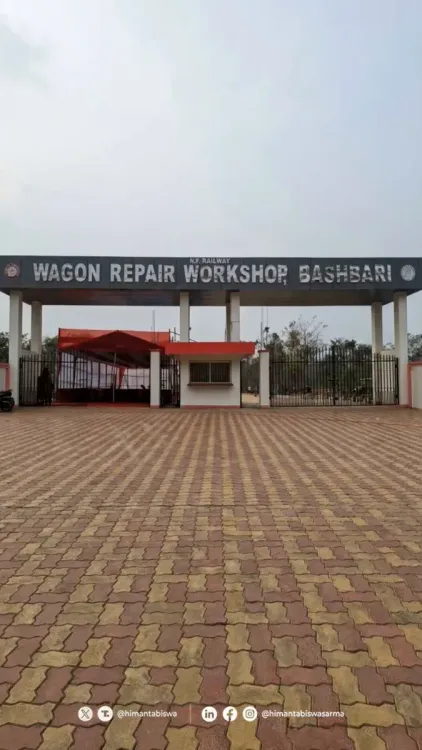
CM Himanta flags Wagon Workshop at Bashbari for Bodoland
Synopsis
Assam CM Himanta Biswa Sarma has announced a Wagon Periodic Overhauling Workshop at Bashbari, promising jobs and industrial growth for Bodoland as part of the Viksit Assam vision. The project links central rail investment with the Bodoland peace architecture to drive economic development in the region.
Key Takeaways
Assam CM Himanta Biswa Sarma announced the upcoming Wagon Periodic Overhauling Workshop at Bashbari on 5 July 2026 .
The workshop is expected to create direct employment and catalyse rail infrastructure in the Bodoland Territorial Council areas.
The project is framed under Viksit Assam , Assam's state-level mission aligned with the central government's Viksit Bharat 2047 vision.
It continues Assam's strategy of siting rail-maintenance and industrial facilities in formerly conflict-affected districts of Bodoland .
The 2003 Bodo Accord and the post-2014 Act East Policy form the dual policy foundation for the investment.
Tendering timelines and land-acquisition updates for Bashbari will be the key near-term milestones to watch.
Assam Chief Minister Himanta Biswa Sarma on Sunday, 5 July 2026, announced that an upcoming Wagon Periodic Overhauling Workshop at Bashbari will create employment, strengthen rail infrastructure, and place Bodoland firmly on Assam's industrial map — framing the project as a pillar of his administration's Viksit Assam vision.
Context
Sarma stated that 'strong infrastructure builds strong economies,' positioning the Bashbari workshop as a dual-purpose investment — generating direct and ancillary jobs for local youth while catalysing broader rail infrastructure in the Bodoland Territorial Council areas. The announcement underscores the state government's deliberate strategy of routing large-scale industrial facilities into the region's formerly conflict-affected districts.
Policy Backdrop
The project sits at the intersection of two long-running policy frameworks. The 2003 Bodo Accord established the Bodoland Territorial Council and committed successive governments to targeted economic development in the region. Post-2014, Indian Railways began sanctioning periodic overhauling workshops and new rail lines across Northeast India as part of the Act East Policy and the broader Northeast connectivity programme.
At the state level, Viksit Assam — Assam's adaptation of the central government's Viksit Bharat vision for a developed India by 2047 — has become the organising framework under which CM Sarma's government clusters infrastructure, employment, and industrial announcements. Rail-maintenance facilities, which anchor supply chains and logistics clusters, are a recurring instrument in this playbook.
Stakeholders and Impact
The most immediate beneficiaries are the youth of Bodoland, for whom the workshop is expected to generate both direct employment in rail maintenance and indirect opportunities in ancillary industries. The Bodoland Territorial Council, which administers the region, stands to gain a significant industrial anchor that could attract further investment to districts that have historically lagged behind the Brahmaputra valley in economic activity.
For Indian Railways, a periodic overhauling workshop in the region improves rolling-stock turnaround capacity for the Northeast network, reducing dependence on workshops located farther west. The project therefore serves both a state development objective and a national rail-operations need.
What's Next
Attention will now shift to the tendering timeline and land-acquisition process for the Bashbari facility. Subsequent announcements at North-East Democratic Alliance (NEDA) meetings or Bodoland Territorial Council sessions are expected to provide further detail on project phasing and investment quantum. The workshop's progress will also be a marker of how effectively Assam translates rail-sector central allocations into on-ground industrial outcomes in its peripheral districts.
Point of View
Sarma ties a specific infrastructure project to a larger electoral and developmental narrative ahead of potential council and state-level political cycles. The move also reinforces his role as NEDA convenor by demonstrating that BJP-aligned governance in the Northeast can translate peace accords into tangible industrial outcomes. If the project clears land acquisition and tendering without delay, it could serve as a replicable template for other peripheral districts across the Northeast.
NationPress
3 Oct 2026
Frequently Asked Questions
What is the Wagon Periodic Overhauling Workshop at Bashbari?
It is an upcoming Indian Railways facility announced for Bashbari in Bodoland, Assam, designed to overhaul freight wagons and create employment in the region. Specific capacity and sanction details are yet to be officially confirmed.
Where is Bashbari located?
Bashbari is located in the Bodoland Territorial Council area of Assam in Northeast India.
What is Viksit Assam?
Viksit Assam is Assam's state-level development mission modelled on the central government's Viksit Bharat vision, which aims for a developed India by 2047. CM Himanta Biswa Sarma has used it as the overarching framework for infrastructure and industrial investments in the state.
How does the Bodoland Territorial Council relate to this project?
The Bodoland Territorial Council, created under the 2003 Bodo Accord, administers the region where the Bashbari workshop is to be built. Successive governments have committed to targeted economic development in BTC areas as part of the peace framework.
What is the Act East Policy and its connection to Northeast rail projects?
The Act East Policy, accelerated post-2014, prioritises connectivity and economic integration of Northeast India with Southeast Asia. Under it, Indian Railways has sanctioned multiple workshops, rail lines, and logistics projects across Assam and neighbouring states.