CM Himanta Flags Assam Family Welfare Push With #NijutBabuMoina
Synopsis
Assam Chief Minister Himanta Biswa Sarma invoked the warmth of tea and kachori on 15 October 2026 to signal a child and family welfare scheme under the hashtag #NijutBabuMoina, framing a policy promise as an everyday household conversation.
Key Takeaways
Assam CM Himanta Biswa Sarma posted on 15 October 2026 with hashtag #NijutBabuMoina , signalling a child-welfare initiative.
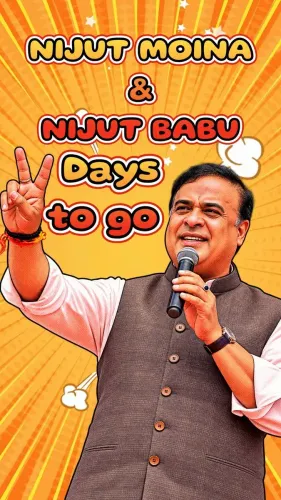
The post reads: 'The tea and kachori are hot; the future of our nephews and nieces is safe' — mixing domestic imagery with a welfare promise. #NijutBabuMoina loosely translates to 'countless boys and girls' in Assamese, pointing to a youth- or child-focused scheme.
The post included a video , consistent with the Assam government's pattern of using social media as the first channel for welfare announcements.
The tea metaphor ties the announcement to Assam's identity as India's premier tea-producing state, grounding the policy promise in everyday life.
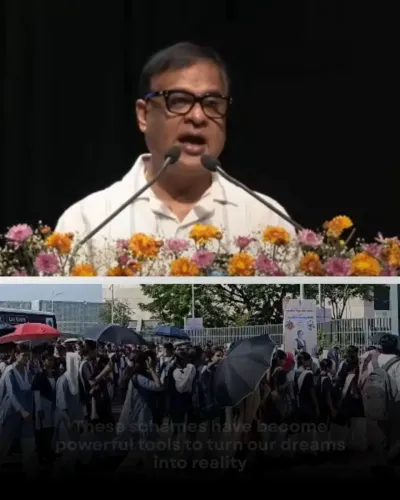
A steaming cup of tea and a crisp kachori — and a promise that Assam's children have a secure future. Assam Chief Minister Himanta Biswa Sarma leaned into the warmth of everyday domestic imagery on Thursday, 15 October 2026, posting a short video with the words 'चाय-कचोरी गरम है भांजा-भांजी का Future Safe है' ('The tea and kachori are hot; the future of our nephews and nieces is safe') alongside the hashtag #NijutBabuMoina.
The idiom doing political heavy-lifting
The phrase 'bhanja-bhanji' — Assamese and Hindi terms of endearment for nephews and nieces — is a deliberate cultural choice, not an accident. In Assam's social fabric, the uncle-niece and uncle-nephew bond carries deep affective weight. By pairing that warmth with 'Future Safe,' Sarma frames a welfare message as a family conversation rather than a government bulletin. It is a communication style the Chief Minister has used repeatedly: local idiom first, policy claim second, making the announcement feel like something overheard at a dhaba rather than read off a press release.What #NijutBabuMoina signals
The hashtag itself — #NijutBabuMoina — translates loosely as 'a lakh boys and girls' or 'countless children' in Assamese, pointing toward a scheme or initiative aimed at the state's younger population. While the specific programme details are yet to be officially elaborated in the public domain, the framing of the post — children's financial or social security, paired with a video — is consistent with the Assam government's pattern of rolling out family-welfare and youth-welfare announcements through social media before formal press briefings follow. Under Sarma's administration, Assam has pushed a range of targeted welfare interventions — from women-centric financial schemes to educational support for underprivileged households. The hashtag and video combination here suggests a fresh scheme is either launched or imminent, with the Chief Minister using his personal X account as the first point of announcement.Why the tea-kachori frame matters
Assam is synonymous with tea — the state produces a significant share of India's total tea output, and the imagery is as much identity as beverage. Opening with 'chai-kachori garam hai' places the welfare promise squarely in the register of everyday household comfort: this is not an abstract policy, the post implies, but something as real and immediate as breakfast. That rhetorical move is calculated. In a state where a substantial portion of the workforce is employed in tea gardens and allied sectors, invoking tea is invoking home. The video attached to the post — the only media element — is likely to carry more granular scheme details, reinforcing how Sarma's government has shifted announcements away from formal press conferences and toward direct-to-citizen social content.Point of View
Chai-kachori — is a studied departure from the bureaucratic register of welfare announcements, reflecting a broader BJP communications strategy of personalising state schemes through the chief minister's own social-media persona. The hashtag #NijutBabuMoina fits a pattern of Assam government branding that bundles policy launches with emotionally sticky slogans, making the CM the face of delivery rather than the department. If a formal scheme follows, it will be worth watching whether it targets girls' education, child nutrition, or youth employment — three areas the Sarma administration has prioritised since 2021. The timing, ahead of an Assam assembly session, suggests a budget or scheme rollout may be imminent.
NationPress
15 Oct 2026
Frequently Asked Questions
What is #NijutBabuMoina?
#NijutBabuMoina is a hashtag used by Assam Chief Minister Himanta Biswa Sarma on 15 October 2026, loosely meaning 'countless boys and girls' in Assamese, signalling a child and family welfare scheme by the Assam government. Exact scheme details are yet to be formally announced.
What did Himanta Biswa Sarma post about on 15 October 2026?
CM Himanta Biswa Sarma posted a video with the message 'The tea and kachori are hot; the future of our nephews and nieces is safe,' using the hashtag #NijutBabuMoina to signal a welfare initiative aimed at Assam's children and families.
What does bhanja-bhanji mean in Assam CM's post?
'Bhanja-bhanji' refers to nephews and nieces, a term of endearment in Assamese and Hindi culture. CM Sarma used it to frame the welfare promise as a personal, family-oriented message rather than a formal government announcement.
Is there a new welfare scheme launched by the Assam government in October 2026?
CM Sarma's post strongly indicates an upcoming or newly launched child and family welfare scheme under #NijutBabuMoina. However, a formal official announcement with full scheme details had not been made at the time of the post.
Why did Himanta Biswa Sarma use tea imagery in his welfare post?
Assam is one of India's largest tea-producing states, and tea is central to local identity and livelihoods. By opening with 'chai-kachori garam hai,' Sarma anchored the welfare message in everyday household life, making the policy promise feel immediate and relatable to ordinary Assamese families.