CM Himanta Credits Nijut Moina for Curbing Child Marriage in Assam
Synopsis
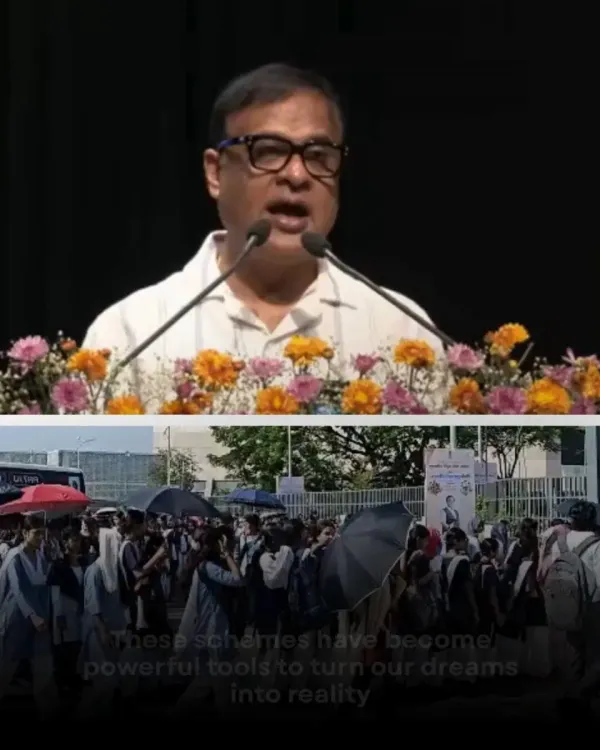
Assam Chief Minister Himanta Biswa Sarma highlighted the Nijut Moina welfare scheme on October 15, 2026, crediting it with reducing child marriage incidence and empowering adolescent girls in Assam to pursue and achieve their aspirations.
Key Takeaways
Nijut Moina is an Assam government welfare scheme targeting adolescent girls through education support and financial incentives.
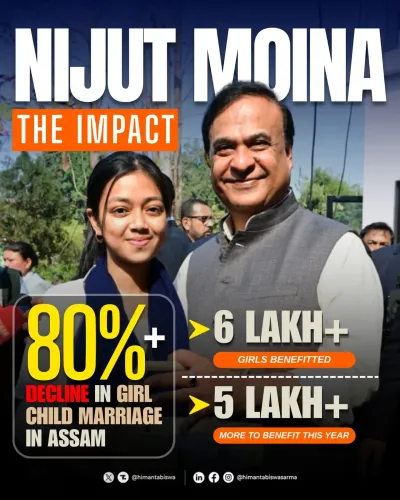
CM Himanta Biswa Sarma cited a visible reduction in child marriage incidence as a key outcome of the scheme.
The programme is framed as both a harm-reduction measure and an aspiration-building initiative for girls.
Assam has maintained a sustained policy focus on child marriage through a combination of enforcement and welfare-led approaches.
Independent evaluation data and updated district-level child marriage statistics will be the next credibility test for the scheme's claimed impact.
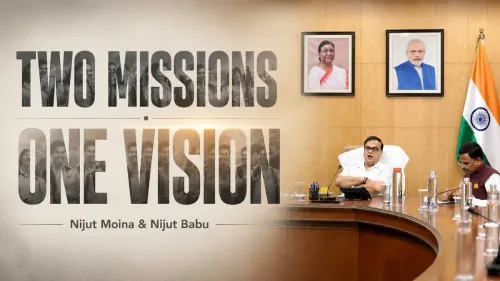
A welfare scheme aimed at adolescent girls is quietly rewriting futures across Assam — and Assam Chief Minister Himanta Biswa Sarma wants that story told. On Thursday, October 15, 2026, the Chief Minister pointed to Nijut Moina as concrete proof that targeted state intervention can bend the curve on child marriage while giving girls the tools — and the confidence — to chase their own ambitions.
What Nijut Moina sets out to do
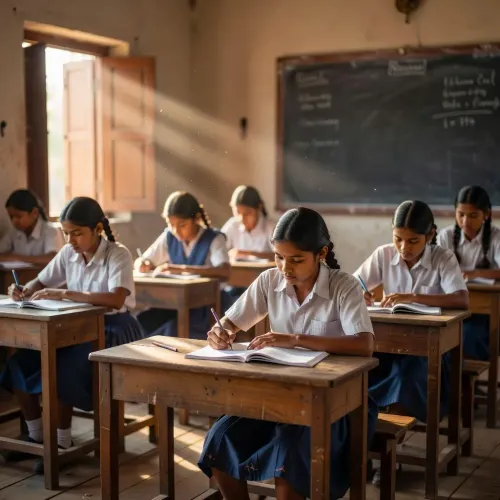
Nijut Moina — whose name translates loosely from Assamese as 'beloved girl child' — is an Assam government welfare programme designed to empower adolescent girls through education support and financial incentives. The scheme sits within a broader national pattern: Indian states have periodically deployed such targeted measures to pull girls out of early marriage and into classrooms, recognising that economic support and institutional linkages together shift household decision-making more durably than awareness drives alone.
Assam has maintained a sustained policy focus on this issue across successive administrations, pairing education and health programmes with direct girl-child welfare efforts. CM Sarma has framed Nijut Moina as a centrepiece of that continuity — and, increasingly, as a measurable success story.
The child marriage challenge in Assam
Child marriage has historically been among Assam's most stubborn social challenges, cutting across communities and districts and carrying downstream consequences for maternal health, educational attainment, and economic participation. The state has at various points pursued enforcement-led approaches alongside welfare-led ones — including high-profile crackdowns — making the welfare architecture around schemes like Nijut Moina all the more significant as a complementary, prevention-first lever.
By highlighting a visible reduction in child marriage incidence, CM Sarma is making an implicit case that sustained, girl-centred welfare investment — keeping adolescents in school, giving them financial stake in their own futures — delivers outcomes that enforcement alone cannot.
Dreams as a policy metric
The language CM Sarma chose is telling: not just reduced incidence of child marriage, but girls empowered 'to dream and achieve them as well.' That framing positions Nijut Moina not merely as a harm-reduction intervention but as an aspiration engine — a programme whose success is measured not only in what it stops, but in what it starts.
The next test will be quantified: independent evaluations and updated district-level child marriage prevalence data will determine whether the on-ground numbers match the political narrative. Those figures, when released, will either cement Nijut Moina's status as a model or invite sharper scrutiny of what 'visible impact' actually means in practice.
For now, Assam has a Chief Minister staking political capital on a welfare scheme for girls — and the girls it was designed for are, by his account, already running with it.
Point of View
Rather than a crackdown outcome, signals maturation in political communication around sensitive social issues. However, the absence of published, independently verified impact data means the claim rests almost entirely on political assertion for now. The real test will come when district-level prevalence numbers are released — those figures will either validate the model as exportable to other states or expose the gap between programme intent and ground reality.
NationPress
15 Oct 2026
Frequently Asked Questions
What is the Nijut Moina scheme in Assam?
Nijut Moina is an Assam government welfare scheme aimed at empowering adolescent girls through education support and financial incentives, with reducing child marriage as a core objective.
Has child marriage reduced in Assam because of Nijut Moina?
Assam Chief Minister Himanta Biswa Sarma has stated that the Nijut Moina scheme has contributed to a visible reduction in child marriage incidence, though independently verified quantitative data on the scheme's outcomes has not yet been publicly released.
Who is eligible for the Nijut Moina scheme?
The scheme targets adolescent girls in Assam; precise eligibility criteria have not been independently verified from available data.
What does 'Nijut Moina' mean in Assamese?
'Nijut Moina' translates approximately to 'beloved girl child' in Assamese, reflecting the programme's focus on the welfare and empowerment of girls.
What is Assam's broader approach to ending child marriage?
Assam has pursued both enforcement-led measures — including high-profile legal actions — and welfare-led programmes like Nijut Moina that keep girls in school and provide financial support, treating prevention and prosecution as complementary strategies.