CM Himanta hails Nijut Moina scheme for Assam's college girls
Synopsis
Assam Chief Minister Himanta Biswa Sarma on 19 August 2026 reaffirmed the Nijut Moina scheme, pledging sustained financial support for college-going girls to cover books, travel, and educational needs, framing it as a shield against societal pressures that push young women out of higher education.
Key Takeaways
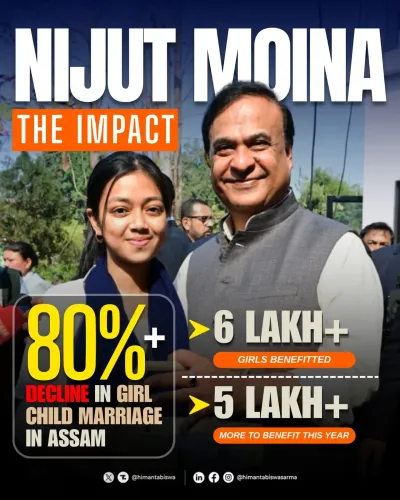
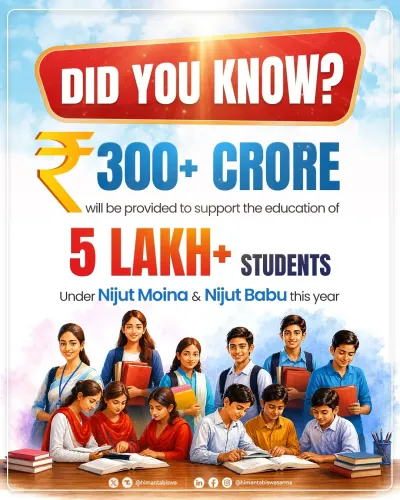
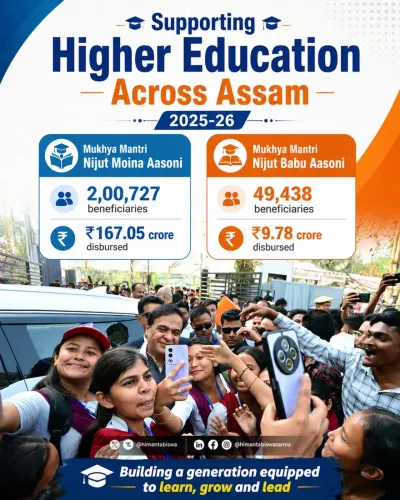
Nijut Moina is an Assam government scheme providing financial assistance to girls enrolled in colleges, covering books, travel, and other educational expenses.
CM Himanta Biswa Sarma reaffirmed on 19 August 2026 that the scheme will continue, addressing beneficiaries directly as 'my daughters'.
The scheme explicitly targets 'societal pressures' — acknowledging cultural and structural barriers, not just financial ones, as drivers of female dropout.
Travel cost coverage is a notable feature, addressing mobility and safety concerns that deter girls from attending colleges outside their immediate locality.
The public reaffirmation serves as a policy signal during active academic enrolment cycles, reassuring families investing in daughters' higher education.
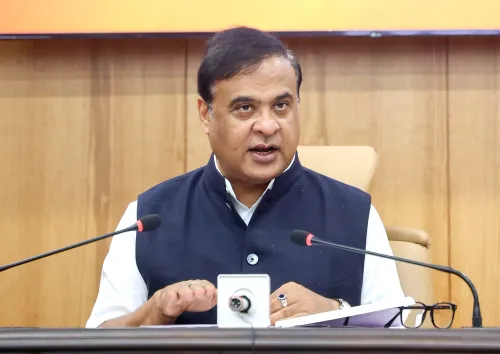
A scholarship that covers books, travel, and everyday educational costs is quietly reshaping how young women in Assam experience higher education — and Assam Chief Minister Himanta Biswa Sarma wants every beneficiary to know the support is not going away. On Wednesday, 19 August 2026, the Chief Minister took to social media to reaffirm his government's commitment to the Nijut Moina scheme, addressing the state's college-going girls directly.
Writing with unmistakable personal warmth, CM Sarma called the beneficiaries 'my daughters' and framed the scheme's purpose in one clear sentence: easing the journey through college so young women can 'learn, grow and pursue their dreams without having to worry about societal pressures.' That phrase — societal pressures — is doing real work. It signals that the scheme is designed not just as a financial top-up, but as a buffer against the family and community expectations that push girls out of classrooms and into early marriages or domestic roles.
What Nijut Moina covers — and who it reaches
Nijut Moina, which translates roughly to 'beloved daughter' in Assamese, is an Assam government initiative that provides financial assistance to girls enrolled in colleges across the state. The support is structured to address the practical friction points that interrupt girls' education: the cost of textbooks, daily commuting, and other incidental educational expenses. By targeting these specific pain points, the scheme aims to reduce dropout rates among female students at the higher-secondary and undergraduate levels.
Assam has historically grappled with relatively high rates of female dropout at the transition from school to college, driven by a combination of economic stress and social norms around girls' mobility and independence. A scheme that explicitly addresses travel costs — not just tuition — acknowledges that geography and safety concerns are as much a barrier as fees.
Sarma's direct address and what it signals
The Chief Minister's choice to speak directly to beneficiaries — rather than issue a routine administrative update — carries its own message. Calling the girls 'my daughters' is a political register common in Assam's public discourse, but deploying it in the context of educational empowerment ties the scheme to a larger BJP governance narrative around 'Beti Bachao, Beti Padhao' values at the state level. The explicit mention of 'societal pressures' is a rarer, sharper acknowledgement that structural and cultural obstacles, not just financial ones, stand between girls and their degrees.
The reaffirmation — 'this support will continue' — also functions as a policy signal ahead of what are likely to be active academic enrolment cycles, reassuring families who might otherwise hedge on investing in a daughter's college education.
For the girls of Assam who are already in classrooms because of Nijut Moina, the message is straightforward: the state is not stepping back. For those still deciding whether college is possible, that assurance may be the nudge that tips the scales.
Point of View
Not just signing up. Sarma's direct address to beneficiaries suggests the government is aware that visibility and reassurance are as important as the cash transfer itself in sustaining behavioural change at the household level.
NationPress
3 Oct 2026
Frequently Asked Questions
What is the Nijut Moina scheme in Assam?
Nijut Moina is an Assam government scheme that provides financial assistance to girls enrolled in colleges, covering costs such as books, daily travel, and other educational expenses to reduce dropout rates among female students.
Who is eligible for the Nijut Moina scheme?
The scheme targets college-going girls in Assam. Specific eligibility criteria — such as income limits or institutional requirements — are set by the Assam state government.
What does Nijut Moina mean in English?
'Nijut Moina' is an Assamese phrase that translates roughly to 'beloved daughter,' reflecting the scheme's focus on supporting young women in their educational journey.
Why did CM Himanta Biswa Sarma post about Nijut Moina on 19 August 2026?
CM Sarma used the post to reaffirm that the Nijut Moina scheme will continue, addressing beneficiaries directly to reassure families and students during active academic enrolment periods.
Does Nijut Moina cover travel costs for college girls in Assam?
Yes, the scheme includes travel costs among the supported expenses, recognising that daily commuting is a significant barrier for girls attending colleges away from their homes.