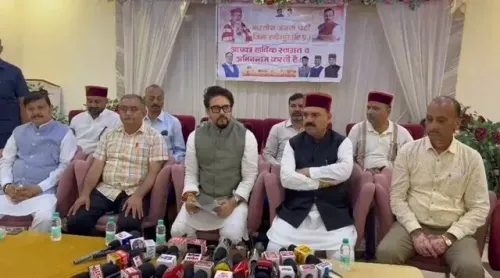
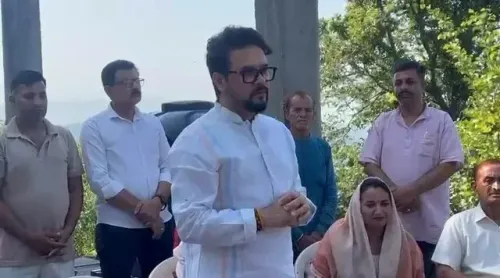
Anurag Thakur Inaugurates Cooperative Facility in Hamirpur
Synopsis
BJP MP Anurag Thakur inaugurated newly built rooms and a community hall at the Hatwad Krishi Seva Sahkari Samiti in Ghumarwin, Himachal Pradesh, using the occasion to highlight 12 years of central government agricultural and farmer-welfare initiatives under PM Modi.
Key Takeaways
Anurag Thakur inaugurated newly constructed rooms and a community hall at the Hatwad Krishi Seva Sahkari Samiti , Ghumarwin, on 17 November 2026 .
Former minister Rajendra Garg was present alongside Thakur at the event in Hatwad, Himachal Pradesh .
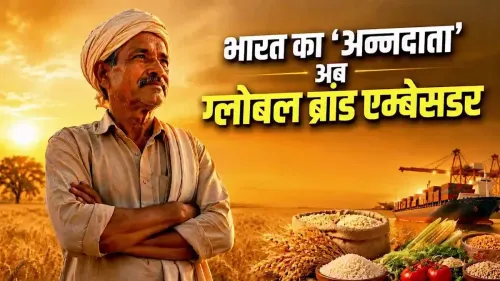
Thakur credited the Modi government with building a comprehensive farm ecosystem over 12 years , covering income support, insurance, irrigation, market access and digital agriculture.
PM-KISAN (2019) provides ₹6,000 annual direct transfers; Pradhan Mantri Fasal Bima Yojana (2016) covers crop risk; e-NAM (2016) digitises market access; and PMKSY (2015) targets irrigation efficiency.
Thakur emphasised ground-level delivery through cooperatives and local bodies as central to converting policy into farmer benefit.
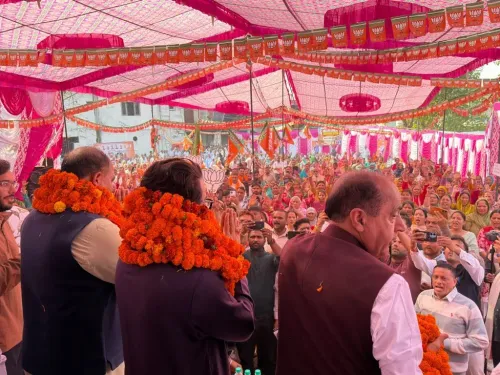
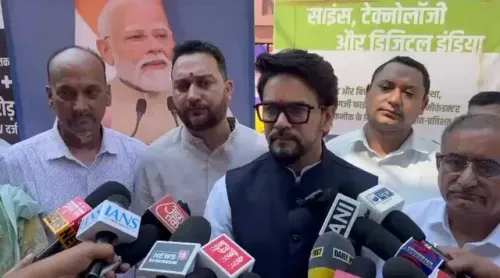
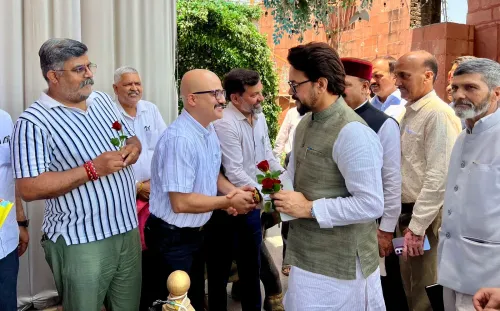
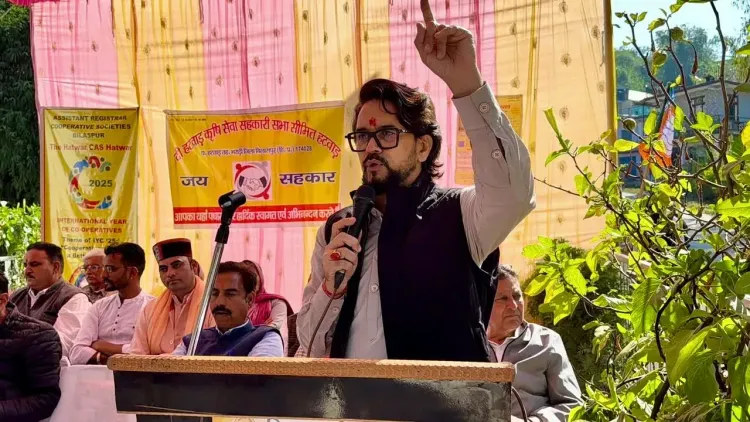
A new agricultural cooperative hall opened its doors in Hatwad, Ghumarwin constituency, Himachal Pradesh on Tuesday, 17 November 2026 — and BJP MP Anurag Thakur used the moment to lay out the case for a decade of transformation in Indian farm policy. Standing before the gathered community alongside former minister Shri Rajendra Garg, Thakur did not just cut a ribbon; he delivered a wide-ranging address on what 12 years of Modi government farm initiatives have meant for the country's cultivators.
What was inaugurated at Hatwad
The event was organised under the aegis of the Hatwad Krishi Seva Sahkari Samiti — the local agricultural service cooperative society. Thakur, alongside Rajendra Garg, formally inaugurated newly constructed rooms and a community hall (navnirmit kamron evam sabhagar) at the facility. The cooperative infrastructure, modest in scale but significant for a rural constituency in the hills of Himachal Pradesh, is precisely the kind of ground-level asset the central government's agricultural ecosystem push is designed to reinforce.
The 12-year farm policy arc Thakur outlined
Speaking to the gathering, Thakur argued that the central government had consciously widened its definition of agriculture — moving beyond crop production to encompass farmer welfare, income security, technological modernisation, market access and rural development as a unified ecosystem. 'The Modi government did not merely make announcements,' he said, 'but delivered schemes on the ground, giving farmers their rightful due.'
That framing maps onto a well-documented policy lineage. PM-KISAN, launched in 2019, delivers ₹6,000 annually in direct income support to landholding farmers. The Pradhan Mantri Fasal Bima Yojana crop insurance scheme, introduced in 2016, shifted risk away from cultivators during weather shocks. The e-NAM electronic national agriculture market, also rolled out in 2016, extended digital market reach to farmers who previously had to sell at whatever price local mandis offered. And Pradhan Mantri Krishi Sinchayee Yojana, begun in 2015, targeted water-use efficiency at the field level.
Thakur pointed to a newer layer of this ecosystem — agri-startups, digital agriculture platforms and improved irrigation — as evidence that today's farmer is moving, in his words, 'towards self-reliance' (atmanirbharta ki or). The Atmanirbhar Bharat framing, used heavily since 2020, ties agriculture into the broader national self-sufficiency narrative the BJP has championed.
Why a cooperative inauguration in Ghumarwin carries weight
Hamirpur is a predominantly rural constituency where agricultural cooperatives serve as the primary interface between state policy and smallholder farmers. The Hatwad Krishi Seva Sahkari Samiti event is thus a micro-instance of the macro argument Thakur was making: schemes announced in Delhi acquire meaning only when physical infrastructure — a meeting hall, a storage room, a local body capable of channelling credit and input support — exists at the village level. His presence here, with a former minister and a local crowd, signals continued grassroots engagement by the BJP in a state where the party is in opposition at the state government level.
Point of View
Where the BJP is currently in opposition, such grassroots visibility events serve a dual purpose — they demonstrate constituency service while keeping the central government's welfare record front and centre. The cooperative sector has regained political salience since the Ministry of Cooperation was created in 2021, and events like this signal that the BJP intends to contest that institutional space. Watch whether the next Union Budget references cooperative infrastructure as a distinct budget line, which would validate the on-ground emphasis Thakur is projecting.
NationPress
17 Nov 2026
Frequently Asked Questions
What did Anurag Thakur inaugurate in Himachal Pradesh on 17 November 2026?
Anurag Thakur inaugurated newly built rooms and a community hall at the Hatwad Krishi Seva Sahkari Samiti (Hatwad Agricultural Service Cooperative Society) in the Ghumarwin assembly segment of his Hamirpur Lok Sabha constituency, Himachal Pradesh.
What is the Hatwad Krishi Seva Sahkari Samiti?
It is an agricultural service cooperative society based in Hatwad, located in the Ghumarwin assembly area of Hamirpur district, Himachal Pradesh. It serves local farmers with cooperative services and now has newly constructed meeting and storage infrastructure.
Which Modi government agriculture schemes did Anurag Thakur highlight?
Thakur highlighted a range of central schemes introduced over 12 years, including PM-KISAN direct income transfers of ₹6,000 per year, the Pradhan Mantri Fasal Bima Yojana crop insurance programme, the e-NAM digital agriculture market, and the Pradhan Mantri Krishi Sinchayee Yojana irrigation initiative.
How much do farmers receive annually under PM-KISAN?
Under PM-KISAN, launched in 2019, eligible landholding farmers receive ₹6,000 per year in direct bank transfers, disbursed in three instalments of ₹2,000 each.
Why is Anurag Thakur focusing on agricultural cooperatives in Himachal Pradesh?
As BJP's Lok Sabha MP from Hamirpur and former Union Minister, Thakur uses cooperative infrastructure events to demonstrate ground-level delivery of central schemes in a state where the BJP is currently in opposition, reinforcing the party's rural welfare narrative and maintaining constituency presence.