CM Himanta Moved by Marwari Community's Welcome in Tinsukia

Synopsis
Assam Chief Minister Himanta Biswa Sarma praised the Marwari community after a visit to Tinsukia, calling their generations-long role in Assam's economy and culture 'invaluable' and a symbol of shared heritage and social harmony.
Key Takeaways
Himanta Biswa Sarma visited Tinsukia on 28 October 2026 and posted his tribute the following morning.
He described the Marwari community's contribution to Assam's culture, economy and social life as 'invaluable across generations.' The CM framed the community's presence as 'a symbol of shared heritage and social harmony.' Tinsukia is one of eastern Assam's most commercially active districts, with a historically significant Marwari trading presence dating to the colonial era.
The outreach fits a broader pattern of Sarma's district-level community engagement across Assam's diverse social groups.
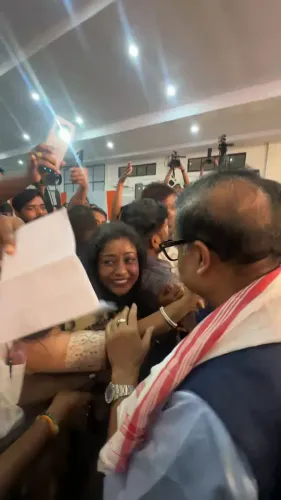
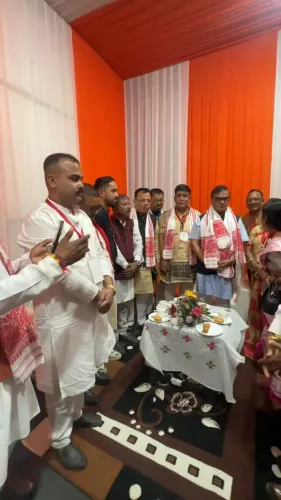
A warm reception in eastern Assam's commercial heartland has prompted Assam Chief Minister Himanta Biswa Sarma to publicly salute the Marwari community's generations-long contribution to the state — a tribute that lands at the intersection of cultural diplomacy and inclusive politics.
Posting on Thursday, 29 October 2026, the Chief Minister wrote in Hindi: 'कल तिनसुकिया प्रवास के दौरान मारवाड़ी समाज से मिले आत्मीय स्वागत से अभिभूत हूँ' — 'I am overwhelmed by the warm welcome I received from the Marwari community during my visit to Tinsukia yesterday.' He added that the community's contribution to Assam's culture, economy and social life has been 'invaluable across generations,' and described their participation in the state's progress as 'a symbol of our shared heritage and social harmony.'
Tinsukia and the Marwari commercial footprint in eastern Assam
Tinsukia, in the far-eastern corner of Assam, is one of the state's busiest commercial districts — a node for trade in tea, timber and general goods where the Marwari community has maintained a strong business presence since the colonial era. Traders from Rajasthan began settling across Assam's towns and market towns over a century ago, embedding themselves in retail, wholesale and small industry at a time when indigenous mercantile networks were still forming.
That long arc of commerce has not been without tension. Successive Assam governments have had to balance recognition of the community's economic weight against periodic local anxieties about migration, business dominance and identity. Sarma's warm language — 'shared heritage,' 'social harmony' — is a deliberate register, one that frames the Marwari presence as constitutive of Assam rather than external to it.
Sarma's district outreach and the politics of community recognition
The Chief Minister has made district-level community engagements a consistent feature of his governance style. Reaching out to trading and business communities in a commercially significant district such as Tinsukia fits a pattern of building coalitions across Assam's diverse ethnic and social groups. Public appreciation for the Marwari community — visible, on record, in Hindi — signals both respect for the community's cultural identity and an invitation to deepen economic partnership with the state.
For a state government pushing infrastructure and investment, having an energised, historically entrepreneurial community as a visible ally is as much economic strategy as it is social grace. The kicker is simple: in Assam's complex mosaic, a chief minister who can make every community feel seen is a chief minister who makes governing look easy.
Point of View
' he repositions a community historically viewed through a migrant-trader lens as integral to Assam's identity, blunting any nativist friction. The move also courts an economically influential constituency ahead of continued investment-push efforts in eastern Assam. It reflects a wider BJP playbook of using community recognition as both soft-power diplomacy and ground-level outreach.
NationPress
29 Oct 2026
Frequently Asked Questions
Why did CM Himanta Biswa Sarma visit Tinsukia?
The Chief Minister was on a district visit to Tinsukia on 28 October 2026 , during which the local Marwari community extended a warm reception. He posted his appreciation the following day, though specific programme details of the visit have not been officially detailed.
What is the Marwari community's role in Assam?
The Marwari community , originally from Rajasthan, has been settled across Assam's towns for generations, playing a central role in retail, wholesale trade and small industry since the colonial era, making them a significant part of the state's commercial fabric.
What did CM Sarma say about the Marwari community?
Sarma said the Marwari community's contribution to Assam's culture, economy and social life has been 'invaluable across generations,' and called their participation in the state's progress 'a symbol of our shared heritage and social harmony.'
Where is Tinsukia located in Assam?
Tinsukia is a district in far-eastern Assam, one of the state's most commercially active zones with strong links to the tea, timber and general goods trade.
What is CM Himanta Biswa Sarma's community outreach strategy?
Sarma has consistently undertaken district-level engagements with diverse ethnic, cultural and business communities across Assam, using public recognition on social media to reinforce messages of inclusive governance and social harmony.