Uttarakhand CM Office: Mandua Procurement Begins in Rudraprayag
Synopsis
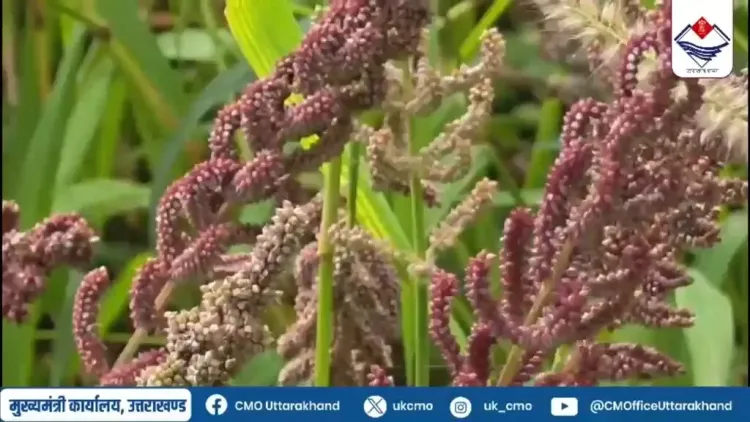
The Chief Minister's Office of Uttarakhand has launched mandua (finger millet) procurement in Rudraprayag under the State Millet Mission, offering hill farmers ₹52.05 per kg as minimum support price. A total of 150 quintals have been purchased so far, reviving a climate-resilient traditional crop for marginal mountain farmers.
Key Takeaways
Mandua procurement launched in Rudraprayag district under Uttarakhand's State Millet Mission as of 29 October 2026 .
The Minimum Support Price set at ₹52.05 per kilogram gives hill farmers a guaranteed income floor for finger millet.
150 quintals of mandua have already been purchased since procurement began.
The initiative aligns with India's post-2023 International Year of Millets push to revive nutri-cereal cultivation nationally.
Uttarakhand's Millet Mission aims to reduce hill farmers' dependence on the ecologically mismatched rice-wheat system.
Expansion of procurement centres to other districts and 2027 budget allocations for processing infrastructure remain key milestones to watch.
Hill farmers in Rudraprayag district now have a guaranteed buyer at a guaranteed price — and that changes everything for a crop that once fed Himalayan communities but lost ground to subsidised rice and wheat for decades. The Chief Minister's Office of Uttarakhand announced on Thursday, 29 October 2026 that finger millet (mandua) procurement has formally begun under the State Millet Mission, with 150 quintals already purchased at a support price of ₹52.05 per kilogram.
What ₹52.05 per kg means for a Rudraprayag farmer
Rudraprayag sits deep in the Uttarakhand Himalayas, where small farmers work rainfed terraced slopes unsuited to the irrigation-heavy crops that dominate plains agriculture. Mandua — finger millet — thrives here naturally, but for years growers had no assured market, leaving them at the mercy of local traders who set prices well below the crop's nutritional and economic value. A state-backed Minimum Support Price of ₹52.05/kg directly addresses that structural gap, giving marginal hill households a predictable income floor for a crop they already know how to grow.
State Millet Mission and the Vocal for Local push
The State Millet Mission is Uttarakhand's programmatic answer to a broader national rethink on food systems. When India hosted the International Year of Millets in 2023, it sparked policy momentum across states to revive nutri-cereals through procurement, value addition, and market linkages — the full chain from farm to shelf. Uttarakhand's mission threads that national framework into a Himalayan context: reducing dependence on the rice-wheat model, which is both ecologically mismatched to mountain terrain and a drain on state food subsidy budgets. The Vocal for Local hashtag the CMO used is deliberate — it signals that mandua is being positioned not just as a welfare crop but as a brand.
150 quintals in — and the road from Rudraprayag to other districts
The figure of 150 quintals procured so far is modest by plains standards, but as an opening number in a single Himalayan district, it marks a system going live. The more consequential question is whether procurement centres roll out across additional districts — Chamoli, Tehri, Pithoragarh — where millet cultivation is similarly embedded in farming practice. Infrastructure for millet processing will be equally critical: without cleaning, grading, and packaging capacity, MSP procurement can become a storage problem rather than a value chain. Observers will also track whether the 2027 state budget carries a dedicated line for millet processing investment, which would signal a multi-year commitment rather than a one-season exercise.
Uttarakhand's bet is that a crop the mountains have always grown can now earn what it has always deserved.
Point of View
Though the programme's real test will come when it moves beyond a single district pilot. The Vocal for Local framing also reflects a strategic bet: that premium positioning of Himalayan millets in urban and export markets can eventually make the mission self-sustaining, rather than perpetually dependent on state procurement budgets.
NationPress
29 Oct 2026
Frequently Asked Questions
What is mandua and why is it important for Uttarakhand farmers?
Mandua is the local name for finger millet, a traditional cereal grown on rainfed terraced slopes across the Uttarakhand Himalayas. It is nutritionally rich, climate-resilient, and well-suited to mountain terrain, making it a vital crop for marginal hill farmers who cannot access irrigation-based agriculture.
What is the support price for mandua under Uttarakhand's Millet Mission?
The Uttarakhand State Millet Mission is procuring mandua at a Minimum Support Price of ₹52.05 per kilogram in Rudraprayag district as of October 2026.
How much mandua has been procured so far in Rudraprayag?
As announced by the Chief Minister's Office of Uttarakhand on 29 October 2026, a total of 150 quintals of mandua have been purchased under the State Millet Mission in Rudraprayag district.
What is the Uttarakhand State Millet Mission?
The State Millet Mission is a Uttarakhand government programme designed to revive millet cultivation in the hills through MSP-based procurement, value addition, and market linkages, reducing farmers' dependence on rice and wheat systems.
Is the Uttarakhand millet scheme connected to India's national millet push?
Yes. India led the global International Year of Millets in 2023, which generated policy momentum across states to support nutri-cereal cultivation. Uttarakhand's State Millet Mission draws on that national framework while tailoring it to the specific ecological and socioeconomic conditions of Himalayan farming communities.