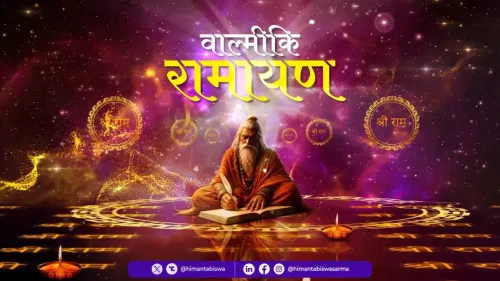
CM Himanta Shares Valmiki Ramayana Verse, Bala Kanda Sarga 34
Synopsis
Assam Chief Minister Himanta Biswa Sarma shared a verse from the Valmiki Ramayana — Bala Kanda, Sarga 34, Shloka 06 — in both Assamese and Hindi scripts on 19 July 2026, continuing a pattern of BJP leaders in the Northeast invoking classical Hindu texts in public messaging.
Key Takeaways
Assam Chief Minister Himanta Biswa Sarma posted a citation from the Valmiki Ramayana, Bala Kanda, Sarga 34, Shloka 06 on 19 July 2026 .
The post was rendered in both Assamese and Hindi (Devanagari) scripts, reflecting bilingual outreach.
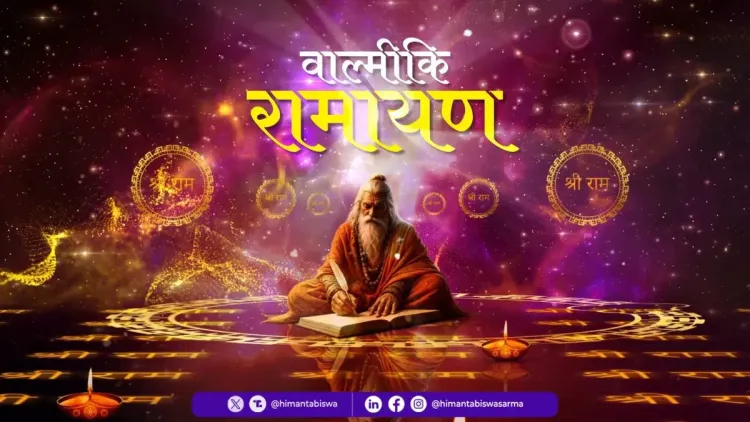
The post included a video , suggesting the verse was recited or visually presented.
Bala Kanda is the first book of the Valmiki Ramayana, dealing with lineage, dharma, and the moral foundations of kingship.
The reference fits a broader pattern of BJP leaders in Assam and the Northeast invoking classical Indic texts alongside heritage and cultural initiatives.
No explicit policy announcement accompanied the post; possible state-level cultural events on Ramayana studies remain to be confirmed.
Assam Chief Minister Himanta Biswa Sarma on Sunday, 19 July 2026, shared a verse from the Valmiki Ramayana on his official X account, citing specifically Bala Kanda, Sarga 34, Shloka 06 — a reference rendered in both Assamese and Hindi scripts in the post.
Context
The post, published at 8:00 AM IST, carries the citation in two scripts: Assamese (বাল্মীকি ৰামায়ণ, বালকাণ্ড, সৰ্গ ৩৪, শ্লোক ০৬) and Devanagari (वाल्मीकि रामायण, बालकाण्ड, सर्ग ३४, श्लोक ०६), both translating to 'Valmiki Ramayana, Bala Kanda, Canto 34, Verse 06'. The bilingual presentation underscores the Chief Minister's outreach across the linguistic communities of Assam, where both the Assamese script and Hindi-medium audiences are significant constituencies.
The post is accompanied by a video, suggesting the verse may have been recited, sung, or visually presented, though the specific content of the video is not independently available for this report. No additional explanatory text was included in the post.
Policy Backdrop
BJP leaders in Assam and the broader Northeast have periodically invoked Hindu epics and Sanskrit texts in public messaging, framing such references as an affirmation of civilisational continuity. This pattern sits alongside state-level initiatives to promote heritage tourism, classical learning, and the preservation of traditional texts in a region characterised by deep linguistic and ethnic diversity.
The Valmiki Ramayana's Bala Kanda is the first of the epic's seven books, dealing with the early life of Lord Rama in Ayodhya. Sarga 34 falls within a section of the text that addresses lineage, dharma, and the moral foundations of kingship — themes that BJP leaders have frequently cited in the context of governance and cultural identity.
Stakeholders and Impact
The post is likely to resonate with Assamese Hindu communities and cultural organisations that have long advocated for greater institutional recognition of Sanskrit and classical Indic texts. The dual-script presentation signals an intent to reach both the vernacular Assamese readership and the broader Hindi-speaking audience that follows the Chief Minister's national profile.
Cultural groups engaged in Ramayana studies, classical recitation traditions (Ramayana patha), and neo-Vaishnavite institutions — which hold considerable social weight in Assam — are among the stakeholders most likely to engage with such a reference. The post carries no explicit policy announcement but functions within a broader pattern of cultural signalling by the state's top executive.
What's Next
State-supported events centred on Ramayana studies, classical text recitation, or Sanskrit education in Assam's schools and cultural institutions remain a space to watch in the coming weeks. Chief Minister Sarma has previously used social media references to classical texts as a precursor to or accompaniment of related cultural programmes. Whether this post is linked to a specific forthcoming event or forms part of routine cultural outreach will become clearer as official state communications follow.
Point of View
Not merely broad Hindu sentiment. The bilingual Assamese-Hindi presentation is equally calculated: it bridges the Chief Minister's regional base with his national BJP profile at a time when the Northeast's cultural identity is increasingly central to the party's civilisational narrative. Such posts rarely exist in isolation; they tend to precede or accompany state-backed cultural programming, making this worth tracking as a policy signal rather than a purely ceremonial gesture. The reference to Bala Kanda — a section concerned with righteous lineage and dharmic kingship — carries implicit political resonance for a sitting Chief Minister seeking to frame governance in classical moral terms.
NationPress
19 Jul 2026
Frequently Asked Questions
What verse did Himanta Biswa Sarma share from the Valmiki Ramayana?
Assam CM Himanta Biswa Sarma shared Valmiki Ramayana, Bala Kanda, Sarga 34, Shloka 06, posting the citation in both Assamese and Hindi scripts on 19 July 2026.
What is Bala Kanda in the Valmiki Ramayana?
Bala Kanda is the first of the seven books of the Valmiki Ramayana. It covers the early life of Lord Rama, questions of lineage, dharma, and the moral foundations of kingship.
Why did Assam CM Himanta Biswa Sarma post a Ramayana verse?
No explicit reason was stated in the post. It fits a broader pattern of BJP leaders in Assam and the Northeast referencing classical Hindu texts to highlight civilisational continuity, often alongside cultural or heritage initiatives.
Is Himanta Biswa Sarma known for referencing Hindu scriptures publicly?
Yes, Chief Minister Sarma and other BJP leaders in the Northeast have periodically cited Hindu epics and Sanskrit texts in public messaging as part of cultural outreach in a linguistically diverse region.
Could this Ramayana post signal a government cultural event in Assam?
Possibly. State-supported events on Ramayana studies or classical text education in Assam remain a space to watch, as such social media references have previously accompanied related cultural programmes.