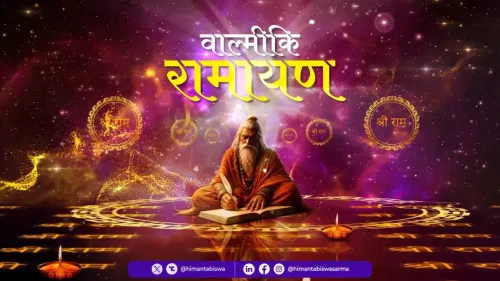
CM Himanta Quotes Valmiki Ramayana, Balakanda Verse

Synopsis
Assam Chief Minister Himanta Biswa Sarma shared a verse from the Valmiki Ramayana — Balakanda, Canto 31, Shloka 16 — in Assamese and Devanagari on X on 26 May 2026, continuing a pattern of scriptural citation that BJP leaders have amplified since the 2024 Ram Mandir consecration.
Key Takeaways
Assam CM Himanta Biswa Sarma posted a citation from Valmiki Ramayana, Balakanda, Canto 31, Shloka 16 on 26 May 2026 .
The post used both Assamese and Devanagari scripts, reflecting a deliberate dual-audience outreach strategy.
A video was attached to the post, suggesting the verse was recited or visually presented.
The citation fits a broader pattern of BJP chief ministers increasing public references to the Valmiki Ramayana following the January 2024 Ram Mandir inauguration .
Sarma convenes the North-East Democratic Alliance (NEDA) , giving his cultural messaging reach across multiple Northeast states.
Possible follow-up policy moves include heritage curriculum initiatives or cultural festival programming tied to the cited verse.
Assam Chief Minister Himanta Biswa Sarma on Tuesday, 26 May 2026, shared a verse from the Valmiki Ramayana, Balakanda, Canto 31, Shloka 16 on the social media platform X, citing it in both Assamese and Devanagari script — a bilingual format he has used before to reach audiences across the Northeast and the Hindi heartland simultaneously.
Context
The post, brief by design, carries only the scriptural citation: 'বাল্মীকি ৰামায়ণ, বালকাণ্ড, সৰ্গ ৩১, শ্লোক ১৬' (Valmiki Ramayana, Balakanda, Canto 31, Shloka 16) rendered identically in Devanagari below. No accompanying commentary or contemporary context was offered. The Chief Minister's post was accompanied by a video, suggesting the verse may have been recited or visually presented in that format.
The Balakanda is the first of seven kandas (books) of the Valmiki Ramayana, dealing primarily with the early life of Lord Rama and events preceding his exile. Public citations of specific shlokas by BJP leaders have grown notably more frequent since the January 2024 consecration of the Ram Mandir in Ayodhya.
Policy Backdrop
Since the Bharatiya Janata Party formed its first government in Assam in 2016, the state administration has actively promoted indigenous Assamese Hindu cultural practices through policy and public communication. Sarma, who took charge as Chief Minister in May 2021, has consistently woven Sanskrit and classical scriptural references into his official social media presence.
The bilingual Assamese-Devanagari format is a deliberate outreach strategy: Assamese script signals rootedness in the Northeast's distinct linguistic identity, while Devanagari extends the message to a pan-India BJP audience. Sarma also convenes the North-East Democratic Alliance (NEDA), giving his cultural messaging a regional resonance beyond Assam's borders.
Stakeholders and Impact
The primary audience for such posts is Assamese Hindu communities and cultural organisations that view scriptural citation by elected leaders as an affirmation of civilisational identity. For the broader BJP base, it reinforces the party's cultural-nationalist positioning ahead of any upcoming electoral or legislative cycle in the Northeast.
Critics and minority community groups in Assam have in the past noted that the frequency of Hindu scriptural references in official communication can feel exclusionary, though Sarma's office has maintained that celebrating classical Indian heritage is a non-partisan cultural act.
What's Next
Observers of Assam politics will watch whether this citation is followed by a policy announcement — such as inclusion of Valmiki Ramayana recitation in state cultural festivals or a heritage curriculum initiative at the next Assam assembly session. BJP chief ministers across states have increasingly tied such scriptural posts to concrete programme launches, and Sarma has a track record of using social media to preview or reinforce policy directions. The specific choice of Balakanda, Canto 31, Shloka 16 may become clearer if the accompanying video elaborates on the verse's contemporary relevance.
Point of View
Thereby keeping the message broad and largely controversy-proof. The bilingual Assamese-Devanagari format is particularly strategic: it asserts that Assam's distinct Northeast identity and pan-India Hindu heritage are complementary, not competing. Since the Ram Mandir consecration, this genre of post has become a low-cost, high-visibility tool for BJP leaders to maintain base enthusiasm between electoral cycles. Whether it presages a concrete cultural-policy announcement or remains purely symbolic will be the key question for Assam watchers in the coming weeks.
NationPress
12 Oct 2026
Frequently Asked Questions
What verse did Himanta Biswa Sarma quote from the Valmiki Ramayana?
He cited Valmiki Ramayana, Balakanda, Canto 31, Shloka 16 , posting the reference in both Assamese and Devanagari script without additional commentary.
Why did Assam CM Himanta post a Ramayana verse on X?
Sarma regularly shares Sanskrit and scriptural references on social media as part of the BJP's cultural-nationalist communication strategy, a practice that intensified after the January 2024 Ram Mandir consecration in Ayodhya.
What is the Balakanda of the Valmiki Ramayana?
The Balakanda is the first of seven books of the Valmiki Ramayana, covering the early life of Lord Rama, the circumstances of his birth, and events leading up to his marriage to Sita.
What is NEDA and what is Himanta Biswa Sarma's role in it?
The North-East Democratic Alliance (NEDA) is a BJP-led coalition of political parties in India's Northeast. Himanta Biswa Sarma serves as its convenor, giving him significant political influence across the region beyond his role as Assam's Chief Minister.
Has Himanta Biswa Sarma quoted Ramayana verses before?
Yes, Sarma has a consistent track record of sharing Hindu scriptural references on social media. BJP chief ministers across India have increased such citations since the Ram Mandir inauguration in January 2024.