Nvidia Blackwell Boosts DeepSeek Inference by 50%
Synopsis
Nvidia on July 13, 2026, showcased Baseten's deployment of DeepSeek V4 Pro on Blackwell GPUs using TensorRT-LLM, achieving up to 50% more tokens per second for reasoning — illustrating the performance edge of Nvidia's integrated hardware-software inference stack.
Key Takeaways
Baseten deployed DeepSeek V4 Pro on Nvidia Blackwell GPUs using the TensorRT-LLM open-source library.
Proprietary runtime optimisations delivered up to 50% more tokens per second for reasoning workloads.
Blackwell is Nvidia's latest GPU architecture, announced at GTC in March 2024 as the successor to Hopper.
DeepSeek , a Chinese AI company , has released a series of cost-efficient open-source LLMs widely used by global inference providers.
The result highlights Nvidia's strategy of combining hardware and open software to lock in inference customers across GPU generations.
US export controls on AI chips remain a policy backdrop, though they do not prevent global developers from running open-source Chinese models on Nvidia hardware outside China.
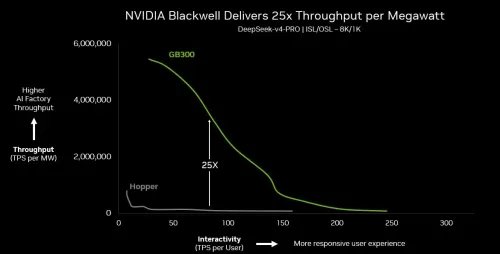
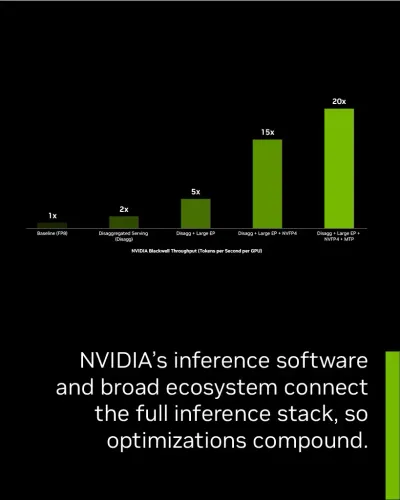
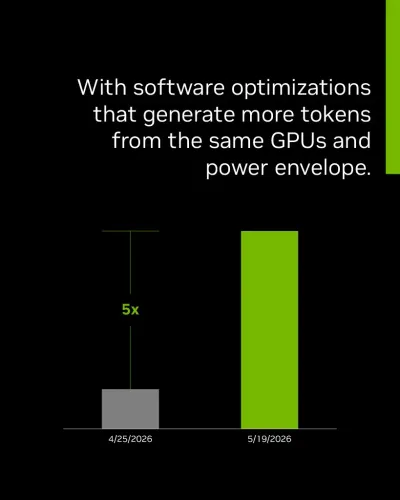
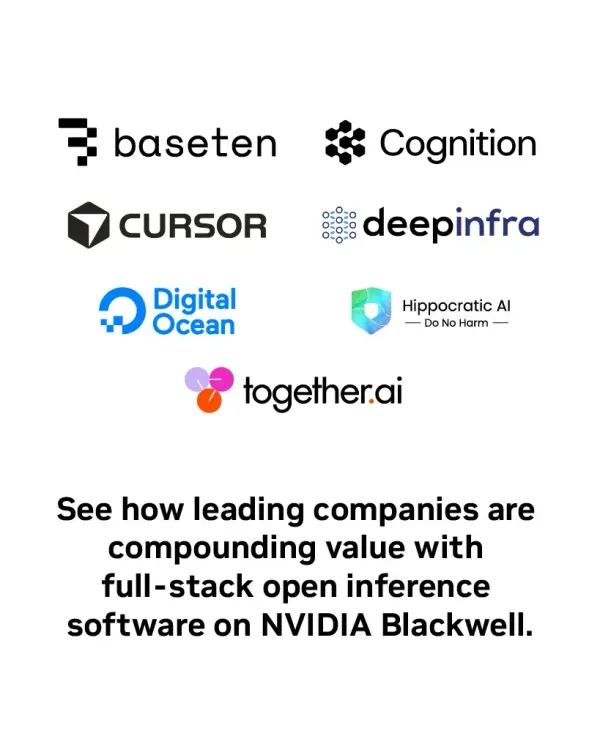
Chip giant Nvidia on Monday, July 13, 2026, highlighted how leading companies are compounding value using its full-stack open inference software on Blackwell GPUs, spotlighting Baseten's deployment of DeepSeek V4 Pro that delivered up to 50% more tokens per second for reasoning workloads.
Context
Nvidia's post states that Baseten used TensorRT-LLM — Nvidia's open-source library for optimising large language model inference — to serve DeepSeek V4 Pro on Blackwell hardware. By applying 'proprietary runtime optimizations,' Baseten achieved up to 50% more tokens per second for reasoning tasks compared to baseline configurations. The announcement underscores Nvidia's strategy of bundling hardware and software into a unified ecosystem that inference providers can leverage out of the box.
Blackwell is Nvidia's GPU architecture unveiled at its GTC conference in March 2024 as the successor to the Hopper generation. It was designed specifically to handle the rising computational demands of very large AI models, offering higher throughput and energy efficiency for production inference at scale.
Policy Backdrop
DeepSeek, the Chinese AI company behind the open-source model family, has built a reputation for releasing cost-efficient large language models that developers worldwide can run and fine-tune. Its successive releases — including V2 and V3 in 2024 — emphasised lean inference, making the models attractive to infrastructure platforms such as Baseten.
The pairing of a Chinese open-source model with Nvidia's Blackwell stack sits against a backdrop of ongoing US export controls on advanced AI chips to China. While those controls restrict what hardware Chinese entities can import, they do not prevent global developers from running Chinese open-source models on Nvidia silicon outside China — a nuance that has kept DeepSeek models widely deployed on Nvidia platforms internationally.
Stakeholders and Impact
Baseten is an infrastructure platform that specialises in deploying and serving machine learning models at scale. Its integration of TensorRT-LLM with Blackwell for DeepSeek V4 Pro is a concrete example of how inference providers can extract significant performance gains without changing the underlying model weights — purely through software-level optimisations.
For Indian AI startups and enterprises building on open-source LLMs, the development is relevant: higher tokens-per-second throughput translates directly into lower serving costs and faster response times for end users. As Indian cloud and AI infrastructure spending grows, the efficiency gains demonstrated on Blackwell could influence procurement decisions among domestic inference providers.
What's Next
Nvidia's post signals that Baseten is one of several companies it expects to highlight as part of a broader campaign showcasing Blackwell adoption across the inference stack. Industry observers will watch whether other major inference platforms — particularly those serving Indian and South Asian markets — report comparable performance improvements using the same TensorRT-LLM toolchain.
Regulatory developments around US AI chip export controls remain a variable: any tightening or relaxation could reshape which hardware and software combinations are available to global developers running open-source models. For now, Nvidia's full-stack push on Blackwell appears to be cementing its position as the default infrastructure layer for production AI inference worldwide.
Point of View
Even amid US-China tech tensions. For Indian enterprises evaluating AI infrastructure, such benchmarks from production deployments carry more weight than synthetic tests. The broader arc here is Nvidia's effort to make TensorRT-LLM the de facto optimisation layer for inference, mirroring how CUDA became indispensable for training.
NationPress
12 Oct 2026
Frequently Asked Questions
What is Nvidia Blackwell and why does it matter for AI?
Nvidia Blackwell is the company's latest GPU architecture, unveiled at GTC in March 2024 as the successor to Hopper. It is designed for higher throughput and energy efficiency when running very large AI models in production, making it central to Nvidia's inference strategy.
What is TensorRT-LLM and how does it improve inference?
TensorRT-LLM is Nvidia's open-source library that optimises large language model inference on its GPUs. It allows inference providers like Baseten to apply runtime-level tuning — such as kernel fusion and quantisation — to extract more performance from the same hardware without retraining the model.
What is DeepSeek V4 Pro?
DeepSeek V4 Pro is a large language model from DeepSeek , a Chinese AI company known for releasing open-source models that emphasise cost-efficient inference. The model was served by Baseten on Nvidia Blackwell GPUs, yielding up to 50% more tokens per second for reasoning tasks.
How do US export controls on AI chips affect DeepSeek running on Nvidia hardware?
US export controls restrict the sale of advanced Nvidia chips to entities in China, but they do not prevent developers outside China from running open-source Chinese models — such as those from DeepSeek — on Nvidia hardware. Global inference providers like Baseten can therefore deploy DeepSeek V4 Pro on Blackwell GPUs without restriction.
What does 'tokens per second' mean in AI inference?
'Tokens per second' measures how quickly an AI model generates output — higher numbers mean faster responses and lower serving costs. Baseten achieved up to 50% more tokens per second on Nvidia Blackwell by applying proprietary runtime optimisations via TensorRT-LLM , directly reducing the cost of serving DeepSeek V4 Pro at scale.