Nvidia Claims 5x More AI Tokens From Same GPUs Via Software
Synopsis
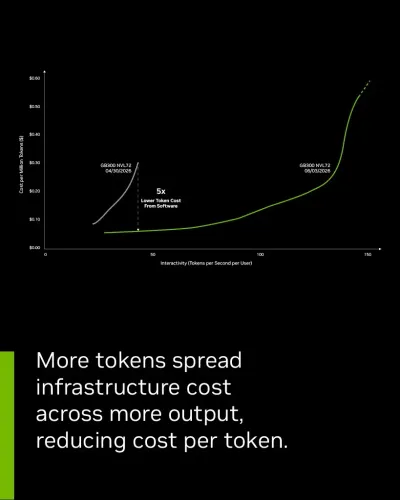
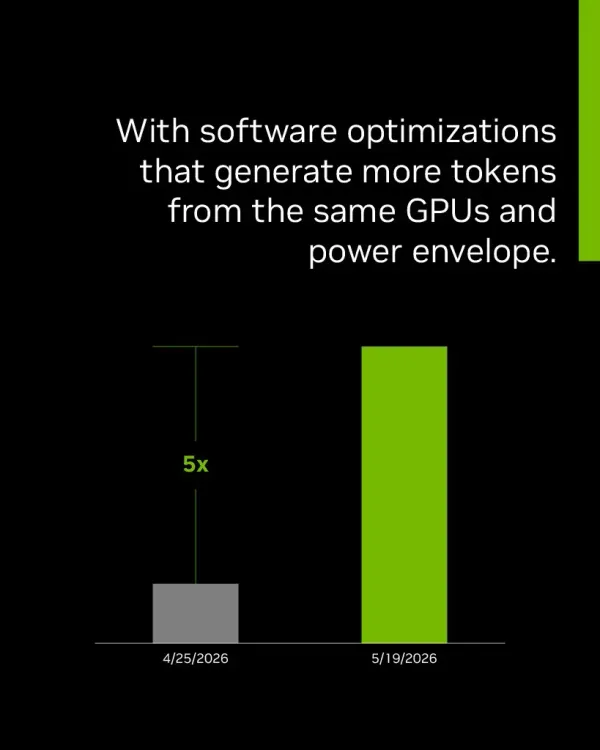
Chip giant Nvidia announced on 14 July 2026 that software optimizations have delivered a five-fold increase in AI token output from the same GPUs and power envelope. The company says the pace of improvement is accelerating, with implications for data-centre operators and cloud providers worldwide.
Key Takeaways
Nvidia claims a 5x increase in AI token output achieved through software optimizations alone, with no new hardware required.
The gains apply to the same GPUs and power envelope , meaning existing deployments can benefit without additional capital expenditure.
Nvidia 's CUDA platform, introduced in 2006 , underpins the software optimization ecosystem behind these efficiency improvements.
The announcement has strategic relevance amid U.S. export controls on advanced chips, as software gains on permitted hardware extend their effective lifespan.
Cloud providers, AI developers , and data-centre operators — including those in India scaling GPU fleets — are the primary beneficiaries.
Detailed benchmarks are expected at Nvidia's next GTC developer conference , with quarterly data-centre revenue figures to reflect adoption.
Chip giant Nvidia announced on Monday, 14 July 2026 that software optimizations alone have delivered a five-fold increase in token output from the same GPUs and power envelope, with the company indicating the pace of improvement is accelerating.
Context
In its post on X, Nvidia stated: 'With software optimizations alone, NVIDIA has delivered 5x more tokens from the same GPUs and power envelope, and the pace is accelerating.' The claim is significant because it suggests that customers running existing Nvidia hardware can extract substantially greater AI inference throughput without purchasing new chips or expanding power infrastructure.
Token throughput is the primary measure of how many responses an AI model can generate per second, making it a critical metric for cloud providers, enterprise AI deployments, and data-centre operators managing cost and energy budgets.
Policy Backdrop
Nvidia's software efficiency push has deep roots. The company introduced its CUDA parallel-computing platform in 2006, establishing a software ecosystem that has repeatedly unlocked performance gains on existing hardware. Subsequent tools such as the TensorRT inference optimizer demonstrated the same pattern: shipping software updates that improve GPU utilization without requiring a hardware upgrade cycle.
The latest claim arrives in a period of intensifying scrutiny over AI energy consumption and U.S. export controls on advanced semiconductors. Software-level gains on already-deployed or export-permitted chips carry strategic weight, allowing operators in restricted markets to scale AI workloads without importing newer accelerators.
Stakeholders and Impact
AI developers, data-centre operators, and cloud providers stand to benefit most directly. A five-fold improvement in token output per GPU — if realised at scale — would effectively reduce the per-token cost of inference by a commensurate factor, compressing the economics of deploying large language models.
The announcement also puts competitive pressure on rival chip designers such as AMD and custom silicon programmes at hyperscalers, who have framed their own efforts partly around software-hardware co-design. Nvidia's ability to extract efficiency gains through software on its installed base reinforces the moat created by the CUDA ecosystem, which remains the dominant programming environment for AI workloads globally.
For India, where government-backed AI compute programmes and private cloud operators are scaling GPU fleets, the development is relevant: domestic operators running Nvidia hardware could see inference capacity multiply without fresh capital expenditure on chips.
What's Next
Detailed benchmarks and technical documentation are expected to emerge at Nvidia's next GTC developer conference, where the company typically presents granular performance data. Quarterly data-centre revenue figures will serve as a downstream indicator of whether the efficiency claims are translating into broader adoption and customer retention.
The broader implication is structural: as AI inference scales globally, the competition between hardware generations and software optimization layers is reshaping how operators plan capacity — and Nvidia's latest move suggests software may outpace silicon on the efficiency curve for at least the near term.
Point of View
Deepening lock-in. For policymakers and regulators watching AI energy consumption, the efficiency narrative also provides political cover for continued large-scale GPU deployments. The acceleration language, however, invites scrutiny: independent benchmark verification will determine whether this is a durable engineering trajectory or an optimistic marketing frame.
NationPress
12 Oct 2026
Frequently Asked Questions
What did Nvidia announce about AI token output in July 2026?
Nvidia stated that software optimizations alone have delivered a five-fold increase in AI token output from the same GPUs and power envelope, and that the pace of improvement is accelerating.
What does '5x more tokens from the same GPUs' mean?
It means Nvidia's software updates allow existing GPU hardware to generate five times as many AI model responses per unit of time and power, without requiring new or more powerful chips.
How does Nvidia achieve performance gains through software?
Nvidia uses its CUDA parallel-computing platform and inference optimization tools such as TensorRT to improve how efficiently AI workloads run on its GPUs, extracting more performance from the same hardware.
Does this Nvidia software improvement affect India's AI sector?
Yes. Indian cloud operators and government-backed AI compute programmes running Nvidia GPUs could see inference capacity multiply significantly without additional hardware investment.
When will Nvidia provide detailed benchmarks for this 5x claim?
Detailed technical data is expected at Nvidia's next GTC developer conference; quarterly data-centre revenue reports will also indicate how widely the improvement is being adopted.