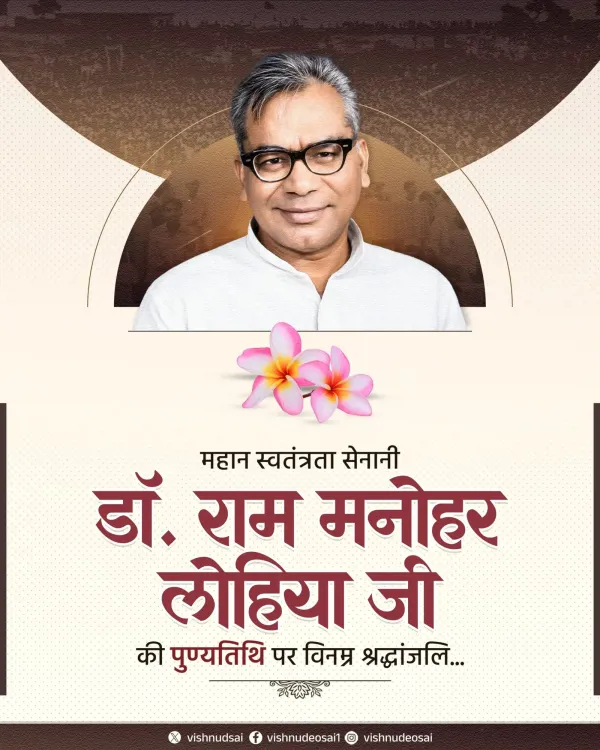
CM Vishnu Deo Sai pays tribute to Dr Ram Manohar Lohia
Synopsis
Chhattisgarh Chief Minister Vishnu Deo Sai on 12 October 2026 paid tribute to Dr Ram Manohar Lohia on his death anniversary, honouring the socialist icon's 'Sapt Kranti' vision and his lifelong fight for the poor, farmers, and the marginalised.
Key Takeaways
CM Vishnu Deo Sai posted a tribute to Dr Ram Manohar Lohia on 12 October 2026 , Lohia's death anniversary.
Lohia passed away on 12 October 1967 , making this his 59th death anniversary .
Sai highlighted Lohia's 'Sapt Kranti' (Seven Revolutions) framework as an enduring ideological contribution.
The tribute specifically cited Lohia's advocacy for the poor, farmers, labourers, and marginalised communities .
The homage crosses typical party lines, reflecting Lohia's status as a shared national legacy across political traditions.
On the death anniversary of one of India's most consequential socialist thinkers, Chhattisgarh Chief Minister Vishnu Deo Sai on Monday, 12 October 2026 paid humble homage to Dr Ram Manohar Lohia, the freedom fighter and architect of the 'Sapt Kranti' — the Seven Revolutions.
Posting on X, CM Sai wrote: 'महान स्वतंत्रता सेनानी एवं सप्त क्रांति के प्रणेता डॉ. राम मनोहर लोहिया जी की पुण्यतिथि पर विनम्र श्रद्धांजलि।' — 'Humble tribute on the death anniversary of great freedom fighter and pioneer of the Sapt Kranti, Dr Ram Manohar Lohia.' He added that Lohia's struggle and ideas for the rights and upliftment of the poor, farmers, labourers, and the marginalised 'will always guide us.'
Who was Dr Ram Manohar Lohia?
Dr Ram Manohar Lohia (23 March 1910 – 12 October 1967) was a towering figure in India's independence movement and post-independence socialist politics. A fierce critic of caste hierarchy, economic inequality, and concentrated political power, he remains one of the most cited ideological anchors of India's non-Congress left.
His 'Sapt Kranti' — the Seven Revolutions — was a framework that called for simultaneous transformation across seven fronts: against inequality based on gender, skin colour, caste, and class; against colonialism; for individual freedom against state overreach; for world unity; and for a new economic order. It was a sweeping, interconnected vision that distinguished Lohia from the more narrowly economic socialism of his contemporaries.
Why a BJP chief minister invokes Lohia
The tribute carries a quiet political resonance. Lohia is most closely associated with the socialist tradition that shaped parties like the Samajwadi Party and the Janata Dal family — not the BJP. Yet Lohia's insistence on social justice for the poor, farmers, and backward communities, and his sharp critique of dynastic Congress rule, have long made him a figure politicians across the spectrum choose to claim. CM Sai's invocation — centred on Lohia's commitment to the marginalised — underscores that legacy as a broad national inheritance, not a partisan one.
In Chhattisgarh, a state where tribal and agrarian communities form a substantial share of the population, the emphasis on Lohia's advocacy for farmers, labourers, and the dispossessed carries local weight as much as symbolic national gesture.
Fifty-nine years after his passing, Dr Lohia's demand for a politics rooted in the everyday lives of those at the bottom remains the standard against which leaders still measure themselves.
Point of View
His critique of dynastic power and his championing of the marginalised now claimed across the ideological spectrum. For CM Sai, the tribute also serves a grounded state-level purpose: in a Chhattisgarh defined by its tribal, agrarian, and working-class demographics, Lohia's framework of rights for the dispossessed speaks directly to the electorate. The annual ritual of cross-party Lohia tributes reveals how India's political mainstream has absorbed socialist vocabulary — farmers, labourers, the poor — even as it contests socialist policy prescriptions.
NationPress
12 Oct 2026
Frequently Asked Questions
When did Dr Ram Manohar Lohia die?
Dr Ram Manohar Lohia passed away on 12 October 1967 . His death anniversary, known as Punyatithi, is observed annually on this date.
What is the 'Sapt Kranti' associated with Ram Manohar Lohia?
'Sapt Kranti' or the Seven Revolutions was Lohia's framework calling for simultaneous social transformation — against inequality based on gender, caste, class, and skin colour, against colonialism, for individual freedom, and for global unity and a new economic order.
Why did Chhattisgarh CM Vishnu Deo Sai pay tribute to Lohia?
CM Sai paid tribute on Lohia's 59th death anniversary, acknowledging Lohia's enduring legacy as a freedom fighter and champion of the poor, farmers, and marginalised — values CM Sai said would 'always guide us.'
Was Ram Manohar Lohia associated with the BJP?
No. Lohia was a socialist leader whose ideology shaped parties like the Samajwadi Party and the Janata Dal family. However, his critique of dynastic Congress rule and his advocacy for social justice have made him a figure respected and cited across party lines, including by BJP leaders.
When was Ram Manohar Lohia born?
Dr Ram Manohar Lohia was born on 23 March 1910 in Akbarpur, in present-day Uttar Pradesh.