CM Sai Pays Tribute to Alluri Sitarama Raju on Jayanti
Synopsis
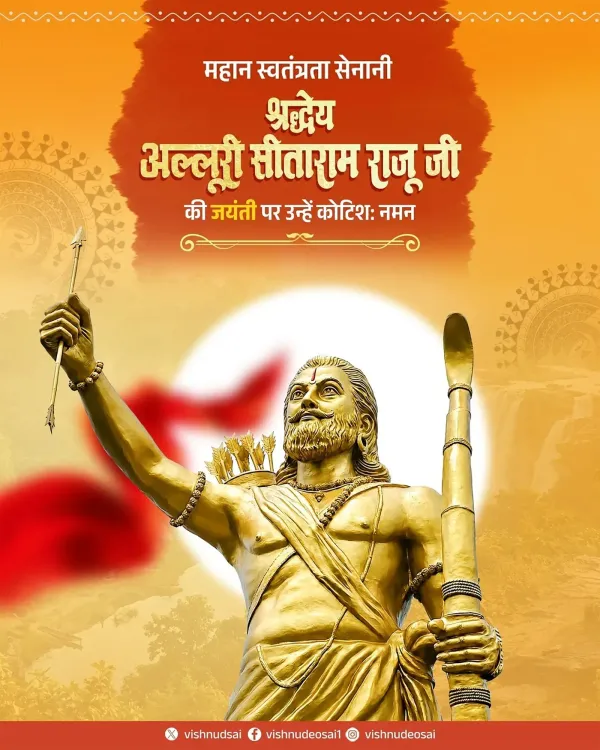
Chhattisgarh Chief Minister Vishnu Deo Sai on 4 July 2026 honoured Alluri Sitarama Raju on his Jayanti, saluting the Rampa Rebellion leader's struggle for tribal rights and national freedom, reflecting the BJP's sustained outreach to Adivasi communities.
Key Takeaways
CM Vishnu Deo Sai posted a tribute to Alluri Sitarama Raju on his birth anniversary on 4 July 2026 .
Alluri Sitarama Raju led the Rampa Rebellion (1922–1924) against British forest laws to protect Adivasi land and livelihood rights.
The Chief Minister praised Raju's sacrifice for the freedom of the motherland and the protection of tribal society's rights.
The Ministry of Culture had marked the centenary of the Rampa Rebellion in 2022 with national commemorations under Azadi Ka Amrit Mahotsav .
Chhattisgarh's Scheduled Tribe population makes tributes to Adivasi freedom fighters politically and culturally significant in the state.
Chhattisgarh Chief Minister Vishnu Deo Sai on Saturday, 4 July 2026, paid homage to freedom fighter Alluri Sitarama Raju on his birth anniversary, honouring the leader of the Rampa Rebellion for his sacrifice in defence of tribal rights and national independence.
Context
In his post, CM Sai offered 'kotishaha naman' (countless salutations) to Alluri Sitarama Raju, describing him as the hero of the Rampa Rebellion and a revered freedom fighter. He wrote that Raju's sacrifice and struggle for 'matribhumi ki swatantrata aur adivasi samaj ke adhikaron ki raksha' (the freedom of the motherland and protection of tribal society's rights) would continue to inspire every citizen toward national service and patriotism.
Alluri Sitarama Raju led the Rampa Rebellion of 1922–1924 in the Eastern Ghats of present-day Andhra Pradesh, mobilising Adivasi communities against oppressive British forest laws that restricted tribal livelihoods and land access. He remains one of the most celebrated tribal freedom fighters in Indian history.
Policy Backdrop
In 2022, the Ministry of Culture marked the centenary of the Rampa Rebellion with national-level commemorations, bringing renewed attention to Alluri Sitarama Raju's legacy during the Azadi Ka Amrit Mahotsav celebrations. The centenary events included cultural programmes and tributes at the state and central level, reinforcing the effort to highlight contributions of regional and tribal freedom fighters in India's independence narrative.
BJP-led state governments have consistently issued tributes to Adivasi freedom fighters as part of a broader outreach to Scheduled Tribe communities, mirroring the central government's emphasis on unsung contributors to the independence movement.
Stakeholders and Impact
Chhattisgarh has one of the largest tribal populations in India, with Scheduled Tribes accounting for roughly 32 per cent of the state's population. Tributes by the Chief Minister to figures like Alluri Sitarama Raju carry symbolic weight for Adivasi communities and signal the government's intent to acknowledge tribal heritage in public discourse.
For Adivasi youth and tribal welfare advocates, such observances serve as occasions to draw attention to ongoing issues of forest rights, land access, and community welfare — themes that Raju's rebellion originally centred on.
What's Next
State-level observances of Alluri Sitarama Raju Jayanti in Chhattisgarh may be accompanied by announcements or programmes related to tribal welfare, forest-rights schemes, or cultural initiatives. The Jayanti provides a platform for the state government to reinforce its engagement with Scheduled Tribe communities ahead of any forthcoming policy or electoral cycles.
Point of View
Particularly in tribal-majority states like Chhattisgarh. The gesture connects to a broader national arc established during Azadi Ka Amrit Mahotsav, where the central and state governments systematically elevated regional and tribal contributors to the independence struggle. For a Chief Minister governing a state where over 32 per cent of the population belongs to Scheduled Tribes, such symbolic acknowledgements carry electoral as well as cultural resonance. The recurring pattern across BJP-governed states suggests a coordinated strategy to deepen tribal outreach through heritage and identity politics.
NationPress
2 Oct 2026
Frequently Asked Questions
Who was Alluri Sitarama Raju?
Alluri Sitarama Raju was a tribal freedom fighter who led the Rampa Rebellion of 1922–1924 in the Eastern Ghats against British colonial forest laws that restricted Adivasi land and livelihood rights. He is celebrated as a hero of India's independence movement, especially among tribal communities.
What was the Rampa Rebellion?
The Rampa Rebellion was a tribal uprising led by Alluri Sitarama Raju from 1922 to 1924 in the region that is now Andhra Pradesh. It was directed against British exploitation and oppressive forest regulations that denied Adivasi communities their traditional rights over land and forests.
Why did CM Vishnu Deo Sai pay tribute to Alluri Sitarama Raju?
CM Vishnu Deo Sai paid tribute on the occasion of Alluri Sitarama Raju's birth anniversary, honouring his sacrifice for national freedom and the protection of tribal rights. Chhattisgarh has a large Scheduled Tribe population, making such observances culturally and politically significant.
When was the centenary of the Rampa Rebellion observed?
The centenary of the Rampa Rebellion was observed in 2022, when the Ministry of Culture organised national-level commemorations as part of the Azadi Ka Amrit Mahotsav celebrations, bringing renewed attention to Alluri Sitarama Raju's legacy.
What is the significance of Alluri Sitarama Raju Jayanti in Chhattisgarh?
Alluri Sitarama Raju Jayanti is significant in Chhattisgarh because the state has one of India's largest tribal populations. Tributes to Adivasi freedom fighters on such occasions reinforce the government's engagement with tribal heritage and welfare, and often precede related policy or cultural announcements.