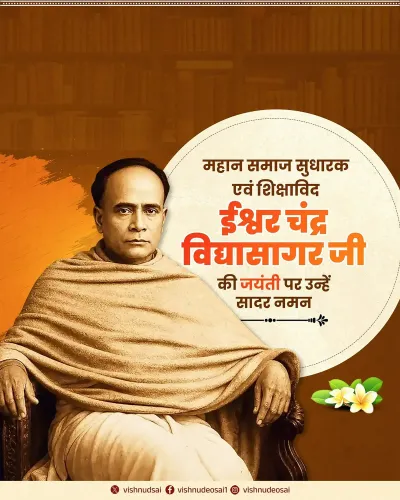
CM Sai Pays Tribute to Raja Ram Mohan Roy on Birth Anniversary
Synopsis
Chhattisgarh Chief Minister Vishnu Deo Sai paid tribute to Raja Ram Mohan Roy on his birth anniversary, honouring the 19th-century reformer's campaigns against sati, his promotion of women's education and widow remarriage, and his foundational role in India's social renaissance.
Key Takeaways
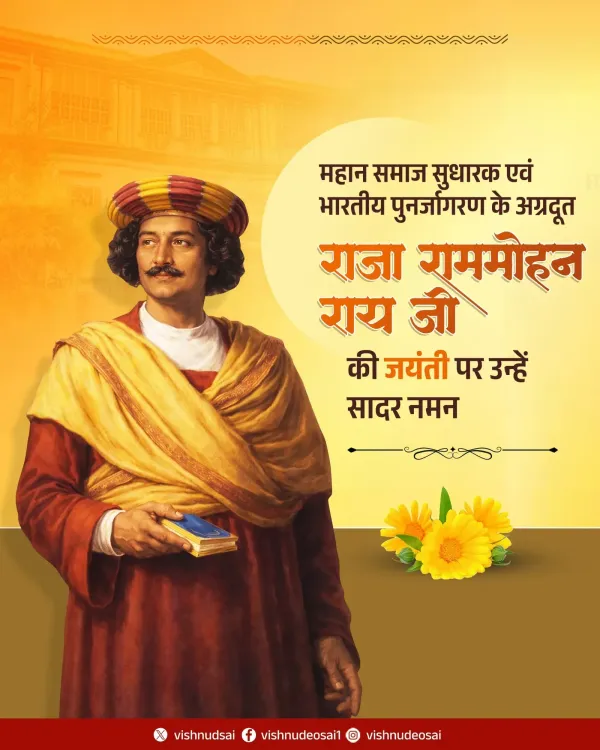
CM Vishnu Deo Sai posted a tribute to Raja Ram Mohan Roy on his birth anniversary on 22 May 2026 .
Roy ( 1772–1833 ) is credited as a pioneer of the Indian Renaissance and founder of the Brahmo Samaj .
His advocacy directly contributed to the Bengal Sati Regulation of 1829 , which banned the practice of sati.
CM Sai specifically highlighted Roy's work on women's education , widow remarriage , and social equality.
Indian political leaders across party lines routinely commemorate 19th-century reformers to connect governance with narratives of social progress.
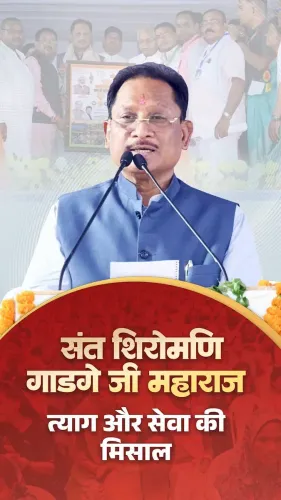
Chhattisgarh Chief Minister Vishnu Deo Sai on Friday, 22 May 2026 paid tribute to social reformer Raja Ram Mohan Roy on his birth anniversary, honouring the 19th-century reformer's contributions to modern India's social and educational foundations.
Context
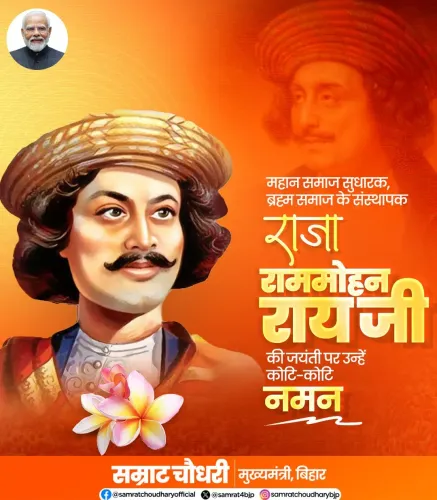
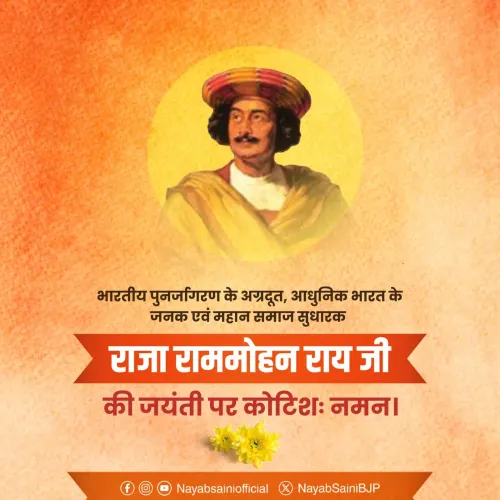
In his post, CM Sai described Raja Ram Mohan Roy as a 'mahan samaj sudharak, prakhar chintak evam Bharatiya punarjagaran ke agradoot' — 'great social reformer, incisive thinker and pioneer of the Indian Renaissance' — and offered him 'kotishaha naman', meaning 'salutations a crore times over.'
He recalled Roy's struggles against social evils, superstition, and discrimination, crediting him with strengthening the foundations of modern India. The post specifically highlighted Roy's work on the abolition of sati, promotion of women's education, support for widow remarriage, and the spread of equality and awareness in society.
Policy Backdrop
Raja Ram Mohan Roy (1772–1833) was a Bengali reformer whose sustained advocacy contributed directly to the passage of the Bengal Sati Regulation of 1829, which banned the practice of sati under Governor-General Lord William Bentinck. He also founded the Brahmo Samaj, a socio-religious movement that challenged orthodox Hindu practices and championed rational inquiry and modern education.
Roy's campaigns against child marriage, his advocacy for women's rights, and his promotion of English-language education placed him at the centre of what historians call the Bengal Renaissance — a broad intellectual and social awakening in 19th-century India that shaped the country's path toward modernity.
Stakeholders and Impact
Roy's legacy remains directly relevant to contemporary policy debates on gender equality, women's education, and social reform. Indian political leaders across party lines regularly invoke his memory on his birth anniversary to connect present-day governance priorities with the reformist tradition he represents.
For Chhattisgarh, a state with significant tribal and rural populations where gender equity and education access remain active policy concerns, such commemorations carry particular resonance. CM Sai's tribute aligns with the broader BJP government's stated emphasis on social welfare and women's empowerment at the state level.
What's Next
Official commemorations of Raja Ram Mohan Roy's birth anniversary frequently serve as occasions to announce or highlight education and social welfare initiatives at the state level. Whether the Chhattisgarh government marks the occasion with any specific programme or policy announcement remains to be seen.
The tribute also fits a wider national pattern: as India continues to debate gender equality, women's safety, and access to education, the reformist legacy of figures like Raja Ram Mohan Roy is likely to remain a touchstone for political leaders seeking to frame contemporary governance within a long arc of social progress.
Point of View
Linking the BJP-led Chhattisgarh government to a reformist social legacy that transcends party lines. By foregrounding sati abolition, women's education, and widow remarriage, the post signals alignment with gender-equity narratives that are central to the BJP's national messaging on women's welfare. Such tributes also serve a soft-power function — positioning the ruling party as the inheritor of India's long reformist tradition rather than a purely ideological outfit. In states like Chhattisgarh, where grassroots social challenges remain acute, invoking Roy's memory carries both symbolic and aspirational weight.
NationPress
5 Oct 2026
Frequently Asked Questions
Who was Raja Ram Mohan Roy?
Raja Ram Mohan Roy (1772–1833) was a Bengali social reformer, the founder of the Brahmo Samaj, and a leading figure of the Indian Renaissance who campaigned against sati, child marriage, and social discrimination while promoting modern education and women's rights.
Why is Raja Ram Mohan Roy's birth anniversary observed?
His birth anniversary is observed to honour his transformative contributions to Indian society, particularly his role in the abolition of sati through the Bengal Sati Regulation of 1829 and his advocacy for women's education and equality.
What did Chhattisgarh CM Vishnu Deo Sai say about Raja Ram Mohan Roy?
CM Vishnu Deo Sai described Roy as a great social reformer, incisive thinker, and pioneer of the Indian Renaissance, and paid tribute to his work against sati, superstition, and discrimination, as well as his promotion of women's education and widow remarriage.
What was the Bengal Sati Regulation of 1829?
The Bengal Sati Regulation of 1829 was a law passed under Governor-General Lord William Bentinck that banned the practice of sati — the immolation of widows on their husbands' funeral pyres — following sustained advocacy by Raja Ram Mohan Roy and other reformers.
Who is Vishnu Deo Sai?
Vishnu Deo Sai is the BJP Chief Minister of Chhattisgarh, who took office in December 2023 after the party's victory in the state assembly elections.