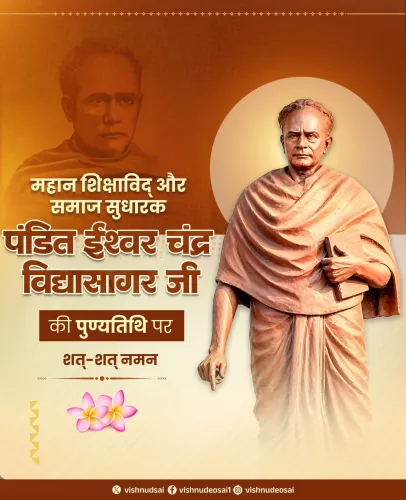
CM Vishnu Deo Sai pays tribute to Ishwar Chandra Vidyasagar on his birth anniversary
Synopsis
Chhattisgarh Chief Minister Vishnu Deo Sai marked the birth anniversary of 19th-century reformer Ishwar Chandra Vidyasagar on September 26, 2026, honouring his legacy of women's education, widow remarriage advocacy and the Bengal Renaissance.
Key Takeaways
Chhattisgarh CM Vishnu Deo Sai paid tribute to Ishwar Chandra Vidyasagar on his birth anniversary on September 26, 2026 .
Sai described Vidyasagar's work as 'the foundation of the awakening of Indian society,' citing his fight against social evils and push for women's education.
Vidyasagar was a 19th-century Bengali polymath best known for championing the Hindu Widows' Remarriage Act of 1856 and opening girls' schools.
His contributions are central to the Bengal Renaissance , a 19th-century movement of rationalist and reformist thought in India.
Indian political leaders across parties routinely invoke reform-era anniversaries to frame contemporary agendas around equality and education.
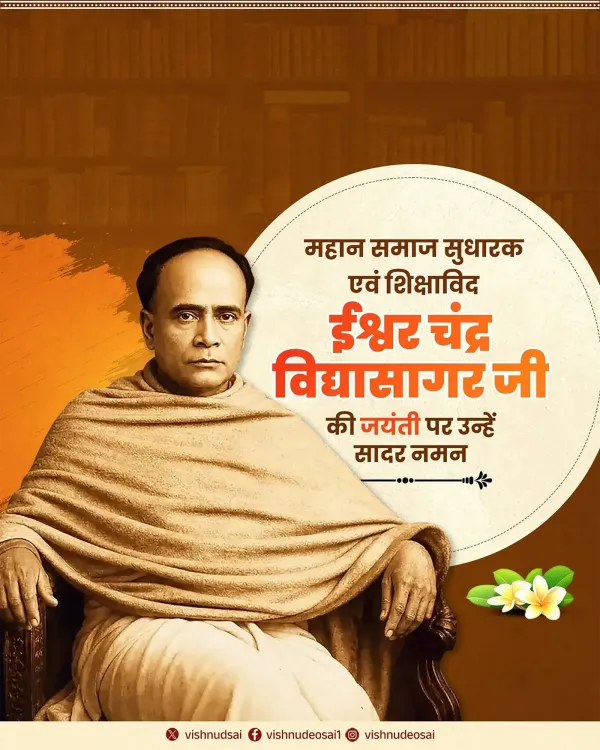
On the birth anniversary of one of India's most consequential 19th-century reformers, Chhattisgarh Chief Minister Vishnu Deo Sai on Saturday, September 26, 2026 paid solemn tribute to Ishwar Chandra Vidyasagar, hailing him as a pillar of India's social renaissance and a tireless champion of women's education.
In a post on X, CM Sai wrote — translated from Hindi — that Vidyasagar's 'struggle against social evils, his relentless efforts for the spread of education and women's empowerment became the foundation of the awakening of Indian society.' He added that Vidyasagar's 'inspirational life, which gave society the direction of equality, education and progressive thought, will always guide us.'
Who was Ishwar Chandra Vidyasagar and why does he still matter
Ishwar Chandra Vidyasagar was a 19th-century Bengali polymath whose work reshaped Indian society at a time when colonial rule and entrenched customs locked millions — especially women — out of public life. He was among the most determined advocates for widow remarriage, helping push through the landmark Hindu Widows' Remarriage Act of 1856. He simultaneously simplified Bengali prose, making literacy more accessible, and opened schools for girls at a scale almost unimaginable for his era.
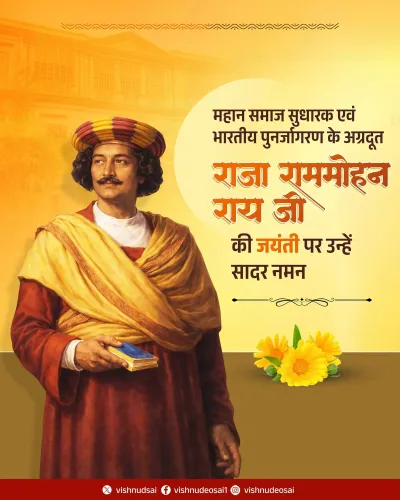
His legacy sits at the heart of the Bengal Renaissance — that extraordinary 19th-century surge of rationalist, reformist energy that produced figures like Ram Mohan Roy and Rabindranath Tagore. Vidyasagar's contribution was distinctly practical: he did not just write about equality, he built institutions for it.
A political tradition of invoking reform anniversaries
CM Sai's tribute is part of a well-established pattern across India's political spectrum, where leaders mark the birth anniversaries of 19th-century reformers to frame contemporary agendas around education, equality and women's empowerment. For BJP governments in particular, invoking figures like Vidyasagar allows them to root development policy in a longer national narrative of social progress — one that predates the independence movement itself.
Chhattisgarh, as a state with significant tribal and rural populations, has its own ongoing stakes in the conversation about girls' schooling and social mobility. The anniversary, marked with posts like this one, keeps reform-era values visible in public discourse.
Vidyasagar's relevance is not merely ceremonial — his model of linking education directly to the liberation of women continues to inform policy debates about school enrolment, teacher training and community-level reform. The man's life was a blueprint. The question each generation inherits is whether it will build on it.
Point of View
Not solely a Bengali or Congress-linked heritage. By foregrounding women's empowerment and education — both central to current government schemes — the tribute doubles as a soft alignment of historical prestige with present policy. For Chhattisgarh specifically, where girls' enrolment and social mobility remain live political issues, invoking Vidyasagar is not empty symbolism. It signals which values the administration wants associated with its governance identity.
NationPress
26 Sept 2026
Frequently Asked Questions
Who was Ishwar Chandra Vidyasagar?
Ishwar Chandra Vidyasagar was a 19th-century Bengali polymath, educator and social reformer who campaigned for widow remarriage, simplified Bengali prose and opened schools for girls across Bengal, becoming one of the central figures of the Bengal Renaissance.
Why is Vidyasagar's birth anniversary observed in India?
Vidyasagar's birth anniversary is observed across India to honour his foundational contributions to women's education, social reform and the broader modernisation of Indian society. Political leaders and institutions use the occasion to reaffirm commitments to equality and education.
What did CM Vishnu Deo Sai say about Vidyasagar?
CM Sai said that Vidyasagar's struggle against social evils and his efforts for women's education 'became the foundation of the awakening of Indian society,' and that his life, guided by equality and progressive thought, 'will always guide us.'
What was the Hindu Widows' Remarriage Act of 1856?
The Hindu Widows' Remarriage Act of 1856 was a colonial-era law that legalised the remarriage of Hindu widows in India. Ishwar Chandra Vidyasagar was one of its principal advocates, campaigning vigorously to end the social stigma and legal prohibition against widow remarriage.
What is the Bengal Renaissance?
The Bengal Renaissance was a 19th-century intellectual and social reform movement centred in Bengal that produced thinkers like Ram Mohan Roy, Vidyasagar and Rabindranath Tagore. It emphasised rationalism, women's rights, education and a reinterpretation of Hindu tradition.