White House Marks Rural Health Day With $50B Investment Pledge
Synopsis
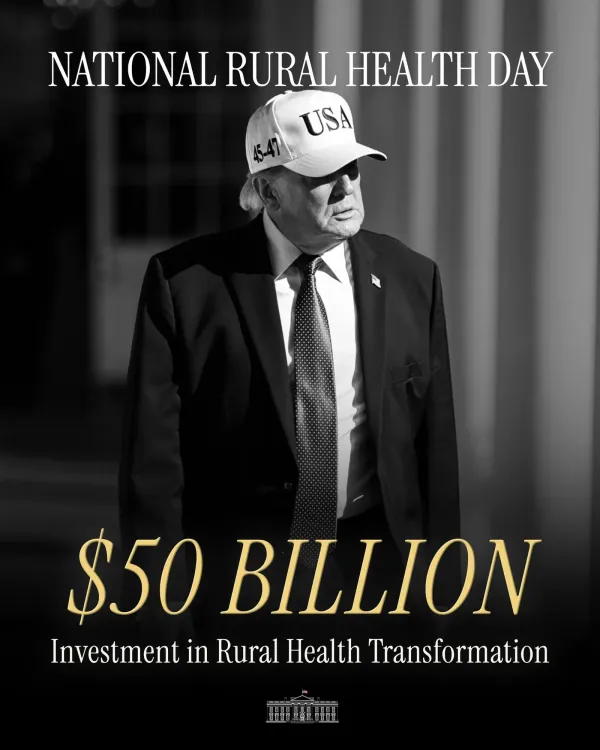
The White House announced on Rural Health Day that President Trump's administration has committed $50 billion to rural healthcare transformation across the United States, with $20 billion already distributed to all 50 states for infrastructure and disease prevention.
Key Takeaways
The White House announced a $50 billion federal commitment to rural health transformation on Rural Health Day . $20 billion of that total has already been distributed across all 50 US states .
Funding targets health infrastructure upgrades, disease prevention, and broader rural access improvements.
The announcement is framed as a signature achievement of President Trump's administration.
Urban-rural healthcare disparities — including hospital closure risks and physician shortages — are the structural problems the investment aims to address.
Remaining $30 billion in pledged funds will depend on future congressional appropriations and federal budget action.
On Rural Health Day, the White House put the starkest number in American healthcare onto the table: a claimed $50 billion commitment to transforming rural health infrastructure across the country, with $20 billion already distributed to all 50 states. The announcement, framed as a signature achievement of President Donald Trump's current term, positions rural America's long-neglected clinics and hospitals at the centre of federal health policy.
A $50 Billion Bet on Rural America's Health System
The White House described the investment as 'historic,' covering a broad sweep of priorities — health infrastructure upgrades, disease prevention programmes, and expanded access to care in communities that have watched local hospitals shutter for decades. The funding's reach across every state signals a deliberate political as well as policy calculation: rural health is not a regional issue but a national one.
Urban-rural healthcare disparities have been a stubborn feature of the American system for generations. Rural hospitals face disproportionate closure risks, physician shortages, and older patient populations with higher rates of chronic disease. Federal programmes under multiple administrations have attempted to bridge the gap, historically through HHS rural hospital grants and telehealth expansions — but rarely at a scale the White House is now advertising.
What the Funding Is Meant to Fix
The stated pillars — health infrastructure and disease prevention — target the two most acute pressure points in rural care. Infrastructure funding can mean everything from rebuilding ageing emergency departments to equipping rural clinics with diagnostic technology that currently requires patients to drive hours to a city. Prevention funding, meanwhile, addresses rural America's outsized burden of conditions like heart disease, diabetes, and opioid dependency.
The $20 billion already distributed represents the first tranche of action against the broader pledge — a signal, the White House argues, that this is a programme already in motion rather than a promise deferred to future budget cycles. Congressional dynamics and further federal appropriations will ultimately determine whether the remaining $30 billion flows as projected.
Rural Health Day and the Politics of Proximity
Rural Health Day, observed annually, exists precisely because rural communities have historically struggled to make their healthcare needs visible in federal budget conversations dominated by large urban hospital systems. By anchoring this announcement to the observance, the White House frames the investment as a direct response to that long-standing advocacy — a move that carries weight in states where rural constituencies are politically decisive.
Whether the funding's real-world reach matches the headline figure will be the story to watch. The pipeline from federal commitment to a rebuilt clinic in a small county is long — running through state health agencies, hospital boards, and procurement cycles. But for communities where the nearest emergency room is fifty miles away, even the opening of that pipeline matters.
Point of View
A politically savvy frame given rural constituencies' electoral weight. Historically, federal rural health funding has arrived in smaller, fragmented tranches through HHS programmes, making a consolidated headline figure useful for communications even as the implementation mechanics remain complex. The gap between the $20 billion reportedly distributed and the $30 billion still pending is the real story to watch: it will reveal whether this is structural transformation or a well-timed announcement. For India's observers of US domestic policy, it also illustrates how advanced democracies publicly reckon with the same urban-rural health equity challenge that shapes Indian health policy debates.
NationPress
20 Nov 2026
Frequently Asked Questions
What is Rural Health Day in the United States?
Rural Health Day is an annual observance in the US highlighting the unique healthcare challenges faced by rural communities, including hospital shortages, physician access gaps, and higher rates of chronic disease.
How much has the Trump administration committed to rural healthcare?
The White House announced a $50 billion commitment to rural healthcare transformation, of which $20 billion has already been distributed across all 50 states.
What will the $50 billion rural health funding be used for?
According to the White House, the funding covers health infrastructure improvements, disease prevention programmes, and other initiatives aimed at transforming rural healthcare delivery across the United States.
Which states receive the rural health funding?
The White House stated that the funding reaches all 50 US states, making it a nationwide rural health initiative rather than a targeted regional programme.
What are the main healthcare challenges in rural America?
Rural American communities face disproportionate hospital closure risks, physician shortages, longer travel times to emergency care, and higher rates of chronic conditions like heart disease, diabetes, and opioid dependency.