White House Touts Investments, Tax Refunds, Rural Health Funds for Georgia
Synopsis
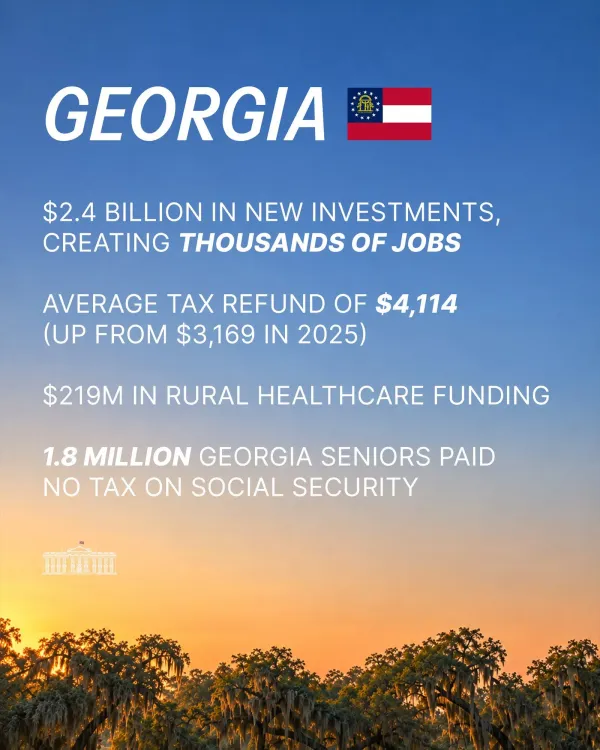
The White House flagged 'huge investments, massive tax refund increases, and historic rural healthcare funding' for Georgia on October 25, 2026, continuing its pattern of state-targeted federal spending communications aimed at highlighting executive-branch economic priorities.
Key Takeaways
The White House posted on October 25, 2026 highlighting federal benefits directed at Georgia .
Three areas were cited: broad investments, a 'massive increase in tax refunds,' and 'historic rural healthcare funding.' Rural healthcare funding is especially significant given longstanding hospital closures and provider shortages in Georgia's non-urban counties.
No specific dollar figures were included in the post; detailed numbers would typically appear in Treasury or HHS agency reports.
The post follows a standard White House communications strategy of state-specific federal spending announcements.
Georgia's status as a political battleground makes it a frequent target of tailored federal messaging from both parties.
Federal dollars are flowing south — and the White House wants Georgia to know it. The White House posted on X on Sunday, October 25, 2026, spotlighting what it described as 'huge investments, massive increase in tax refunds and historic rural healthcare funding' directed at the state of Georgia.
Three Pillars of the Georgia Pitch
The post bundles three distinct categories of federal action into a single message. First, broad investment inflows — likely a reference to federal grants, infrastructure outlays, or incentivised private capital tied to executive-branch priorities. Second, a 'massive increase in tax refunds,' pointing to Treasury-level changes that put more money back in Georgia residents' pockets. Third, and perhaps most pointed politically, 'historic rural healthcare funding' — a phrase that signals a deliberate outreach to the state's non-urban counties, which have long faced hospital closures and provider shortages.
Why Georgia, Why Now
Georgia is a perennial battleground in American politics — a state that has swung between parties in recent election cycles and hosts a mix of booming metropolitan centres like Atlanta and vast rural stretches where economic and healthcare gaps remain acute. White House communications teams routinely tailor state-specific messaging to reinforce the administration's domestic agenda and remind voters of tangible federal benefits. Highlighting rural healthcare funding in particular speaks directly to communities where access to a doctor, let alone a hospital, can require a long drive.
The Broader Pattern of State-Level Federal Messaging
This post fits a well-established playbook: the executive branch amplifying federal spending wins on social media, state by state, to build a cumulative narrative of economic stewardship. Congressional appropriations bills and agency reports from the Treasury Department and the Department of Health and Human Services (HHS) are the upstream sources that typically underpin such claims — and those documents would carry the precise dollar figures the White House chose not to specify here. The absence of hard numbers is notable; it keeps the message broadly positive without anchoring it to figures that opponents could scrutinise.
For Georgia's rural communities — the explicit beneficiaries called out in the post — the proof will be in the disbursements: whether funding reaches clinics, whether refund timelines improve, and whether promised investments translate into jobs and infrastructure on the ground.
Washington can post the headline. Georgia's counties will write the follow-up story.
Point of View
Tax relief, and rural healthcare into one message is strategically layered: it speaks simultaneously to business communities, middle-income households, and medically underserved counties. Georgia's continued electoral competitiveness makes it a high-value target for this kind of messaging. The deliberate omission of specific figures, however, leaves the claims open to challenge until agency-level disbursement data becomes public.
NationPress
25 Oct 2026
Frequently Asked Questions
What did the White House announce for Georgia?
The White House highlighted three federal benefits for Georgia: major investments, a large increase in tax refunds for residents, and what it called historic rural healthcare funding.
How much money is the federal government sending to Georgia?
The White House post did not specify dollar amounts. Precise figures would be found in Congressional appropriations bills or reports from the Treasury Department and HHS.
Why is rural healthcare funding important for Georgia?
Many of Georgia's rural counties have faced hospital closures and severe shortages of healthcare providers, making federal healthcare funding a critical lifeline for those communities.
Why does the White House frequently post state-specific funding announcements?
State-targeted posts allow the administration to connect broad federal policy decisions to tangible local benefits, reinforcing its economic and governance narrative with specific voter constituencies.
Is Georgia a politically important state for US federal policy announcements?
Yes. Georgia has been a competitive battleground state in recent US elections, making it a frequent focus of federal messaging from the executive branch.