CM Shivakumar to Lead Karnataka's Welfare-Growth Model
Synopsis
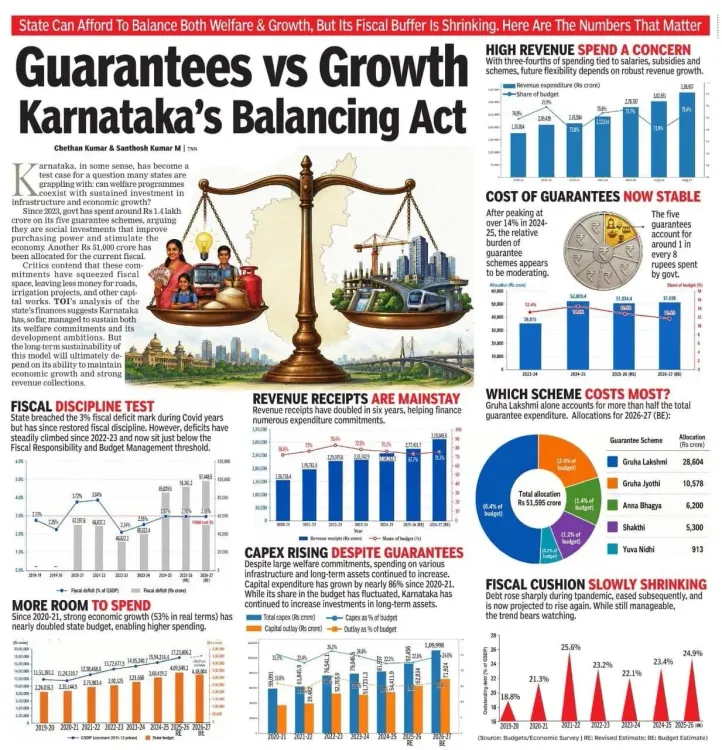
Karnataka's Chief Minister's Office has declared over ₹1.4 lakh crore spent on five guarantees since 2023, with ₹51,595 crore budgeted for 2026-27. The post confirms D.K. Shivakumar will lead the state for the next two years, pairing welfare continuity with rising capital expenditure and a return to FRBM compliance.
Key Takeaways
The Chief Minister's Office of Karnataka announced on 17 June 2026 that the state has spent over ₹1.4 lakh crore on five guarantees since 2023 .
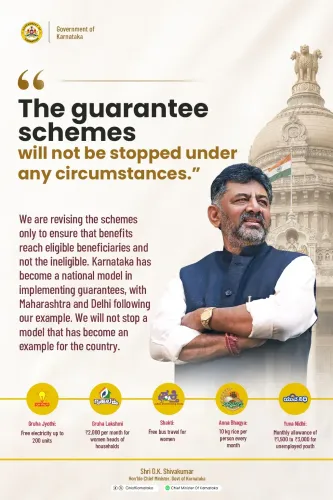
The 2026-27 budget allocates ₹51,595 crore for the five guarantees, with their cost now described as stabilised as a share of the total budget.
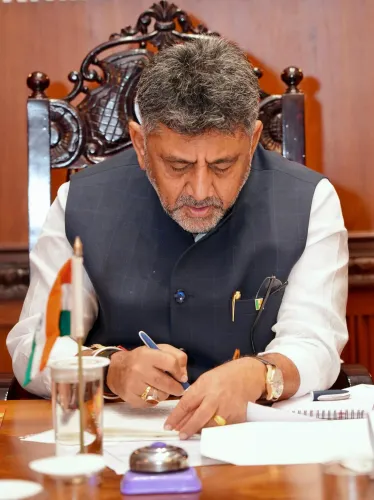
Shivakumar is confirmed as the Chief Minister who will lead Karnataka for the 'next two years', formalising the ruling party's internal leadership transition.
Karnataka claims to have returned to the FRBM (Fiscal Responsibility and Budget Management) path after Covid-era deviations, alongside growing capital expenditure.
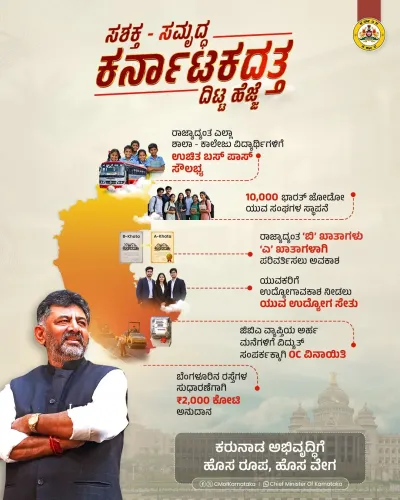
The government's stated priorities include infrastructure, jobs, urban development, irrigation, power, and industry investment across all districts.
The CMO has branded the approach the 'Karnataka Model' — positioning welfare and fiscal discipline as complementary, not competing, goals.
The Chief Minister's Office of Karnataka on Wednesday, 17 June 2026 laid out a comprehensive fiscal and welfare vision for the state, asserting that Karnataka's five-guarantee scheme has been managed with 'fiscal discipline' and that the government will accelerate capital investment over the next two years under incoming Chief Minister D.K. Shivakumar.
Context
The post, published by the official Chief Minister's Office of Karnataka account, frames the five guarantees — launched after the Indian National Congress swept the May 2023 Karnataka Assembly elections — not as short-term relief but as a structural economic foundation. The government states it has spent over ₹1.4 lakh crore on the five guarantees since 2023, with ₹51,595 crore allocated for 2026-27.
The post explicitly names D.K. Shivakumar as the Chief Minister who will lead Karnataka over the 'next two years', signalling the formalisation of the long-anticipated leadership transition within the ruling party's internal arrangement.
Policy Backdrop
Karnataka's five guarantees — which include cash transfers, free bus travel for women, and power subsidies — originated in the Congress party's 2023 election manifesto and were formally budgeted in the 2023-24 state budget. The scheme targets women, youth, rural households, and workers, with the stated goal of raising household purchasing power.
The CMO's post underscores that the cost of guarantees has 'stabilised as a share of the Budget', and points to a return to the Fiscal Responsibility and Budget Management (FRBM) framework after pandemic-era deviations. The government argues that Karnataka proves 'pro-people governance and responsible financial management can go together.'
Several Indian states have pursued similar models since 2022, pairing expanded welfare spending with rising capital expenditure on infrastructure and industry as they recover fiscal space lost during Covid-19.
Stakeholders and Impact
The post highlights that the guarantees are designed to benefit women, youth, and workers across Karnataka's districts. The government claims capital expenditure has 'grown sharply' and that revenue receipts have strengthened, pointing to investments in infrastructure, jobs, urban development, irrigation, power, and industry.
For beneficiaries — particularly women who receive free bus travel and power subsidies — the 2026-27 allocation signals continuity of existing entitlements. For the business and investor community, the FRBM compliance claim and rising capital outlay are positioned as assurances of fiscal credibility.
The post frames the overall approach as 'the Karnataka Model', a phrase that carries political weight as the Congress party seeks to present Karnataka as a replicable governance template ahead of future state elections elsewhere in India.
What's Next
The CMO's statement sets the tone for D.K. Shivakumar's tenure as Chief Minister, with the government committing to move 'faster' and 'deliver better' across every district. Detailed 2026-27 budget documents — including final guarantee outlays and capital expenditure ratios — will be the key test of whether the stated fiscal balance holds.
Any mid-year review of guarantee costs against revenue receipts will be closely watched. If Karnataka sustains FRBM compliance while expanding capital spending, it could reinforce the 'Karnataka Model' as a credible policy framework — and sharpen its political salience nationally.
Point of View
The ruling party is building a transferable brand ahead of future electoral cycles in other states. The emphasis on FRBM compliance is a direct rebuttal to opposition criticism that the five guarantees are fiscally reckless — a charge that has dogged Congress-governed states since 2023. Whether the numbers hold up under independent scrutiny will determine whether Karnataka's model becomes a national template or a cautionary tale. The timing, mid-term and ahead of a leadership handover, suggests the party is keen to lock in a positive fiscal narrative before Shivakumar formally takes charge.
NationPress
17 Sept 2026
Frequently Asked Questions
What are Karnataka's five guarantees?
Karnataka's five guarantees are welfare schemes launched by the Congress government after its May 2023 election victory . They include cash transfers, free bus travel for women, and household power subsidies, aimed at supporting women, youth, and low-income families.
How much has Karnataka spent on five guarantees?
According to the Chief Minister's Office of Karnataka , the state has spent over ₹1.4 lakh crore on the five guarantees since 2023 , with ₹51,595 crore allocated for 2026-27 .
When will DK Shivakumar become Chief Minister of Karnataka?
The CMO's post on 17 June 2026 confirmed that D.K. Shivakumar will lead Karnataka as Chief Minister for the 'next two years', indicating the long-anticipated internal party leadership transition is imminent or already underway.
What is the Karnataka Model of governance?
The Karnataka Model , as described by the CMO, pairs expanded welfare spending through the five guarantees with rising capital expenditure on infrastructure, jobs, and industry — while maintaining FRBM fiscal discipline .
Is Karnataka following FRBM norms?
The Karnataka government claims to have returned to the Fiscal Responsibility and Budget Management (FRBM) path after deviations during the Covid-19 pandemic years, citing strengthened revenue receipts and disciplined budget management.