CM Shivakumar: Karnataka's Guarantee Schemes Will Not Stop
Synopsis
Karnataka Chief Minister D.K. Shivakumar declared on 15 June 2026 that the state's guarantee welfare schemes will not be halted under any circumstances. While a revision to exclude ineligible beneficiaries is under way, he reaffirmed Karnataka's role as a national model, noting Maharashtra and Delhi have adopted similar programmes.
Key Takeaways
Karnataka Chief Minister D.K.
Shivakumar stated on 15 June 2026 that guarantee schemes will not be stopped for any reason.
The government is revising beneficiary eligibility to prevent welfare benefits from reaching ineligible recipients.
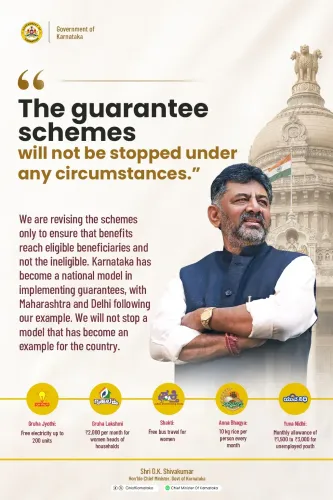
Karnataka's five guarantee schemes — including Gruha Lakshmi , Shakti , and Anna Bhagya — were launched after the 2023 assembly election victory.
Shivakumar cited Maharashtra and Delhi as states that have adopted comparable guarantee-style welfare programmes following Karnataka's model.
The revision exercise is expected to have implications for state budget allocations and fiscal outgo.
Opposition scrutiny of eligibility criteria and fiscal sustainability of the schemes is anticipated to intensify.
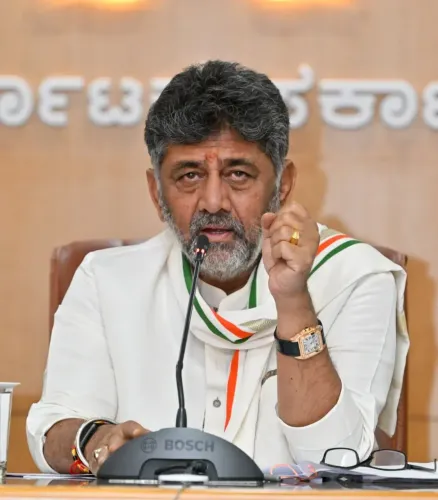
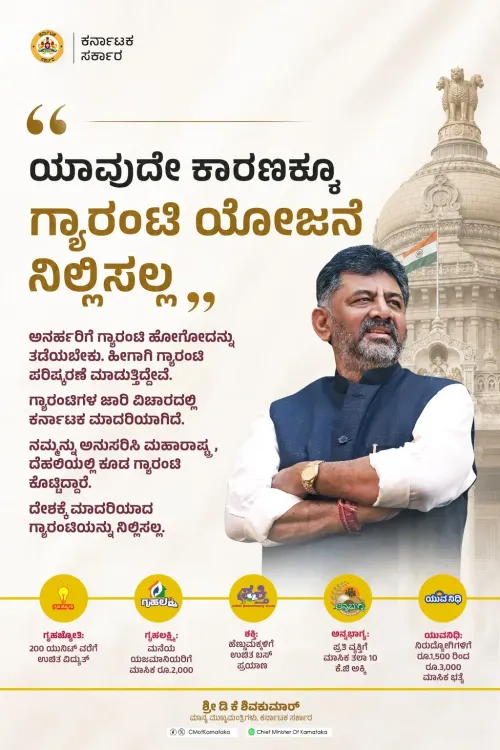
The Chief Minister's Office of Karnataka posted on Monday, 15 June 2026, quoting Chief Minister D.K. Shivakumar reaffirming that the state's flagship guarantee schemes will continue without interruption, even as the government undertakes a revision exercise to weed out ineligible beneficiaries.
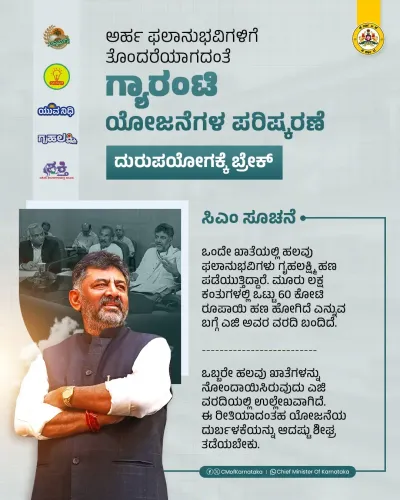
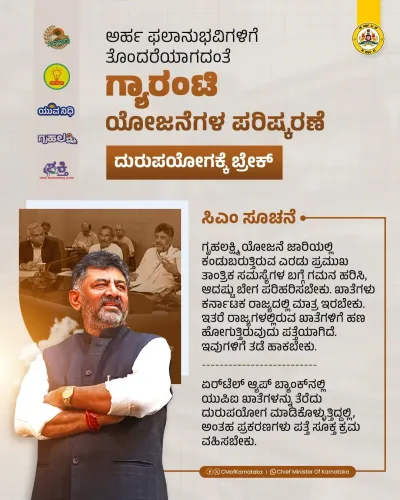
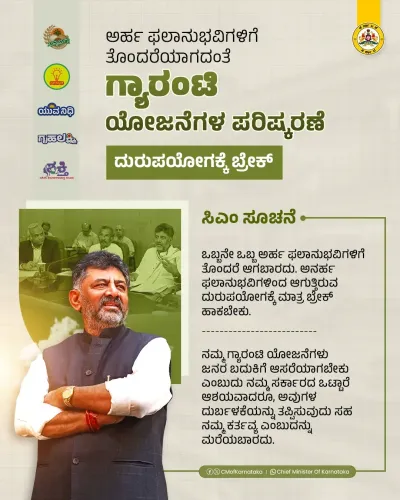
The post, in Kannada, quotes Shivakumar: 'ಯಾವುದೇ ಕಾರಣಕ್ಕೂ ಗ್ಯಾರಂಟಿ ಯೋಜನೆ ನಿಲ್ಲಿಸಲ್ಲ' — 'The guarantee schemes will not be stopped for any reason.' The Chief Minister added that the revision was aimed specifically at preventing benefits from reaching those who do not qualify, not at curtailing the schemes themselves.
Context
Shivakumar stated that the ongoing revision of the guarantee programmes is driven by a need to ensure that benefits reach only eligible recipients. His remarks appear to be a direct response to opposition claims and public speculation that the schemes may be wound down or significantly curtailed. 'We are revising the guarantees to stop them from going to the ineligible,' he said, as quoted in the official post.
He also pointed to Karnataka's standing as a national model, noting that Maharashtra and Delhi had followed the state's example in rolling out their own guarantee-style welfare commitments. 'Karnataka has become a model in implementing guarantees. Following us, Maharashtra and Delhi have also given guarantees,' the post quotes him as saying.
Policy Backdrop
After the Congress party's victory in the 2023 Karnataka assembly elections, the state government launched five guarantee schemes — among them Gruha Lakshmi, Shakti, and Anna Bhagya — designed to deliver direct cash transfers and subsidised services to targeted households. The schemes became a centrepiece of the Congress campaign and were widely credited with the party's electoral success.
The guarantee model has since accelerated the adoption of targeted welfare programmes across Indian states, cutting across party lines. Debates around fiscal sustainability and the efficiency of beneficiary targeting have accompanied this policy diffusion, making the revision exercise politically sensitive. The government's move to tighten eligibility criteria while publicly defending the schemes reflects that tension.
Stakeholders and Impact
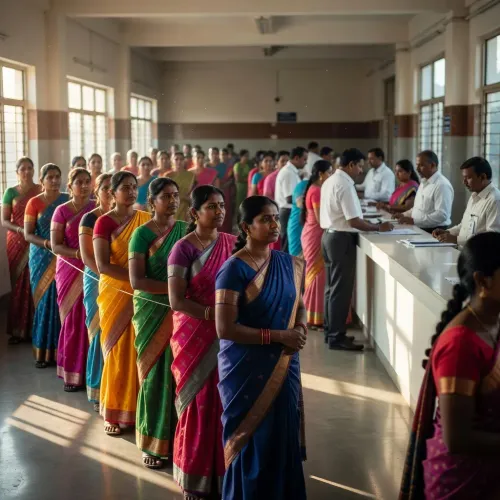
Millions of welfare beneficiaries across Karnataka stand to be directly affected by how the revision is implemented. Households currently enrolled in schemes such as Gruha Lakshmi — which provides monthly cash support to women heads of household — and Shakti — which offers free bus travel to women — are watching whether the eligibility review will alter their access to benefits.
State finances are the other key stakeholder. The guarantee schemes represent a substantial recurring expenditure in Karnataka's annual budget, and any tightening of the beneficiary list is expected to have implications for fiscal outgo. Opposition parties have questioned the state's capacity to sustain the programmes at current scale.
What's Next
Attention will now turn to the specifics of the beneficiary eligibility revision — what criteria will be applied, how many households may be removed from the rolls, and what the revised fiscal outlay will look like. Legislative scrutiny of the revised eligibility norms is also likely. Shivakumar's statement signals that the political commitment to the guarantee framework remains firm, even as administrative and financial adjustments are under way. How the government balances fiscal discipline with its welfare promises will be a defining test for the Congress administration heading into the next budget cycle.
Point of View
Issued alongside an acknowledgement of a beneficiary revision, is a calibrated political move: it pre-empts opposition narratives of scheme rollback while providing administrative cover for tightening eligibility. The invocation of Maharashtra and Delhi as followers of Karnataka's model serves to nationalise the Congress welfare brand ahead of future electoral cycles. This episode underscores a broader pattern in Indian politics where welfare scheme continuity has become a non-negotiable political commitment, even when fiscal pressures demand course corrections. The real test will be whether the revision is implemented transparently and whether the fiscal savings are publicly accounted for.
NationPress
14 Sept 2026
Frequently Asked Questions
Will Karnataka's guarantee schemes be stopped or cancelled?
No. Chief Minister D.K. Shivakumar declared on 15 June 2026 that the guarantee schemes will not be stopped for any reason. The government is only revising eligibility criteria to remove ineligible beneficiaries.
Why is Karnataka revising its guarantee schemes?
The state government is revising the schemes to ensure that welfare benefits reach only eligible recipients and are not availed by those who do not qualify, according to the Chief Minister's statement.
What are Karnataka's main guarantee schemes?
Karnataka's flagship guarantee schemes launched after the 2023 assembly elections include Gruha Lakshmi, which provides monthly cash support to women heads of household; Shakti, which offers free bus travel to women; and Anna Bhagya, a food subsidy programme, among others.
Which states have followed Karnataka's guarantee scheme model?
Chief Minister Shivakumar stated that Maharashtra and Delhi have introduced comparable welfare guarantee programmes following Karnataka's example.
Who is DK Shivakumar and what is his role in Karnataka's welfare schemes?
D.K. Shivakumar is a senior Congress leader who serves as Chief Minister of Karnataka. He has been a key figure in the design and implementation of the state's guarantee welfare programmes since the Congress government came to power after the 2023 assembly elections.