CM Shivakumar Orders Purge of Ineligible Beneficiaries from Karnataka Guarantee Schemes
Synopsis
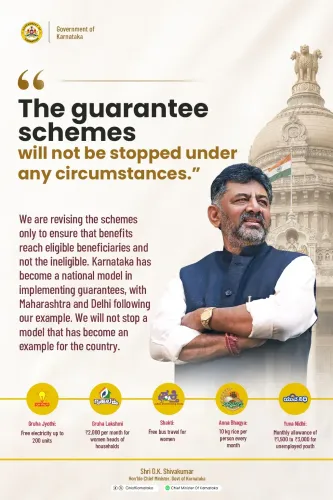
Karnataka Chief Minister D K Shivakumar on Friday chaired a review meeting of the state's Five Guarantee Schemes, issuing directives to protect eligible beneficiaries while systematically excluding ineligible claimants — a move aimed at curbing leakages in the flagship Congress welfare programmes.
Key Takeaways
The Chief Minister's Office of Karnataka announced the review meeting outcome on 20 June 2026 .
CM D K Shivakumar chaired a Friday review meeting of Karnataka's Five Guarantee Schemes .
Directives were issued to protect eligible beneficiaries and simultaneously exclude ineligible claimants from the schemes.
The Guarantee Schemes were promised in Karnataka Congress's April 2023 manifesto and launched after the May 2023 election victory.
The beneficiary audit aligns with a broader national pattern of Aadhaar-linked verification to curb welfare leakages.
Specific exclusion criteria and formal government orders arising from the meeting are yet to be publicly released.
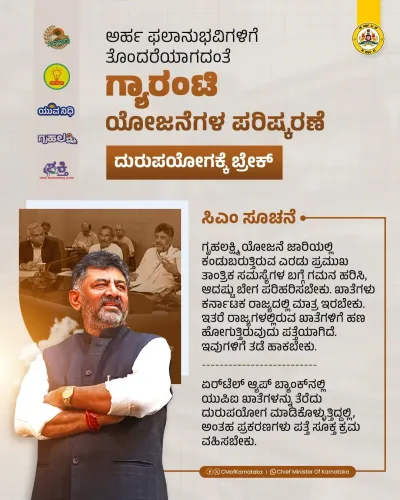
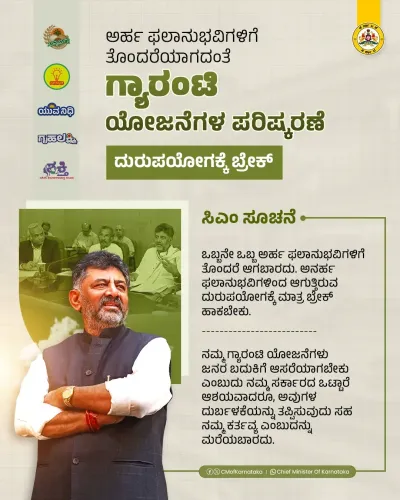
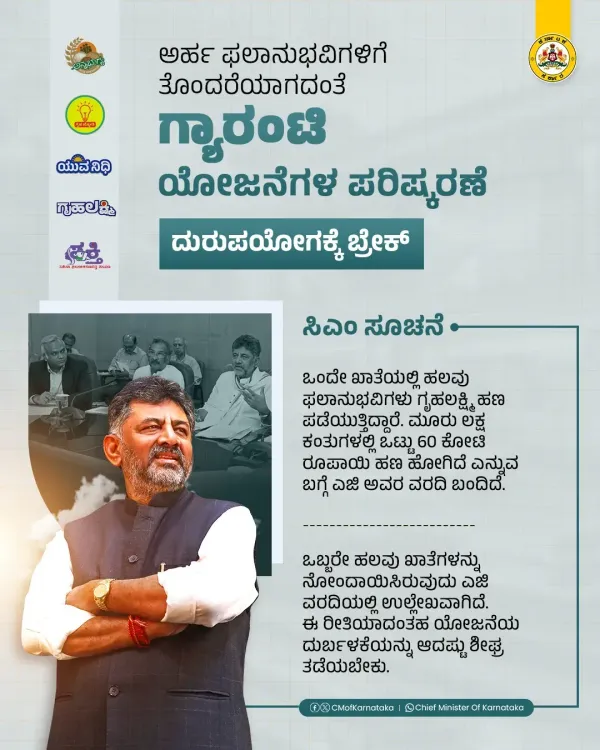
The Chief Minister's Office of Karnataka announced on Saturday, 20 June 2026 that a review meeting of the state's flagship Guarantee Schemes was held on Friday, during which instructions were issued to both protect eligible beneficiaries and exclude ineligible claimants from the programmes.
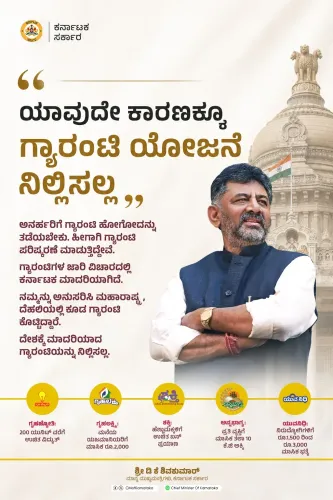
The official post, in Kannada, states that Chief Minister D K Shivakumar chaired the review meeting and issued directives aimed at ensuring that welfare benefits reach only those who qualify, while systematically weeding out those who do not. The post reads: 'ಅರ್ಹ ಫಲಾನುಭವಿಗಳ ಹಿತಕಾಯುವ ಜೊತೆಗೆ ಅನರ್ಹರನ್ನು ಯೋಜನೆಯಿಂದ ಹೊರಗಿಡುವ ಸಂಬಂಧ' — meaning, 'regarding protecting the interests of eligible beneficiaries while excluding ineligible persons from the scheme.'
Context
Karnataka's Five Guarantee Schemes are the centrepiece of the state Congress government's electoral mandate, promised in the party's April 2023 manifesto and progressively rolled out after the May 2023 assembly election victory. The schemes provide free electricity up to a certain unit threshold, free bus travel for women, monthly cash support for women heads of households, and other direct benefits to millions of residents across the state.
Given the scale and fiscal weight of these programmes, the government has periodically convened review meetings since 2023 to assess delivery, plug leakages, and recalibrate beneficiary lists. Friday's session appears to be one such structured audit exercise.
Policy Backdrop
Beneficiary verification in large welfare programmes is a standard governance practice across Indian states, increasingly underpinned by Aadhaar-linked databases, income records, and inter-departmental data sharing. The objective is to reduce 'ghost beneficiaries' — ineligible individuals drawing benefits — without inadvertently cutting off genuinely entitled recipients.
Karnataka's approach mirrors a national pattern in which state governments face dual pressure: fiscal prudence from the exchequer on one side, and political accountability to scheme beneficiaries on the other. Any exclusion drive carries the risk of wrongful removal of eligible households, making the framing of 'protecting the eligible while excluding the ineligible' politically and administratively significant.
Stakeholders and Impact
The primary stakeholders are millions of Karnataka residents enrolled in the Guarantee Schemes — particularly women beneficiaries of the free bus travel and cash transfer components — and the state exchequer, which bears the fiscal burden of these commitments. Tightening the beneficiary list could reduce the state's annual outgo on these programmes, though the government has not disclosed any specific savings target.
Opposition parties and civil society groups are likely to scrutinise the exclusion criteria closely, watching for any evidence of arbitrary or politically motivated removals. Genuine beneficiaries who are incorrectly excluded would have recourse through grievance redressal mechanisms, though the efficiency of those channels remains a point of ongoing debate.
What's Next
The specific instructions issued by CM Shivakumar at Friday's meeting are expected to be detailed in a formal government order or circular. Observers will watch for Karnataka assembly budget debates that may reflect revised allocations for the Guarantee Schemes following the beneficiary audit. Any subsequent internal or statutory audit reports on the verification exercise will be a key indicator of whether the exclusion drive achieves its stated goals without eroding the programme's reach among those it was designed to serve.
Point of View
Shifting from scheme rollout to scheme rationalisation. For CM Shivakumar, tightening the beneficiary rolls is a dual-edged move: it demonstrates administrative rigour to critics who question the programmes' fiscal sustainability, but it also risks alienating core voter groups if exclusions are perceived as arbitrary. This pattern — launching populist guarantees, then quietly pruning beneficiary lists — is increasingly common among state governments navigating the tension between electoral promises and revenue constraints. The political salience of the outcome will depend heavily on how transparently the exclusion criteria are communicated and how robustly the grievance redressal mechanism functions.
NationPress
19 Sept 2026
Frequently Asked Questions
What are Karnataka's Five Guarantee Schemes?
Karnataka's Five Guarantee Schemes are flagship welfare programmes promised by the Congress party in its April 2023 manifesto and implemented after its May 2023 election victory. They include free electricity up to a set unit limit, free bus travel for women, monthly cash transfers for women heads of households, and related direct-benefit programmes.
Why is Karnataka reviewing its Guarantee Scheme beneficiary lists?
The Karnataka government is reviewing beneficiary lists to ensure that only eligible individuals receive welfare benefits and to exclude ineligible or 'ghost' beneficiaries, thereby reducing leakages and containing the fiscal burden on the state exchequer.
What did CM D K Shivakumar say at the Guarantee Schemes review meeting?
According to the Chief Minister's Office of Karnataka, CM Shivakumar issued instructions at Friday's review meeting to both protect the interests of eligible beneficiaries and to exclude ineligible persons from the schemes. The specific directives are expected to be formalised in a government order.
How does Karnataka verify who is eligible for its welfare schemes?
Karnataka, like most Indian states, uses Aadhaar-linked databases, income records, and inter-departmental data sharing to verify beneficiary eligibility and identify ineligible claimants in its welfare programmes.
What happens to beneficiaries wrongly excluded from Karnataka's Guarantee Schemes?
Beneficiaries who believe they have been incorrectly excluded from Karnataka's Guarantee Schemes can approach the government's grievance redressal mechanisms, though the efficiency and accessibility of these channels remain subjects of ongoing public scrutiny.