CM Nayab Saini Pays Tribute to Raja Ram Mohan Roy on Birth Anniversary
Synopsis
Haryana Chief Minister Nayab Singh Saini paid tribute to Raja Ram Mohan Roy on his birth anniversary on 22 May 2026, honouring the 19th-century reformer's role in fighting social evils, advancing women's rights, and shaping modern India's progressive foundations.
Key Takeaways
CM Nayab Singh Saini posted a tribute to Raja Ram Mohan Roy on his birth anniversary on 22 May 2026 .
Saini described Roy as the 'pioneer of the Indian Renaissance' and 'father of modern India.' Raja Ram Mohan Roy (1772–1833) founded the Brahmo Samaj and campaigned against sati, child marriage, and other social evils.
Roy's advocacy contributed directly to the Bengal Sati Regulation of 1829 , which banned the practice in British India.
The tribute highlighted Roy's work in empowering women's rights and dignity as 'always worthy of remembrance.' Such birth-anniversary commemorations by Indian political leaders frequently reinforce contemporary commitments to gender equality and social progress.
Haryana Chief Minister Nayab Singh Saini on Friday, 22 May 2026, paid homage to Raja Ram Mohan Roy on the reformer's birth anniversary, honouring him as the 'pioneer of the Indian Renaissance' and 'father of modern India.' Saini credited Roy's legacy with laying the foundations of a progressive India by challenging orthodox social practices and championing women's rights.
Context
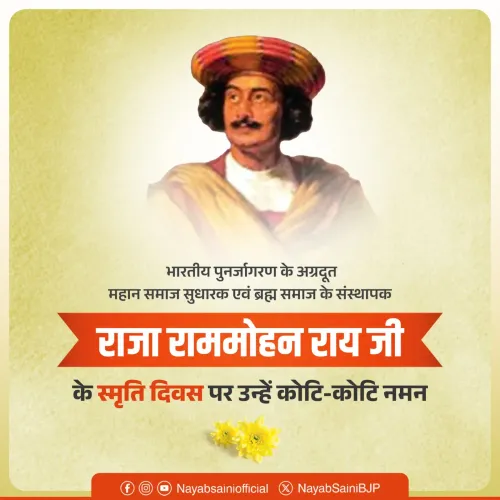
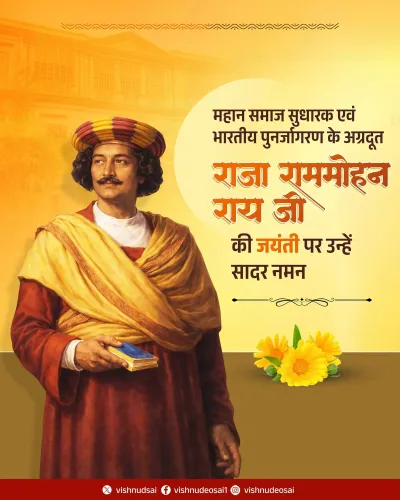
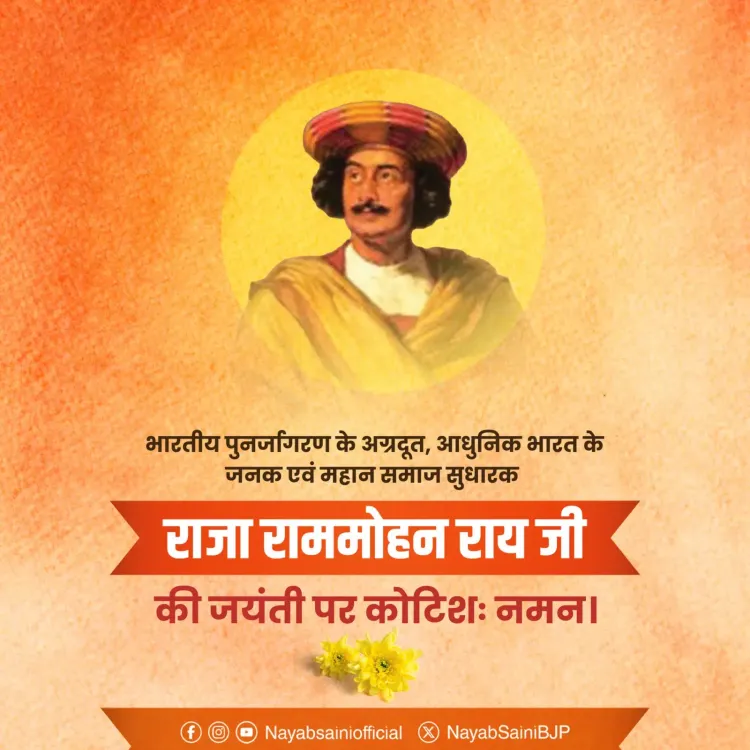
In his post, CM Saini offered salutations — 'kotishah naman' (countless salutations) — to the reformer, describing him as 'Bhartiya punarjagaran ke agradoot, aadhunik Bharat ke janak evam mahan samaj sudhaarak' (pioneer of the Indian Renaissance, father of modern India, and great social reformer). He stated that Roy's contribution to 'liberating society from conservative thinking and social evils, empowering women's rights and dignity, and building a progressive India will always be remembered.'
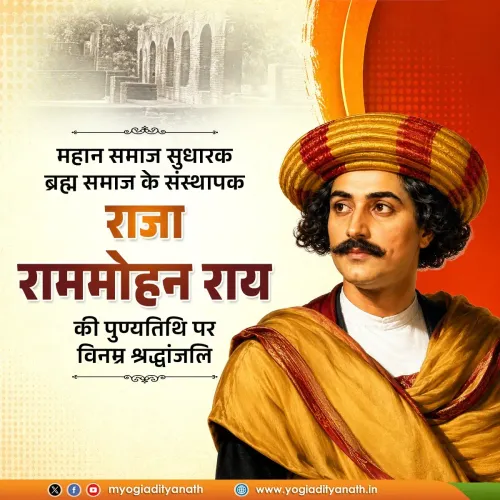
The tribute was accompanied by an image and posted early morning, a common practice for birth-anniversary commemorations by Indian political leaders.
Policy Backdrop
Raja Ram Mohan Roy, born in 1772 in Bengal and died in 1833, founded the Brahmo Samaj and was a central figure in the 19th-century social reform movement. His sustained advocacy against the practice of sati directly contributed to the passage of the Bengal Sati Regulation of 1829, which banned the practice across British India. He also campaigned against child marriage and in favour of women's education, causes that remain touchstones in Indian public discourse.
Indian political leaders across party lines regularly issue public tributes on the birth anniversaries of 19th-century reformers, linking historical campaigns against orthodoxy to contemporary commitments on gender equality and inclusive development. Such commemorations recur annually each May.
Stakeholders and Impact
The tribute resonates with women's groups, educators, and civil society organisations that invoke Roy's legacy when advocating for gender-equality policies and social reform programmes at the state level. For Haryana — a state that has historically faced scrutiny over gender-ratio disparities and women's safety — a sitting Chief Minister's public alignment with Roy's reformist legacy carries a degree of political and symbolic weight.
The post also speaks to a broader constituency of citizens engaged with India's social-reform heritage, reinforcing the ruling dispensation's messaging around progressive values and women's empowerment.
What's Next
Such commemorations occasionally precede or accompany state-level announcements on women's education, social awareness campaigns, or community outreach programmes. Whether Haryana follows the tribute with any concrete policy initiative on women's empowerment or social reform awareness in the near term remains to be seen. Roy's birth anniversary serves as a recurring moment for Indian administrations to restate their commitments to the values he espoused — making it a marker worth watching for any downstream policy signals from Chandigarh.
Point of View
Situating the BJP-led Haryana government within India's mainstream reformist tradition. By invoking Roy's campaigns against orthodoxy and for women's rights, Saini signals alignment with progressive social values — a messaging choice that carries particular resonance in Haryana, where gender-equity indicators have historically drawn scrutiny. The commemoration fits a broader pattern across India's political spectrum of anchoring contemporary governance narratives to 19th-century reform icons. Whether the tribute translates into tangible state-level policy action on women's empowerment will be the real measure of its significance.
NationPress
6 Oct 2026
Frequently Asked Questions
Why did CM Nayab Singh Saini pay tribute to Raja Ram Mohan Roy?
CM Nayab Singh Saini paid tribute to Raja Ram Mohan Roy on his birth anniversary on 22 May 2026, honouring the reformer's contributions to fighting social evils, empowering women, and building a progressive India.
Who was Raja Ram Mohan Roy?
Raja Ram Mohan Roy (1772–1833) was a Bengali social reformer and founder of the Brahmo Samaj. He campaigned against sati, child marriage, and other orthodox practices, and advocated for women's education and rights. His advocacy helped bring about the Bengal Sati Regulation of 1829.
What is Raja Ram Mohan Roy's birth anniversary date?
Raja Ram Mohan Roy was born on 22 May 1772, and his birth anniversary is observed on 22 May each year.
What did Raja Ram Mohan Roy do for women's rights in India?
Raja Ram Mohan Roy campaigned vigorously against sati and child marriage, and advocated for women's education and property rights. His efforts were instrumental in the British colonial government banning sati through the Bengal Sati Regulation of 1829.
What is Brahmo Samaj and who founded it?
Brahmo Samaj was a 19th-century Indian socio-religious reform movement founded by Raja Ram Mohan Roy in 1828. It promoted monotheism, rejected idol worship and caste discrimination, and advocated for rational, progressive values in Indian society.