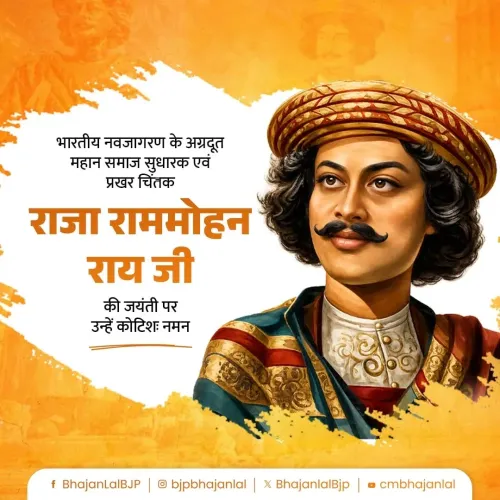
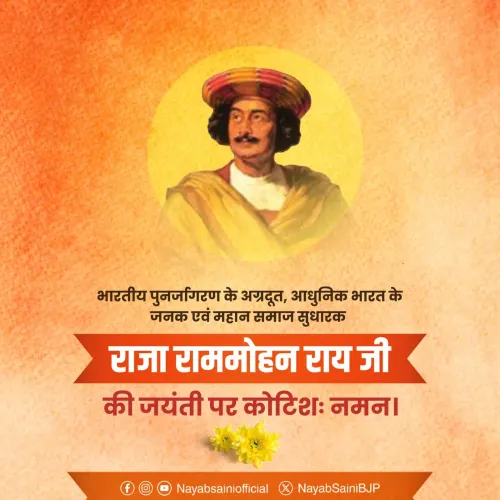
CM Nayab Saini pays tribute to Raja Ram Mohan Roy
Synopsis
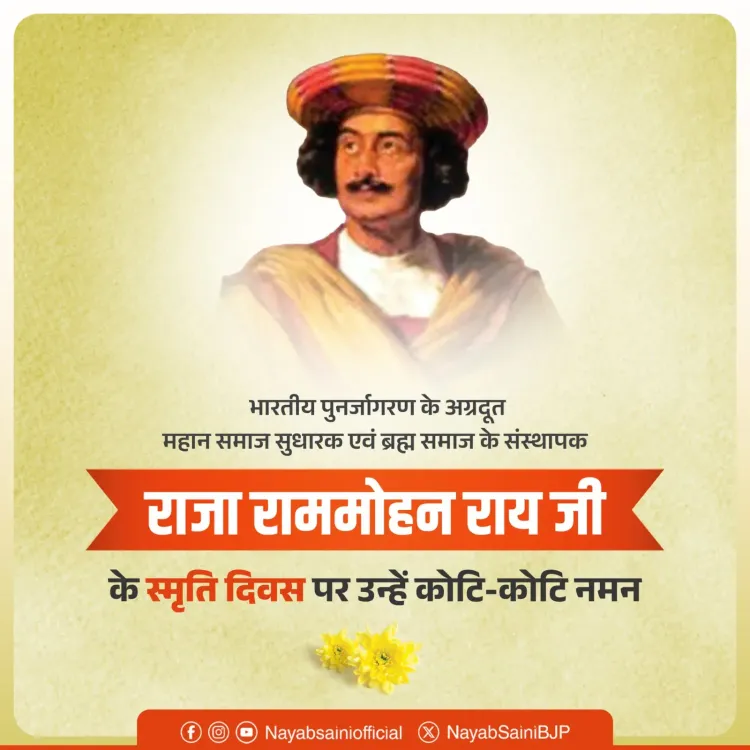
Haryana Chief Minister Nayab Singh Saini paid tribute to Raja Ram Mohan Roy on his death anniversary, 27 September 2026, honouring the Brahmo Samaj founder as the pioneer of the Indian Renaissance and crediting his 19th-century reforms with laying the foundation of modern India.
Key Takeaways
CM Nayab Singh Saini posted a tribute to Raja Ram Mohan Roy on his smriti diwas , 27 September 2026 .
Roy ( 1772–1833 ) founded the Brahmo Samaj in 1828 , a reform movement opposing caste discrimination, idolatry, and the practice of sati.
His campaign against sati led to the Bengal Sati Regulation of 1829 , a landmark colonial-era social reform law.
Saini described Roy as the 'pioneer of the Indian Renaissance' and credited him with strengthening the foundation of modern India through education and social reform.
Tributes to Roy on his death anniversary have become a cross-party ritual in Indian political culture, reflecting his enduring, non-partisan reformist legacy.
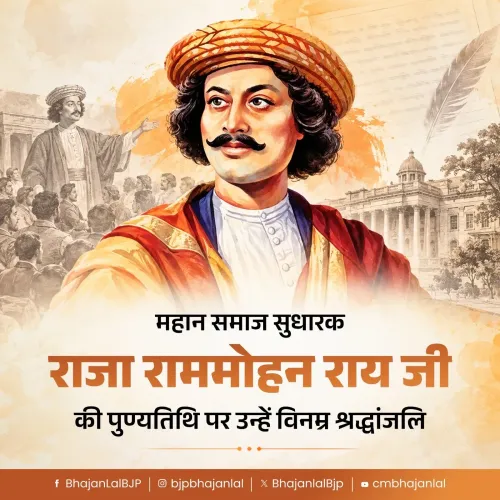
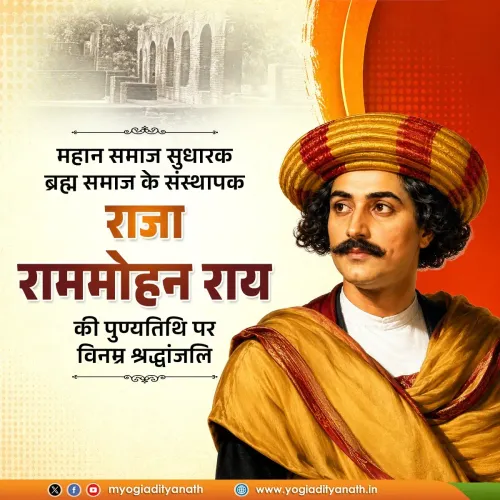
On the death anniversary of the man who fought to abolish sati and shook 19th-century India out of centuries of social stagnation, Haryana Chief Minister Nayab Singh Saini on Sunday, 27 September 2026 paid homage to Raja Ram Mohan Roy, invoking his legacy of education, social reform, and rational thinking as a living compass for modern India.
Posting in Hindi, CM Saini described Roy as 'Bharatiya punarjagaran ke agradoot' — the 'pioneer of the Indian Renaissance' — and offered 'countless salutations' on his smriti diwas (remembrance day). He credited the Brahmo Samaj, which Roy founded in 1828, with kindling public awareness against 'social evils, superstitions and discrimination.'
The reformer who rewired a society
Raja Ram Mohan Roy (1772–1833) was born in Bengal at a moment when India was caught between Mughal decline and British consolidation. He emerged not as a politician but as a relentless intellectual: learning Sanskrit, Persian, Arabic, Hebrew, Greek, and English, and turning each against orthodoxy. His singular campaign against sati — the practice of widows being immolated on their husbands' funeral pyres — resulted in the landmark Bengal Sati Regulation of 1829, one of the first major colonial-era social reform laws in Indian history.
The Brahmo Samaj, the movement he founded, attacked idolatry and caste discrimination while championing widow remarriage and women's education. It seeded a chain of reformers — from Keshab Chandra Sen to Ishwar Chandra Vidyasagar — whose work eventually fed into the nationalist and constitutional thought that shaped independent India's founding documents.
Why political leaders keep returning to Roy
Tributes to Raja Ram Mohan Roy on 27 September have become a near-universal ritual across the Indian political spectrum. That cross-party consensus is itself revealing: Roy represents a strain of reformist modernity that no party can easily oppose — a pre-independence figure whose critique of caste, superstition, and gender discrimination maps onto contemporary debates without being owned by any single ideology.
CM Saini's tribute fits this pattern, noting that Roy's 'thoughts and ideals continue to guide the direction of social awakening, equality, and nation-building even today.' The framing connects a 19th-century Bengali reformer directly to the present-day governance vocabulary of Haryana and the broader BJP discourse on social harmony.
Point of View
While his emphasis on education and national renewal fits neatly within BJP's nation-building vocabulary. Invoking Roy on his death anniversary also allows state-level leaders to participate in a national conversation at low political cost. The pattern signals how reformist icons increasingly function as shared civic property in Indian public life, invoked across ideological lines to legitimise contemporary agendas.
NationPress
27 Sept 2026
Frequently Asked Questions
When is Raja Ram Mohan Roy's death anniversary?
27 September is observed as Raja Ram Mohan Roy's death anniversary. He passed away on this date in 1833 in Bristol, England.
What is Brahmo Samaj and who founded it?
Brahmo Samaj was a 19th-century Hindu reform movement founded by Raja Ram Mohan Roy in 1828 . It advocated monotheism, opposed idolatry and caste discrimination, and promoted widow remarriage and women's education.
Why is Raja Ram Mohan Roy called the pioneer of the Indian Renaissance?
Roy is called the pioneer of the Indian Renaissance because he introduced rational, humanist thinking into Indian society at a time when practices like sati and strict caste hierarchy were widespread. His reforms in education, gender rights, and social equality laid intellectual groundwork for later nationalist thought.
What did Nayab Singh Saini say about Raja Ram Mohan Roy?
On 27 September 2026 , Haryana CM Nayab Singh Saini described Roy as the 'pioneer of the Indian Renaissance,' crediting the Brahmo Samaj with fighting social evils, superstitions, and discrimination, and noting that Roy's contributions to education and public administration strengthened the foundation of modern India.
What law did Raja Ram Mohan Roy's campaign against sati produce?
Roy's sustained campaign against sati directly contributed to the passage of the Bengal Sati Regulation of 1829 , one of the earliest and most significant social reform laws enacted during colonial rule in India.