Nvidia Highlights Full-Stack AI Gains for Every Layer
Synopsis
Chip giant Nvidia on 13 July 2026 posted on X reaffirming that improvements at any layer of its AI stack — silicon, software, or interconnects — cascade gains across the entire ecosystem, a message central to its full-stack infrastructure pitch to data centres and AI developers globally.
Key Takeaways
Nvidia posted on 13 July 2026 stating that every layer of its AI stack benefits when any single layer improves.
The message reflects Nvidia 's long-standing full-stack philosophy underpinning CUDA , TensorRT , and NVLink product lines.
Hyperscale data centres and AI developers are the primary stakeholders who gain compounded performance without application rewrites.
The framing is relevant to India 's IndiaAI Mission and domestic compute infrastructure investment decisions.
Analysts will watch the next Nvidia GTC keynote or earnings call for specifics on which architecture or software release the post previews.
Nvidia 's integrated stack argument implicitly contrasts its ecosystem with point-solution competitors in the AI chip market.
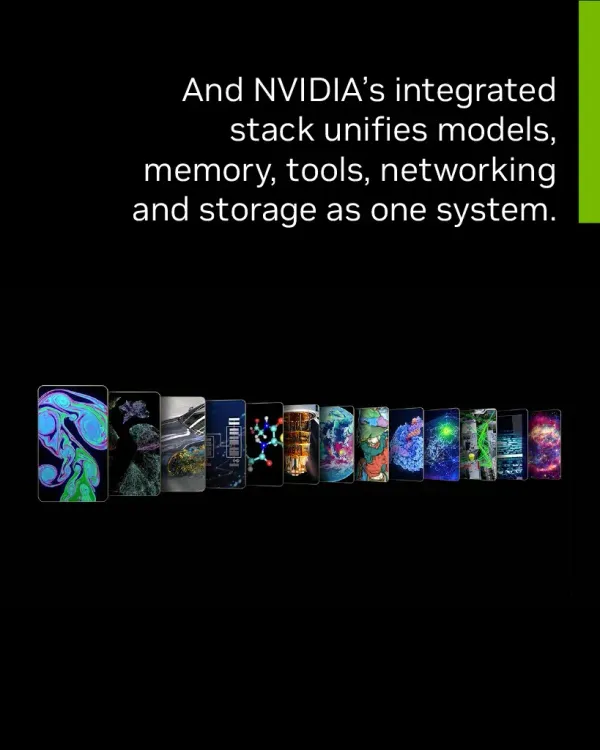
Chip giant Nvidia on Monday, 13 July 2026, posted a pointed message on X reaffirming its core philosophy that improvements at any single layer of the AI stack — silicon, interconnects, or software — translate into gains across the entire ecosystem. The brief but pointed statement, accompanied by an image, encapsulates the Santa Clara-based company's long-held view on integrated AI infrastructure.
The post read: 'This ensures that every layer benefits when any layer improves.' While terse, the message carries significant weight given Nvidia's dominant position in data-centre AI infrastructure and its history of framing product generations around ecosystem-wide performance lifts.
Context
Nvidia, led by co-founder and chief executive Jensen Huang, has built its competitive moat not merely on graphics processing units but on a tightly integrated hardware-software stack. The company's CUDA programming platform, TensorRT inference optimiser, and NVLink high-speed interconnect are designed so that a breakthrough in one component cascades upward and downward through the pipeline. This 'full-stack' philosophy is central to how Nvidia pitches its ecosystem to hyperscale data centres and AI developers worldwide.
The July 2026 post echoes language that has appeared repeatedly in Nvidia keynote addresses and technical publications over recent years, suggesting the message may accompany a specific product, software, or architecture announcement linked in the post's URL.
Policy Backdrop
Globally, governments and enterprises are racing to build sovereign AI capacity, and the choice of infrastructure stack has become a strategic decision. India, through initiatives such as the IndiaAI Mission, has been investing in domestic compute capacity, with Nvidia GPUs forming the backbone of several announced data-centre projects. The principle that software and hardware improvements compound across layers is directly relevant to policymakers evaluating long-term infrastructure investment: a single generational upgrade in silicon or a framework like CUDA can unlock performance gains across every workload running on that infrastructure.
For Indian AI startups and public-sector compute initiatives, this framing matters because it justifies investment in a unified, interoperable stack rather than piecemeal, vendor-agnostic solutions that may not capture cross-layer compounding effects.
Stakeholders and Impact
AI developers and hyperscale data centres are the most direct beneficiaries of the philosophy Nvidia is articulating. When a new GPU architecture such as Blackwell or a software update to TensorRT ships, workloads running on the full Nvidia stack — from training large language models to running inference at the edge — see compounded throughput improvements without requiring application-level rewrites. This is a powerful lock-in argument and a key reason enterprise customers renew and expand Nvidia deployments.
Competitors offering point solutions — faster memory here, a faster interconnect there — face the challenge that their gains do not automatically propagate across layers unless the rest of the stack is co-designed. Nvidia's post implicitly draws this contrast without naming rivals.
What's Next
Observers will watch Nvidia's next GTC keynote or quarterly earnings commentary for specifics on which new software layer or silicon architecture the 13 July 2026 post was previewing. Jensen Huang has historically used such platforms to demonstrate benchmark data showing cross-layer compounding gains. If the linked content points to a new CUDA release, a NVLink generation, or an updated TensorRT build, the market will parse it for signals on the competitive trajectory of AI infrastructure through 2026 and beyond. For India's growing AI ecosystem, any such announcement could influence procurement decisions across both private cloud players and government-backed compute programmes.
Point of View
Where public and private capital is flowing into AI compute, this messaging shapes vendor selection logic at a critical moment. The broader arc here is one of platform dominance: Nvidia is not merely selling chips, it is selling the argument that leaving its stack is costly precisely because improvements anywhere raise the floor everywhere.
NationPress
12 Oct 2026
Frequently Asked Questions
What did Nvidia post on X on 13 July 2026?
Nvidia posted the message 'This ensures that every layer benefits when any layer improves,' along with an image, reaffirming its philosophy that advances in any part of its AI hardware or software stack cascade gains across the entire ecosystem.
What is Nvidia's full-stack AI philosophy?
Nvidia's full-stack philosophy holds that its silicon (GPUs), interconnects (NVLink), and software frameworks (CUDA, TensorRT) are co-designed so that an improvement in one component automatically lifts performance across all workloads running on the integrated stack.
How does Nvidia's stack improvement benefit Indian AI projects?
Indian AI initiatives, including those under the IndiaAI Mission, rely heavily on Nvidia GPUs. If a software or hardware upgrade compounds performance across layers, Indian data centres and startups gain throughput improvements without needing to rewrite applications or replace infrastructure.
What is CUDA and why does it matter for AI?
CUDA is Nvidia's parallel computing platform and programming model that enables developers to use Nvidia GPUs for general-purpose AI and scientific computing. Because it sits at the software layer of Nvidia's stack, improvements to CUDA can accelerate every application built on top of it.
What should investors and developers watch after this Nvidia post?
The next Nvidia GTC keynote or quarterly earnings commentary is the key event to watch. Nvidia's CEO Jensen Huang typically uses these platforms to present benchmark data showing cross-layer performance gains tied to new silicon architectures or software releases.