Nvidia Touts PyTorch Hitting 700 Million CUDA Downloads
Synopsis
Nvidia on 13 July 2026 announced that PyTorch has surpassed 700 million PyPI downloads with CUDA support, framing the milestone as proof that a decade of co-evolution between its GPU architectures and open-source AI frameworks gives Nvidia a durable full-stack advantage in AI infrastructure.
Key Takeaways
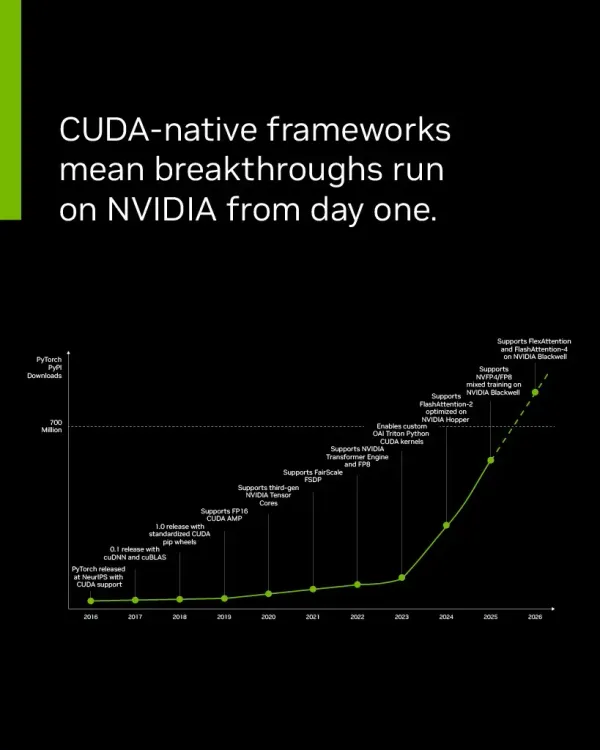
PyTorch has crossed 700 million cumulative PyPI downloads with CUDA support, according to Nvidia's 13 July 2026 post.
CUDA , Nvidia's proprietary parallel computing platform, has been the default GPU acceleration layer for PyTorch since the framework's public release in 2016 .
Nvidia's Volta architecture (2017) introduced Tensor Cores co-designed with deep-learning framework requirements, cementing the CUDA-PyTorch relationship.
The milestone reinforces a network-effect moat : a larger CUDA user base means more community libraries and pre-trained models, raising switching costs for developers.
Competing stacks such as AMD ROCm face an uphill task matching Nvidia's decade of co-evolved software tooling.
Nvidia frames open-source adoption as an accelerant to its hardware business, not a threat — a strategy it is expected to continue across future GPU generations.
Chip giant Nvidia on Monday, 13 July 2026 highlighted a landmark milestone for open-source AI infrastructure, announcing that PyTorch has surpassed 700 million PyPI downloads with CUDA support — a figure the company says reflects a decade of co-evolution between the framework and its GPU architectures.
In its post on X, Nvidia stated: 'PyTorch has surpassed 700 million PyPI downloads with CUDA support — co-evolved with a decade of NVIDIA architecture advances. Open source frameworks built on CUDA mean every AI breakthrough runs on NVIDIA from day one.'
Context
PyTorch, originally developed by Meta AI Research and released publicly in 2016, rapidly became the dominant framework for deep-learning research and production workloads. It was placed under the independent PyTorch Foundation to ensure vendor-neutral governance, yet its default acceleration layer has remained CUDA — Nvidia's proprietary parallel computing platform first introduced in 2007.
The 700 million cumulative download figure on PyPI (the Python Package Index) with CUDA support underscores how thoroughly the framework's user base has adopted Nvidia's hardware stack for training and inference. Each download represents a developer or automated pipeline pulling CUDA-enabled PyTorch binaries, making the metric a proxy for ecosystem lock-in.
Policy Backdrop
Nvidia's strategy of coupling open-source software adoption with proprietary hardware has been deliberate and long-running. When CUDA launched, it allowed developers to use GPUs for non-graphics tasks — a then-novel capability. As deep learning surged post-2012, frameworks like PyTorch were built atop CUDA, making Nvidia silicon the path of least resistance for AI workloads.
A pivotal inflection came with the Volta architecture in 2017, which introduced Tensor Cores specifically optimised for matrix operations central to deep learning. Successive generations — Ampere, Hopper — continued this co-design philosophy, ensuring that new framework features could exploit new hardware capabilities from day one of a product launch.
Stakeholders and Impact
AI developers and machine-learning researchers globally are the primary beneficiaries of a mature, well-documented CUDA-PyTorch stack, gaining access to highly optimised libraries such as cuDNN and cuBLAS. For Indian AI startups and academic institutions scaling model training, this ecosystem dictates hardware procurement decisions — Nvidia GPUs remain the default choice precisely because switching costs are high once a codebase is CUDA-dependent.
Competing platforms such as AMD ROCm have made strides in compatibility but have not yet matched the breadth of Nvidia's software ecosystem. The 700 million download milestone reinforces the network effect: the larger the CUDA-PyTorch user base, the more community libraries, tutorials, and pre-trained models are built for it, making alternatives harder to adopt.
What's Next
Nvidia's post frames open source not as a threat to its business model but as an accelerant — a posture the company is expected to maintain as it rolls out its next GPU architecture generations. Observers will watch whether PyTorch 2.x releases deepen CUDA dependencies or introduce more hardware-agnostic compilation pathways via tools like torch.compile.
For the broader AI industry, the milestone signals that the race for AI infrastructure dominance is as much a software-ecosystem contest as a silicon one. Any challenger to Nvidia's position must now match not just chip performance but a decade of co-evolved tooling — a bar that continues to rise with each new model generation.
Point of View
The company has made its hardware the default substrate for AI development. The '700 million downloads' figure functions as a competitive moat metric, signalling to investors and rivals alike that dislodging Nvidia requires rewriting not just chip economics but an entire developer culture. For India's rapidly expanding AI startup ecosystem — which relies heavily on PyTorch for model development — this lock-in has real procurement and cost implications, as cloud and on-premise GPU choices are effectively pre-decided by framework dependencies. The broader policy arc here is one of soft infrastructure power: whoever controls the dominant open-source stack controls where AI workloads run.
NationPress
14 Jul 2026
Frequently Asked Questions
What is the PyTorch 700 million CUDA downloads milestone about?
Nvidia announced that the PyTorch machine-learning framework has surpassed 700 million cumulative downloads from PyPI with CUDA GPU support enabled, reflecting widespread adoption of Nvidia's hardware platform across the global AI developer community.
What is CUDA and why does it matter for AI?
CUDA is Nvidia's proprietary parallel computing platform, first released in 2007, that allows developers to run general-purpose workloads on Nvidia GPUs. It is the standard acceleration layer for frameworks like PyTorch, making Nvidia GPUs the default hardware for AI training and inference.
Who created PyTorch?
PyTorch was originally developed by Meta AI Research and publicly released in 2016. It is now governed by the independent PyTorch Foundation, though CUDA remains its primary GPU acceleration backend.
Does this milestone affect Indian AI developers?
Yes. Indian AI startups and research institutions that use PyTorch — the dominant framework for model development — are effectively tied to Nvidia hardware through CUDA dependencies, influencing GPU procurement decisions for cloud and on-premise infrastructure.
What are the alternatives to Nvidia CUDA for AI development?
AMD's ROCm platform is the most prominent alternative, offering compatibility with some PyTorch workloads. However, it has not yet matched the breadth and maturity of Nvidia's CUDA ecosystem, making migration costly for teams with established CUDA-based codebases.