Nvidia CEO Jensen Huang: Use AI to amplify human purpose
Synopsis
Nvidia's corporate account posted CEO Jensen Huang's message urging professionals to embrace AI deeply while anchoring their work in human purpose. The statement reinforces Nvidia's long-running narrative that AI amplifies human intent rather than replacing workers, as its GPUs continue to dominate global AI infrastructure.
Key Takeaways
Nvidia's official account shared CEO Jensen Huang's call to 'use AI deeply, challenge the status quo, and stay focused on the human purpose behind the work.' Huang framed AI as a tool that turns human purpose into 'greater impact,' not a substitute for human judgement.
Nvidia has positioned AI as an augmentation tool consistently since 2022 , coinciding with the generative-AI boom powered by its H100 GPUs .
The company launched CUDA in 2007 , pivoting GPU computing toward AI workloads that now underpin most large language model training globally.
US export restrictions on advanced AI chips to China continue to shape Nvidia's product strategy and give its public messaging a geopolitical subtext.
Upcoming GTC keynotes and quarterly earnings will reveal whether new hardware platforms reinforce the human-centred AI narrative with concrete capabilities.
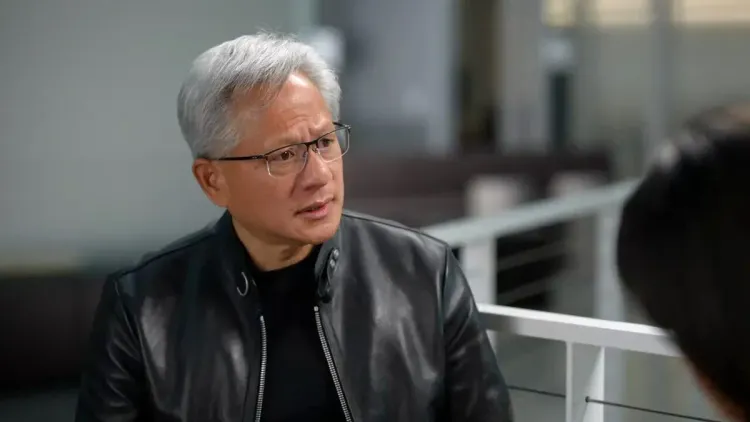
Chip giant Nvidia on Thursday, 11 June 2026 shared remarks from its founder and chief executive Jensen Huang urging professionals worldwide to 'use AI deeply, challenge the status quo, and stay focused on the human purpose behind the work' — framing artificial intelligence as a force multiplier for human intent rather than a replacement for it.
Context
The post, published from Nvidia's official corporate account, distils a philosophy Huang has championed as the company's AI chips have come to dominate global data-centre infrastructure. 'Every job has tasks,' the message reads. 'People give those tasks purpose, and AI can help turn that purpose into greater impact.' The accompanying video elaborates on that thesis, though its specific contents post-date available verified records.
Nvidia has grown from a graphics-card maker into the backbone of the generative-AI economy. Its market capitalisation surged dramatically after 2022 as demand for large language models drove enterprise spending on GPU clusters — hardware that Nvidia overwhelmingly supplies.
Policy Backdrop
Huang's augmentation narrative did not emerge in a vacuum. Since 2022, Nvidia has consistently positioned AI as a tool that amplifies human capability, a framing that aligns with broader industry efforts to address public anxiety over job displacement. The company launched its CUDA platform in 2007, pivoting GPUs toward general-purpose parallel computing and laying the technical groundwork for today's AI infrastructure.
Nvidia's Hopper architecture and the H100 GPU, introduced in 2022, were explicitly designed to serve the generative-AI wave. Simultaneously, the company has had to navigate US export restrictions on advanced AI chips to China, which have shaped its product segmentation and revenue mix — adding a geopolitical dimension to every public statement about AI's global role.
Stakeholders and Impact
The audience for Huang's message spans knowledge workers and enterprise IT teams globally, including a fast-growing base in India, where corporations and startups alike are integrating AI into workflows ranging from software development to customer service. Indian enterprises have been among the more active adopters of Nvidia-powered cloud infrastructure through hyperscale partners.
For workers, the framing offers reassurance: the argument is that AI handles tasks while humans supply meaning and direction. For enterprise buyers, it is also a commercial signal — investing in AI infrastructure is cast as investing in human potential, not in headcount reduction.
What's Next
Nvidia's next GTC (GPU Technology Conference) keynote and upcoming quarterly earnings will be closely watched for concrete product announcements that back up Huang's philosophical positioning. In parallel, legislative developments — including AI accountability bills in the US Congress and the European Union AI Act implementation — will test whether the industry's human-centred rhetoric translates into enforceable standards.
As AI adoption deepens across sectors, the question of how companies measure 'human purpose' against productivity metrics will increasingly define the regulatory and corporate governance conversation.
Point of View
Including India. By casting AI as a purpose multiplier rather than a labour substitute, Nvidia simultaneously addresses regulatory scrutiny and enterprise buyer hesitation. The message also arrives as the EU AI Act moves toward enforcement and US Congress debates AI accountability legislation — contexts in which a chip maker's public philosophy carries real policy weight. For India, where AI skilling and workforce transformation are central to the government's digital economy agenda, Huang's framing dovetails with official narratives around technology-led growth.
NationPress
26 Oct 2026
Frequently Asked Questions
What did Nvidia CEO Jensen Huang say about AI and jobs?
Jensen Huang, speaking through Nvidia's official corporate account, said professionals should 'use AI deeply, challenge the status quo, and stay focused on the human purpose behind the work,' arguing that AI amplifies human intent rather than replacing workers.
Is Nvidia saying AI will not replace jobs?
Nvidia's message frames AI as an augmentation tool: tasks can be handled by AI, but people supply the purpose behind those tasks. The company has maintained this position consistently since the generative-AI boom began in 2022.
What is Nvidia's role in AI infrastructure?
Nvidia's GPUs, particularly the H100 built on the Hopper architecture launched in 2022, power the majority of global AI training workloads. The company's CUDA platform, introduced in 2007, was the technical foundation that made GPU-based AI computing mainstream.
How does Nvidia's AI message affect Indian enterprises?
Indian corporations and startups are active adopters of Nvidia-powered cloud infrastructure. Huang's human-centred AI framing aligns with India's official push for AI-driven economic growth and may encourage further enterprise investment in AI tools that complement existing workforces.
What should I watch for next from Nvidia on AI?
Nvidia's next GTC (GPU Technology Conference) keynote and quarterly earnings reports are the key events to follow for new AI platform announcements. Progress on the EU AI Act and US AI accountability legislation will also shape how Nvidia's public philosophy is tested against regulation.