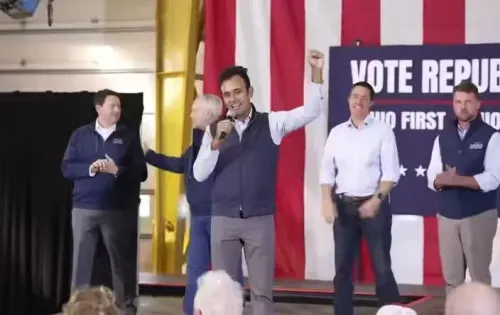
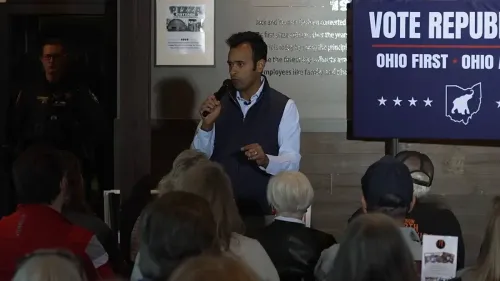
Ramaswamy ties America's 250th to a simple civic duty: vote
Synopsis
Entrepreneur Vivek Ramaswamy invoked the American Revolution on the eve of the US Semiquincentennial to make a pointed case for civic participation, contrasting the Founders' sacrifice with the simple act of voting in the 2026 election cycle.
Key Takeaways
Entrepreneur Vivek Ramaswamy posted a voter-mobilisation message on 26 October 2026 , framing voting as the minimum duty owed in America's 250th anniversary year.
The post contrasts the sacrifice of the US Founding Fathers during the American Revolution with the comparatively easy act of casting a ballot.
The United States Semiquincentennial commemorates 250 years since the Declaration of Independence , with major programming centred on 4 July 2026 .
Congress passed the United States Semiquincentennial Commission Act in 2016 to coordinate anniversary planning.
The anniversary coincides with the 2026 US midterm election cycle , giving civic messaging an immediate electoral context.
Ramaswamy's message names no party, candidate, or policy — making it a broad civic call rather than a partisan appeal.
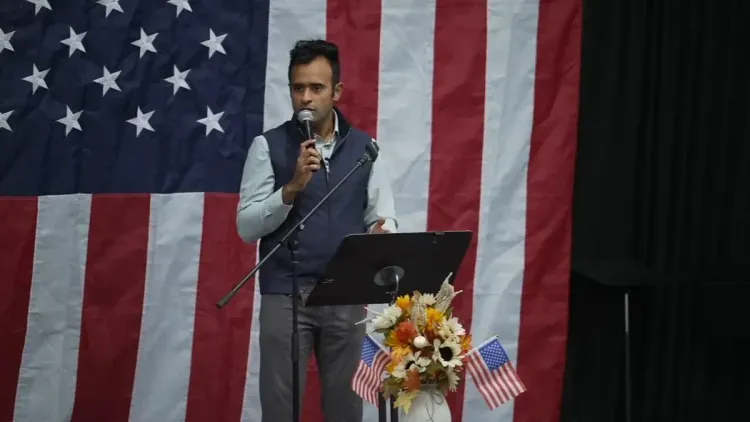
As the United States hurtles toward the most symbolically loaded year in its modern history, entrepreneur Vivek Ramaswamy distilled the entire weight of 250 years of American democracy into a single, blunt instruction — show up and vote.
Posting on Monday, 26 October 2026, Ramaswamy wrote: 'Our Founders fought a revolution. All we have to do on the 250th anniversary is show up and vote.' The message is spare, but the contrast it draws is anything but small.
What the 250th anniversary actually represents
The United States Semiquincentennial — the 250th anniversary of the Declaration of Independence — is one of the most ambitious national commemorations in American history. Congress laid the groundwork as far back as 2016, passing the United States Semiquincentennial Commission Act to begin coordinating the scale of programming expected around 4 July 2026 and beyond.
The milestone arrives during a midterm election cycle, creating a rare overlap between commemorative pageantry and electoral stakes. That convergence is precisely the opening Ramaswamy's post exploits — anniversary as motivation, not just as celebration.
Revolutionary sacrifice versus a ballot box
The rhetorical architecture of the post is deliberately lopsided, and that asymmetry is the point. The US Founding Fathers — George Washington, Thomas Jefferson, John Adams and the broader revolutionary generation — risked execution, property, and family to break from Britain. The ask in 2026 is far simpler: walk into a polling station.
Civic messaging that anchors present-day electoral duty to the cost paid by earlier generations is a familiar instrument across the American political spectrum. What makes Ramaswamy's framing notable is its economy — no policy argument, no opponent named, no ideology flagged. Just the gap between then and now, and an implicit challenge to anyone who would let it go unfilled.
As the bunting goes up and America marks a quarter-millennium of self-governance, the question his post leaves hanging is the only one worth answering: will the people who inherited a revolution bother to use it?
Point of View
This kind of stripped-back civic messaging can travel across ideological lines in a way that issue-specific posts cannot. For Ramaswamy personally, it keeps his public profile active and future-facing without committing him to any specific electoral contest.
NationPress
26 Oct 2026
Frequently Asked Questions
What did Vivek Ramaswamy post about America's 250th anniversary?
Ramaswamy posted on 26 October 2026 urging Americans to vote, writing: 'Our Founders fought a revolution. All we have to do on the 250th anniversary is show up and vote.'
What is the US 250th anniversary or Semiquincentennial?
The United States Semiquincentennial marks 250 years since the Declaration of Independence in 1776. Congress passed the Semiquincentennial Commission Act in 2016 to plan commemorations, with major events centred on 4 July 2026.
Why is the 2026 anniversary politically significant?
The Semiquincentennial falls during the 2026 US midterm election cycle, creating a rare overlap between national commemoration and electoral activity, which political figures across the spectrum have used to frame voting as a civic obligation.
Who is Vivek Ramaswamy?
Vivek Ramaswamy is an American entrepreneur and founder of Strive Asset Management. He ran for the Republican presidential nomination in 2024 and co-led the Department of Government Efficiency advisory effort under the subsequent administration.
Is Ramaswamy's voting post partisan or tied to a specific candidate?
No. The post names no party, candidate, or policy position, making it a broad civic call to participation rather than a targeted partisan appeal.