Nvidia Calls AI Factories the New Industrial Age
Synopsis
Nvidia has framed large-scale GPU clusters as 'AI factories' producing tokens as a commodity, opening a thread on token economics optimisation. The move reflects a broader industry shift from AI capability to AI cost efficiency, with tokens per dollar emerging as the defining metric of the era.
Key Takeaways
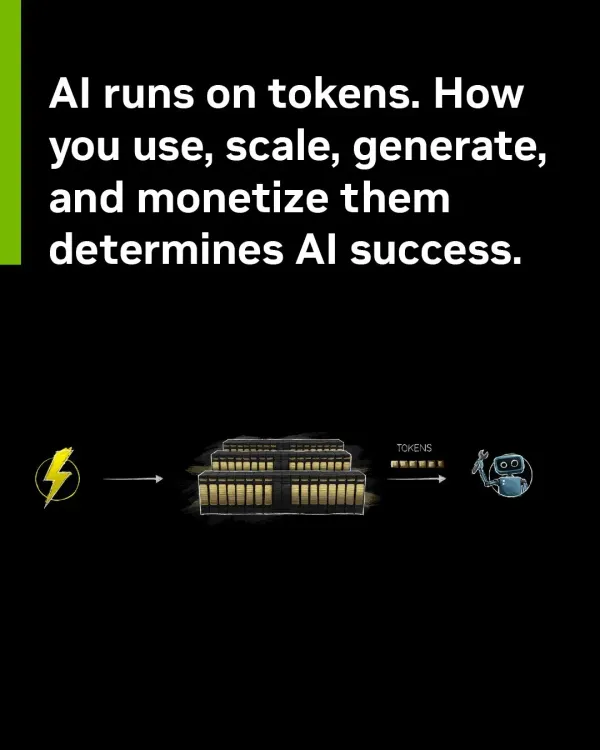
Nvidia posted on 13 August 2026 that 'AI factories are the industrial infrastructure of the AI era.' The company declared tokens the new commodity, repositioning data centres as industrial production facilities.
The post opens a multi-part thread focused on AI token economics optimisation .
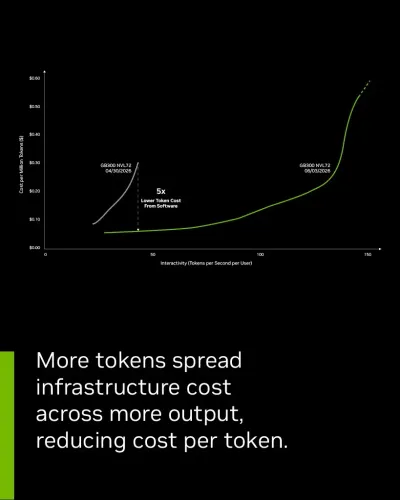
Cost per token has become a critical metric for cloud operators and AI developers running workloads at scale.
The framing reflects a wider industry pivot from building capable AI to running it profitably and efficiently .
The factory floor of the future does not smell like oil or steel — it runs on silicon, and its product is intelligence. Nvidia, the chip giant powering the global AI boom, declared on 13 August 2026 that 'AI factories are the industrial infrastructure of the AI era' and that 'tokens are the new commodity' — opening a detailed thread on how to optimise AI token economics.
From GPU clusters to industrial metaphor
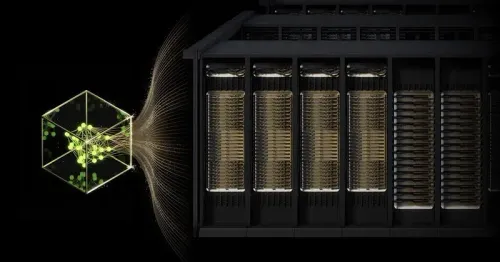
Nvidia has spent years recasting the identity of the modern data centre. Where the old framing saw racks of servers as IT cost centres, Nvidia's language repositions them as production facilities — plants that take in raw compute and output AI tokens at industrial scale. The metaphor is deliberate: factories imply throughput, efficiency targets, and unit economics, the same vocabulary that governs any commodity market from crude oil to semiconductors.
Tokens — the discrete chunks of text, image, or data that large language models process and generate — have quietly become the unit of measure for an entire industry. Every query answered, every image synthesised, every line of code completed costs a countable number of tokens. At hyperscale, the cost per token is the margin.
Why token economics is the next cost battleground
Cloud operators and AI developers are already deep in the arithmetic. Training a frontier model can consume hundreds of billions of tokens; inference at consumer scale multiplies that figure daily. The question Nvidia's thread poses — 'how do you optimise AI token economics?' — is not rhetorical. It points at a genuine pressure point: as AI workloads scale, compute efficiency separates profitable deployments from money-losing ones.
Nvidia's framing aligns with a broader industry shift visible across the 2020s: the conversation has moved from 'can we build capable AI?' to 'can we afford to run it?' Metrics like tokens per second per dollar, model flops utilisation, and inference batch efficiency have moved from research papers into boardroom dashboards.
The thread to watch
The post opens a multi-part thread — the full content of which will detail Nvidia's recommended optimisation techniques, potentially including references to its own tooling and benchmarks. For AI developers and cloud architects, that thread is the deliverable worth tracking. The industrial metaphor is the headline; the engineering specifics are the story.
If tokens truly are the new commodity, the companies that master cost-per-token at scale will hold the same structural advantage that low-cost oil producers held in the twentieth century. Nvidia just rang the opening bell on that market.
Point of View
The company positions its GPU clusters as the default production standard, much as Intel once made clock speed the consumer benchmark. The token-economics conversation also signals that the AI industry is entering a maturation phase: when cost efficiency displaces raw capability as the primary competitive axis, infrastructure vendors with scale advantages — and Nvidia sits atop that hierarchy — tend to consolidate their lead. Developers and cloud operators who internalise this framing will increasingly evaluate every architectural decision through a cost-per-token lens, which is precisely the outcome Nvidia's messaging is designed to produce.
NationPress
28 Sept 2026
Frequently Asked Questions
What is an AI factory according to Nvidia?
Nvidia uses the term 'AI factory' to describe large-scale GPU clusters that function like industrial facilities, taking in compute resources and producing AI tokens at scale, much the way a factory takes in raw materials and outputs a commodity product.
What are AI tokens and why do they matter?
Tokens are the discrete units — chunks of text, image data, or other inputs — that AI models process and generate. At scale, the number of tokens processed per second and the cost per token directly determine whether an AI deployment is economically viable.
What is AI token economics optimisation?
Token economics optimisation refers to improving the efficiency of AI workloads so that each token is produced at the lowest possible compute cost. Techniques typically involve model architecture choices, batching strategies, hardware utilisation, and inference pipeline tuning.
Why is Nvidia talking about token economics?
As AI deployments scale from research to production, cost efficiency has become as important as model capability. Nvidia, as the dominant supplier of AI training and inference hardware, is positioning its platforms as the benchmark for cost-per-token performance.
What should AI developers watch for in Nvidia's thread?
Nvidia's post is the opening of a multi-part thread. Developers and cloud architects should follow the full thread for specific optimisation techniques, tooling recommendations, and any benchmarks Nvidia releases around token throughput and cost efficiency.