CM Himanta contrasts Congress border policy with Modi-era defence push
Synopsis
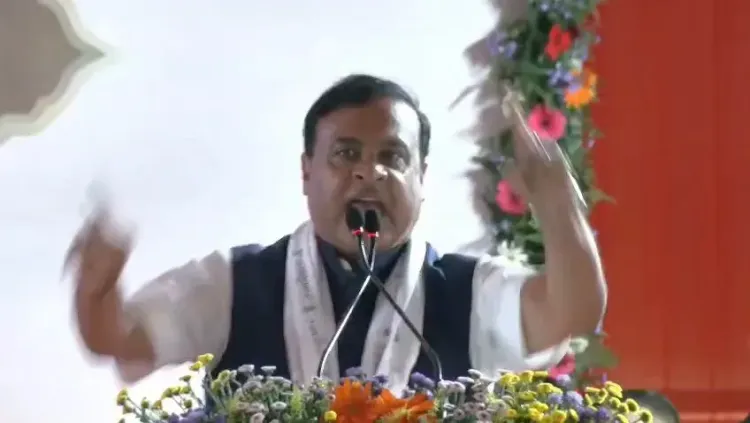
Assam CM Himanta Biswa Sarma fired a pointed political salvo on October 7, 2026, accusing Congress of leaving the army 'to God's mercy' on the China border while crediting PM Modi with building a fearless new India.
Key Takeaways
Assam CM Himanta Biswa Sarma posted a Hindi contrast — 'then' Congress vs 'today' Modi — on border defence on October 7, 2026 .
He used the phrase 'Ram bharose' (left to God's mercy) to accuse Congress of abandoning troops on the China border .
He credited PM Narendra Modi with building a 'new India' that 'fears no one' — a core BJP rhetorical framework since 2014 .
Sarma is convenor of the North-East Democratic Alliance (NEDA) , giving him particular political stakes in China-border narratives.
The post arrives amid continuing India-China boundary engagement, keeping border preparedness a live public issue.
A sharp political contrast — then versus now — landed on Indian timelines on Wednesday, October 7, 2026, when Assam Chief Minister Himanta Biswa Sarma posted a pointed two-line indictment of Congress-era border policy, holding it up against what he described as a fearless new India being built under Prime Minister Narendra Modi.
Posting in Hindi, CM Sarma wrote: 'Tab: Congress ne China seema par sena ko Ram bharose chhod diya. Aaj: Aaradhaniya Modi ji ke netritva mein ek naye Bharat ka nirman ho raha hai, jo kisi se nahin darta.' — ('Then: Congress left the army to fend for itself on the China border. Today: Under the respected leadership of Modi ji, a new India is being built — one that fears no one.')
The 'Ram bharose' charge and its political weight
The phrase 'Ram bharose' — literally 'left to God's mercy' — carries a sting that translates across every Indian language. It is a charge of abandonment, of criminal negligence dressed up as policy. By applying it to India's China border, Sarma is invoking decades of BJP criticism of the Congress government's approach to the 1962 Sino-Indian War and what the party frames as a structural under-investment in border infrastructure and frontline troop readiness across Congress tenures.
Modi government's border build-up as the counter-narrative
The 'new India' framing that Sarma deploys is a core BJP rhetorical pillar, used specifically to signal a break with what the party calls the 'policy of appeasement and unpreparedness' of the UPA years. Since 2014, the central government has pointed to accelerated construction of strategic border roads, forward posts, and infrastructure along the Line of Actual Control (LAC) — particularly in Arunachal Pradesh and Ladakh — as evidence of a hardened posture.
Sarma, as Chief Minister of Assam and convenor of the North-East Democratic Alliance (NEDA), has a direct political stake in the China-border narrative. The north-east sits at the frontline of India's most contested territorial claims, making border security a live electoral and governance issue — not merely a talking point from Delhi.
The timing: border politics back in focus
The post arrives at a moment when India-China boundary management remains a subject of active diplomatic and military engagement, keeping border preparedness in the public conversation. For the BJP and allied parties across the north-east, the contrast between 'then' and 'now' is a reliable mobilising frame — one that Sarma, a prolific and combative communicator, reaches for with precision.
Whether one reads it as a legitimate policy argument or partisan point-scoring, the message is architecturally simple and politically durable: Congress left soldiers exposed; Modi did not. That binary is the entirety of the argument — and its brevity is deliberate.
In north-east Indian politics, where memories of conflict, insurgency, and border anxiety are generational, that message lands differently than it does in a drawing room in Delhi. Sarma knows his audience.
Point of View
Sarma is not simply amplifying a Delhi talking point; he is reinforcing it in a region where border anxiety has direct lived resonance. The post's brevity is strategic: in the social-media information environment, a two-line binary outperforms a policy white paper. It is combative politics, but it maps onto a real fault line in how the two parties have historically framed national security.
NationPress
7 Oct 2026
Frequently Asked Questions
What did Assam CM Himanta Biswa Sarma say about Congress and the China border?
CM Sarma accused Congress of leaving the Indian army 'to God's mercy' on the China border, using the Hindi phrase 'Ram bharose,' and contrasted that with what he called PM Modi's 'fearless new India.'
What does 'Ram bharose' mean in Sarma's post?
'Ram bharose' is a Hindi idiom meaning 'left to the mercy of God' — implying total abandonment or negligence. Sarma used it to charge that Congress left frontline troops without adequate support or preparation on the China border.
Why is Himanta Biswa Sarma significant in India-China border politics?
As Chief Minister of Assam and convenor of the North-East Democratic Alliance (NEDA), Sarma has direct political and governance stakes in border security, since the north-east region sits adjacent to India's most actively contested territorial boundaries with China.
What is the BJP's 'new India' narrative on border defence?
Since 2014, the BJP has argued that Modi governments significantly accelerated border road construction, forward military infrastructure, and strategic readiness along the Line of Actual Control, framing this as a decisive break from Congress-era under-investment.
When did Himanta Biswa Sarma post this statement on the China border?
Sarma posted the statement on Wednesday, October 7, 2026, on the social media platform X.