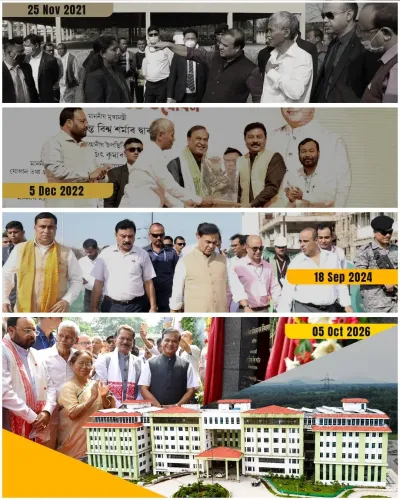
CM Himanta unveils Maharaja Naranarayan statue in Bongaigaon
Synopsis
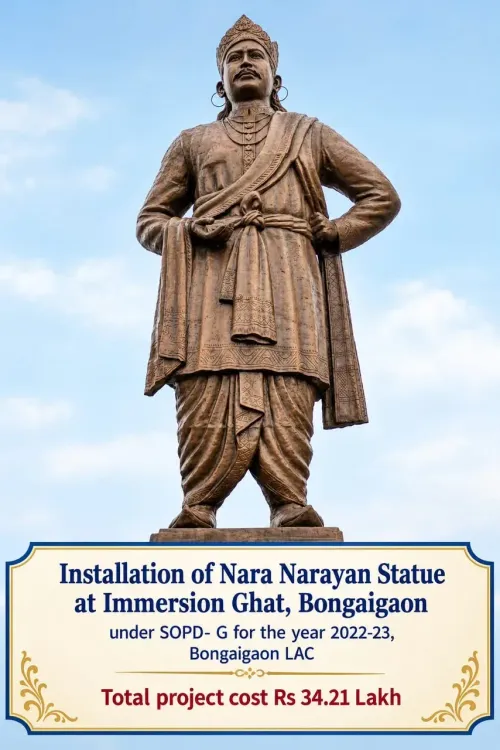
Assam CM Himanta Biswa Sarma unveiled a statue of Maharaja Naranarayan in Bongaigaon on October 5, 2026, commemorating the 16th-century Koch king whose patronage of saint Srimanta Sankardeva gave Assamese literature and culture its golden age.
Key Takeaways
Assam CM Himanta Biswa Sarma unveiled the statue of Maharaja Naranarayan in Bongaigaon on October 5, 2026 .
Naranarayan was a Koch dynasty king who ruled in the sixteenth century and is credited with a golden age of Assamese literature and culture.
He was the royal patron of Mahapurush Srimanta Sankardeva , the saint-scholar whose Vaishnavite movement remains the cornerstone of Assamese cultural identity.
Naranarayan oversaw large-scale temple rebuilding across the Brahmaputra valley during his reign.
The unveiling in Bongaigaon — within the Koch kingdom's historical heartland — continues the BJP-led government's programme of honouring pre-colonial Assamese icons.
A medieval king who gave Assam its cultural spine stepped back into the light on Monday — this time in bronze. Assam Chief Minister Himanta Biswa Sarma unveiled a statue of Maharaja Naranarayan in Bongaigaon on Monday, October 5, 2026, honouring a Koch dynasty ruler whose reign is remembered as a golden age for Assamese literature, temple culture, and spiritual patronage.
The Koch king who shaped Assam's cultural identity
Maharaja Naranarayan ruled the Koch Kingdom during the sixteenth century and is considered one of the most consequential monarchs in the history of the Brahmaputra valley. His reign saw the large-scale rebuilding of temples across the region — a programme of religious and architectural revival that anchored Assamese Hindu identity at a time of significant political turbulence across the subcontinent.
Most significantly, Naranarayan is celebrated as the royal patron of Mahapurush Srimanta Sankardeva, the saint-scholar-playwright whose Vaishnavite Ek Saran Nam Dharma movement became the defining spiritual and cultural force of Assamese civilisation. Sankardeva's literature, music, and drama — the tradition of Bhaona (devotional theatre) and Borgeet (lyrical hymns) — flourished under royal shelter. Without Naranarayan's patronage, historians argue, that literary flowering might never have taken root.
Why Bongaigaon, and why now
Bongaigaon, a district in western Assam, sits within the historical heartland of the Koch kingdom. The choice of location connects the commemorative act directly to the geography Naranarayan once governed. CM Sarma described the monarch as a 'visionary Koch king' and expressed hope that 'his legacy inspire generations' — framing the unveiling as a cultural investment in Assamese youth as much as a historical tribute.
The statue installation fits a broader pattern of the BJP-led Assam government investing in the memorialisation of pre-colonial regional icons — a politics of cultural heritage that runs alongside infrastructure and welfare programmes. Naranarayan sits squarely in that tradition: a figure who is both historically significant and non-controversial across Assam's diverse communities.
Srimanta Sankardeva's enduring shadow
Any tribute to Naranarayan is inevitably also a tribute to Srimanta Sankardeva, whose work the king protected. Sankardeva is not merely a historical figure in Assam — he is a living cultural reference, his Satras (monastic institutions) still active, his compositions still sung. Invoking the king who sheltered him is a way of anchoring the present administration in a lineage of cultural stewardship that resonates deeply across the state.
Centuries after his reign, Maharaja Naranarayan now stands in Bongaigaon — a reminder that the foundations of Assamese literature were laid not just by saints and poets, but also by kings who knew what was worth protecting.
Point of View
Assamese, and Vaishnavite traditions, making him broadly acceptable across the state's diverse communities. CM Sarma's explicit linkage of Naranarayan to Srimanta Sankardeva is politically astute: Sankardeva's institutions remain socially influential, and associating the ruling dispensation with his patron carries soft-power weight. Expect more such memorialisation efforts ahead of the 2026 Assam Assembly elections cycle.
NationPress
6 Oct 2026
Frequently Asked Questions
Who was Maharaja Naranarayan?
Maharaja Naranarayan was a sixteenth-century king of the Koch dynasty who ruled over a vast kingdom centred in what is today Assam and parts of Bengal. He is celebrated for rebuilding temples, patronising art and literature, and most notably sheltering the Vaishnavite saint-scholar Srimanta Sankardeva.
Where was the Maharaja Naranarayan statue unveiled?
The statue was unveiled in Bongaigaon , a district in western Assam, which lies within the historical territory of the Koch kingdom that Naranarayan once ruled.
What is the connection between Maharaja Naranarayan and Srimanta Sankardeva?
Naranarayan was the royal patron of Srimanta Sankardeva, the 15th-16th century saint whose Ek Saran Nam Dharma movement gave Assam its defining spiritual and literary tradition. The king's protection allowed Sankardeva's literature, music, and drama to flourish.
Why did CM Himanta Biswa Sarma unveil the Naranarayan statue?
CM Sarma unveiled the statue to honour Naranarayan as a 'visionary Koch king' who gave Assamese culture its golden age. The act is also consistent with the Assam government's broader effort to memorialise significant pre-colonial regional figures.
What is the Koch kingdom's significance in Assam's history?
The Koch kingdom, which flourished from the early sixteenth century, was one of the most powerful states in northeastern India. Under Naranarayan, it became a major centre of temple construction and literary patronage, shaping the cultural contours of modern Assam.