CM Himanta Marks World Blood Donor Day, Urges Regular Donation
Synopsis
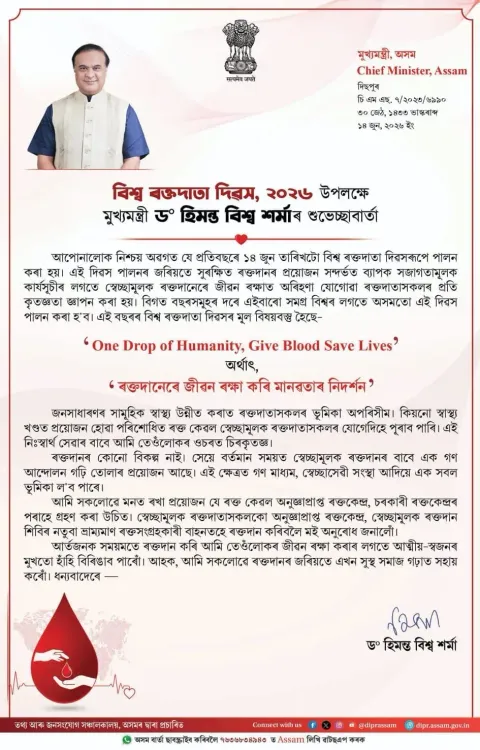
On World Blood Donor Day, 14 June 2026, the Chief Minister's Office of Assam shared CM Himanta Biswa Sarma's appeal to voluntary blood donors, thanking them for their selfless contribution and urging citizens to donate regularly to build a healthier, more compassionate society.
Key Takeaways
The Chief Minister's Office of Assam marked World Blood Donor Day on 14 June 2026 with an official post from CM Himanta Biswa Sarma .
CM Himanta expressed gratitude to voluntary blood donors and highlighted the life-saving impact of each donation.
World Blood Donor Day is a WHO -established annual observance dating to 2005 , held every 14 June .
India's National Blood Policy (2002) has long prioritised voluntary, unpaid donation over replacement donation systems.
Assam has aligned with national blood safety drives through its state blood transfusion service and district-level camps.
District administrations in Assam are expected to organise follow-up donation camps in the coming weeks.
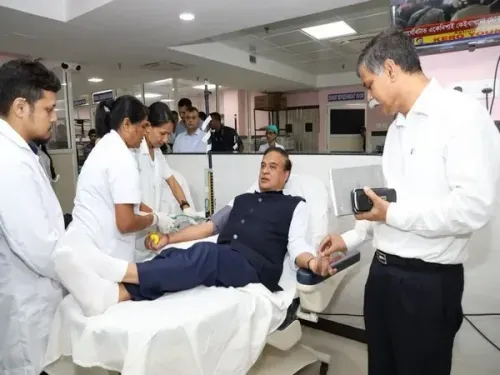
The Chief Minister's Office of Assam on Sunday, 14 June 2026 shared a message from Chief Minister Dr. Himanta Biswa Sarma on World Blood Donor Day, expressing gratitude to voluntary blood donors across the state and encouraging citizens to donate blood regularly.
Context
World Blood Donor Day is observed every year on 14 June, a date established by the World Health Organization (WHO) in 2005 to recognise the contribution of unpaid voluntary donors and raise awareness about the need for safe blood supplies. This year's observance saw state governments across India use official channels to amplify the message.
The CMO's post described blood donation as 'a gift of life, a gesture of hope,' with CM Himanta underlining the 'life-saving impact of every donation' and calling on people to contribute towards 'a healthier, more caring and compassionate society.'
Policy Backdrop
India's National Blood Policy, first adopted in 2002 and revised subsequently, has long promoted voluntary, unpaid blood donation as the cornerstone of a safe national blood supply. The National AIDS Control Organisation (NACO)'s blood safety programme has supported state-level donation camps for decades, with Assam participating in these national drives.
A key policy goal has been reducing reliance on replacement donations — where a patient's family members donate in exchange for blood — and shifting to a system built entirely on voluntary donors. State blood transfusion services have been central to this effort, running collection camps through district administrations and partnering with civil society organisations.
CM Himanta Biswa Sarma, who served as Assam's Health Minister before becoming Chief Minister in 2021, has maintained a visible focus on public health awareness campaigns, making this appeal consistent with his established approach to health communication.
Stakeholders and Impact
Voluntary blood donors and transfusion-dependent patients are the primary stakeholders in this public health ecosystem. Patients undergoing surgery, cancer treatment, or managing conditions such as thalassaemia and sickle cell anaemia depend directly on a steady, safe blood supply.
Official messaging from the Chief Minister's Office on occasions such as this serves to normalise donation as a civic act and can motivate first-time donors. State governments in India have consistently used WHO health observances as platforms to drive citizen participation in public health goals.
What's Next
The immediate follow-through typically involves district administrations in Assam organising blood donation camps in the days surrounding 14 June. Monitoring the state blood transfusion service's collection volumes in the coming months will indicate whether the awareness push translates into measurable increases in voluntary donations.
As India works toward fully voluntary blood collection systems, sustained state-level advocacy — backed by organised camp infrastructure — will remain essential to closing the gap between supply and clinical demand.
Point of View
Whose political identity is closely tied to health administration from his tenure as Health Minister, such messaging reinforces a consistent personal brand. More broadly, the post fits a nationwide pattern where state governments leverage WHO health days to substitute for — or supplement — ground-level outreach when budgets and logistics are constrained. The real test of impact lies not in the post itself but in whether district-level camps follow and whether voluntary donation volumes in Assam show a measurable uptick.
NationPress
20 Sept 2026
Frequently Asked Questions
When is World Blood Donor Day celebrated?
World Blood Donor Day is observed every year on 14 June , a date chosen by the WHO in 2005 to honour voluntary unpaid blood donors worldwide.
What did Assam CM Himanta Biswa Sarma say on World Blood Donor Day 2026?
CM Himanta Biswa Sarma expressed gratitude to voluntary blood donors, called each donation a 'gift of life,' and urged citizens to donate blood regularly to help build a healthier and more compassionate society.
Why is voluntary blood donation important in India?
India's National Blood Policy promotes voluntary, unpaid donation to ensure a safe and adequate blood supply, reducing dependence on replacement donations which carry higher safety risks for patients.
What is Assam's role in national blood donation drives?
Assam participates in national blood safety programmes supported by NACO , running state blood transfusion services and district-level donation camps aligned with central health policy goals.
Who is Himanta Biswa Sarma?
Himanta Biswa Sarma is the Chief Minister of Assam since 2021 . Before becoming CM, he served as the state's Health Minister and has maintained a strong focus on public health awareness.