CM Himanta Marks World Blood Donor Day, Highlights Assam's Blood Banking Push
Synopsis
On World Blood Donor Day, 14 June 2026, Assam Chief Minister Himanta Biswa Sarma praised voluntary blood donors and highlighted the state's ongoing efforts to strengthen blood banking facilities and awareness, situating Assam within India's broader push for voluntary, safe blood donation.
Key Takeaways
Himanta Biswa Sarma , Chief Minister of Assam , marked World Blood Donor Day on 14 June 2026 by appreciating voluntary blood donors nationwide.
He reaffirmed that Assam is actively working to improve blood banking facilities and run awareness initiatives.
World Blood Donor Day has been observed globally every 14 June since 2004 , led by the WHO to promote voluntary, unpaid donation.
The Assam State Blood Transfusion Council (ASBTC) under NACO is the nodal state body for blood bank regulation and donor promotion.
India's National Blood Policy (2002) and subsequent national health programmes have driven the shift from replacement to voluntary blood donation across states.
Improved blood banking capacity in Assam is also linked to the demands of the Ayushman Bharat health assurance rollout in the Northeast.
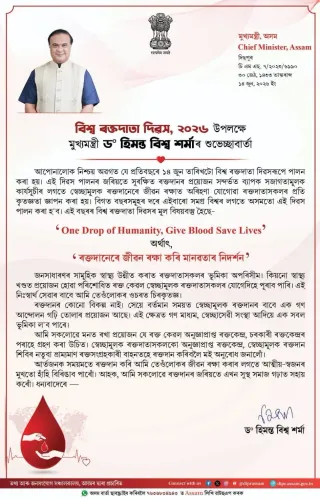
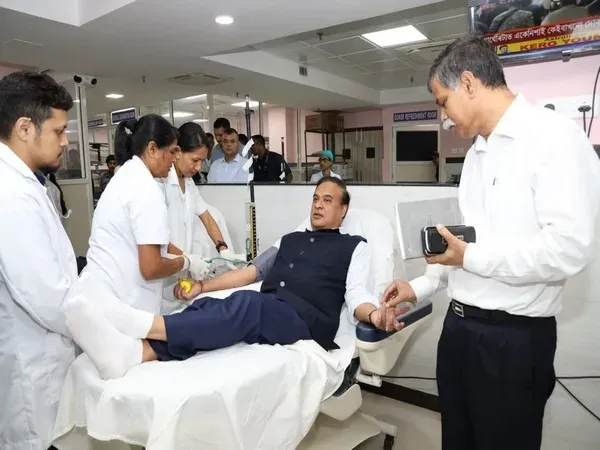
Assam Chief Minister Himanta Biswa Sarma on Sunday, 14 June 2026 — World Blood Donor Day — extended his appreciation to voluntary blood donors across the country, reaffirming the state government's commitment to strengthening blood banking infrastructure and public awareness in Assam.
Context
World Blood Donor Day is observed every year on 14 June, a date chosen to mark the birthday of Karl Landsteiner, the scientist who discovered the ABO blood group system. The global observance, initiated by the World Health Organization (WHO) in 2004, is dedicated to thanking voluntary, unpaid donors and raising awareness about the need for safe blood supplies.
In his post, CM Sarma wrote: 'Donate blood, save lives!' He added that Assam 'continues to strengthen its healthcare ecosystem through improved blood banking facilities and awareness initiatives,' signalling an ongoing administrative focus on the state's transfusion network.
Policy Backdrop
India's push for a robust voluntary blood donation system dates to the National Blood Policy of 2002, which sought to ensure safe, adequate blood supplies through a licensed network of blood banks nationwide. Subsequent phases of the National AIDS Control Programme — particularly Phase III (2007–2012) — expanded voluntary donation campaigns and modernised blood banking infrastructure across states, including Assam.
The Assam State Blood Transfusion Council (ASBTC), functioning under the National AIDS Control Organisation (NACO), is the nodal body responsible for regulating blood banks and promoting voluntary donation within the state. Northeastern states have historically received targeted support under the National Health Mission to overcome geographic barriers and address comparatively lower blood collection rates.
Efforts to upgrade blood banking capacity also align with the broader rollout of Ayushman Bharat, India's flagship health assurance scheme, which places increased demand on secondary and tertiary care services — including reliable blood supplies — across all states.
Stakeholders and Impact
The most immediate beneficiaries of improved blood banking are transfusion-dependent patients — including those undergoing surgery, cancer treatment, or managing conditions such as thalassaemia and sickle cell anaemia. Voluntary donors, donor-motivation organisations, and district-level health infrastructure in Assam are all central to the supply chain.
For the state government, public messaging on occasions such as World Blood Donor Day serves a dual purpose: honouring existing donors and encouraging first-time donations. Awareness drives coordinated through ASBTC and district health offices are a key instrument for bridging the gap between demand and voluntary supply.
What's Next
Observers will watch Assam's next annual health budget for specific allocations toward blood-bank equipment, mobile collection vans, and community outreach. At the national level, targets set by the National Blood Transfusion Council for voluntary donation will shape how states, including Assam, calibrate their collection drives through the remainder of 2026.
As India works to shift fully from replacement to voluntary donation — a transition that remains uneven across states — the political attention given to blood banking by state leaders such as CM Sarma can translate into administrative priority and budget visibility for a healthcare function that is often under-resourced.
Point of View
But it carries policy undertones worth noting: his explicit mention of 'improved blood banking facilities' signals that the Assam government is framing infrastructure investment — not just donor motivation — as a health priority. Northeastern states have long lagged in voluntary blood collection rates, and political visibility on this issue can translate into budget line items. The post also fits a broader pattern of BJP-governed states using health observances to reinforce governance credentials ahead of electoral cycles. The real test will be whether the rhetorical commitment is matched by measurable allocations in Assam's next health budget.
NationPress
14 Sept 2026
Frequently Asked Questions
Why is World Blood Donor Day celebrated on 14 June?
World Blood Donor Day is observed on 14 June each year to commemorate the birthday of Karl Landsteiner , who discovered the ABO blood group system. The WHO established the observance in 2004 to thank voluntary donors and promote safe blood donation globally.
What did Assam CM Himanta Biswa Sarma say on World Blood Donor Day 2026?
CM Himanta Biswa Sarma extended appreciation to all voluntary blood donors and stated that Assam is strengthening its healthcare ecosystem through improved blood banking facilities and public awareness initiatives.
What is the Assam State Blood Transfusion Council?
The Assam State Blood Transfusion Council (ASBTC) is a state-level body functioning under NACO that regulates blood banks and promotes voluntary blood donation in Assam .
What is India's National Blood Policy?
India's National Blood Policy , adopted in 2002 , aims to ensure a safe and adequate supply of blood by building a licensed network of blood banks and encouraging a shift from replacement to voluntary donation nationwide.
How does blood banking connect to Ayushman Bharat in Assam?
Reliable blood supply is essential for secondary and tertiary care services that Ayushman Bharat covers. As the scheme expands in Assam and other northeastern states, demand on blood banks rises, making infrastructure upgrades a practical necessity alongside the policy rollout.