CM Himanta Vows Zero Tolerance on Harassment of Women

Synopsis
Assam Chief Minister Himanta Biswa Sarma declared on 16 October 2026 that he will not tolerate any harassment of women, pledging immediate personal action on every complaint. The post reinforces his pattern of direct, social-media-driven governance interventions on women's welfare.
Key Takeaways
Himanta Biswa Sarma posted a personal zero-tolerance pledge against harassment of women on 16 October 2026 .
The Chief Minister stated he takes 'immediate action' on every complaint that reaches him directly.
The message was in Hindi, addressed to women as 'my sisters', and accompanied by a video.
The post fits Sarma's established pattern of using social media to signal rapid, direct governance intervention.
Assam's Orunodoi scheme (launched 2020–21 ) providing monthly financial assistance to women is a key plank of the state government's women-welfare record.
Concrete accountability will hinge on Assam's crime statistics against women and formal complaint-redressal mechanisms going forward.
Zero tolerance — that is the line Assam Chief Minister Himanta Biswa Sarma drew on Friday, 16 October 2026, posting a direct, personal pledge to every woman in the state: no complaint of harassment will go unaddressed on his watch.
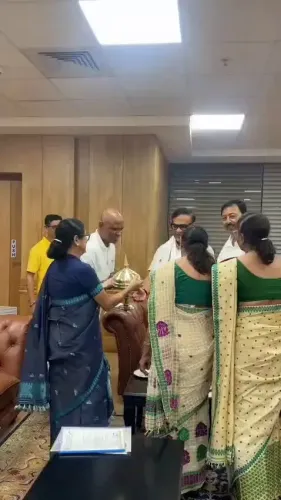
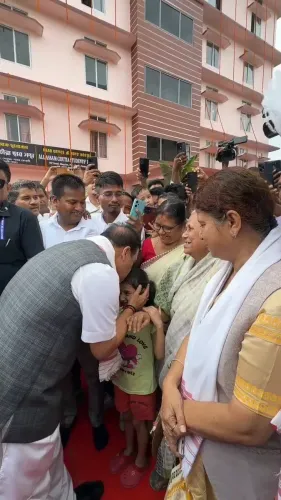
Writing in Hindi, the Chief Minister stated, 'मेरे बहनो के प्रति कोई भी उत्पीड़न मुझे मंज़ूर नहीं है' — 'I will not tolerate any harassment against my sisters. If any such complaint reaches me, I take immediate action and try my best to help them.' The post, accompanied by a video, was addressed in the first person — a deliberate choice that frames the Chief Minister as a directly accessible point of redressal, not a remote administrator.
Sarma's Direct-Intervention Playbook
This is not new territory for Himanta Biswa Sarma. Since taking office as Chief Minister in 2021, he has built a governance identity around rapid, visible responses to public grievances — frequently bypassing formal bureaucratic channels in favour of social-media-signalled action. The pattern is consistent: a post goes up, an intervention is announced or implied, and the message reaches constituents directly. It is responsive governance as political brand.
Assam's record on women's welfare has been a priority plank for the state government. The Orunodoi scheme, launched around 2020–21, provides monthly direct financial assistance to eligible women across the state — one of the flagship programmes that underpins the BJP government's outreach to women voters and beneficiaries. The Chief Minister's latest statement fits squarely within that broader framing.
Why This Moment Matters for Women in Assam
The pledge carries practical weight beyond political messaging. By saying complaints that reach him personally will get 'immediate action', Sarma is effectively positioning his office as an escalation channel — useful for women whose complaints may have stalled at lower administrative levels. It also raises the stakes: public promises of swift action create accountability that can be measured against actual crime data and complaint-resolution outcomes.
Assam has seen sustained government emphasis on law and order, and women's safety has repeatedly been cited as a benchmark issue in the state's governance narrative. What the Chief Minister's office does with individual complaints — whether through police escalation, district administration alerts, or dedicated helpline mechanisms — will determine whether the pledge translates into systemic change or remains a signal of intent.
The watch now shifts to Assam's crime statistics on offences against women and any formal orders the state may issue on complaint-redressal mechanisms — the hard data that will either validate or challenge the promise made here.
Point of View
Social-media-first governance — bypassing institutional channels to create a direct, emotionally resonant line between the Chief Minister and constituents. It serves a dual function: reassuring women voters ahead of any electoral cycle while raising the political cost of visible failures in women's safety. The pledge also deepens the BJP's strategic narrative in Assam of a 'responsive strongman' executive, a model that has proven electorally effective in the Northeast. The real test is whether it produces measurable changes in complaint resolution rates or remains a powerful but unverifiable assertion.
NationPress
17 Oct 2026
Frequently Asked Questions
What did Assam CM Himanta Biswa Sarma say about women's harassment?
He stated he will not tolerate any harassment against women and that he takes immediate action on every complaint that reaches him, personally helping the complainants.
When did CM Himanta make this pledge on women's safety?
The statement was posted on Friday, 16 October 2026 , on his official X account.
What is the Orunodoi scheme in Assam?
The Orunodoi scheme is an Assam government programme launched around 2020–21 that provides monthly direct financial assistance to eligible women in the state.
How can women in Assam file complaints of harassment directly with the CM?
The Chief Minister's post implies complaints that reach his office — including through social media — will receive immediate attention, though the post did not specify a formal helpline or portal.
What is Himanta Biswa Sarma's record on women's welfare in Assam?
Since becoming Chief Minister in 2021 , Sarma's government has run the Orunodoi financial assistance scheme for women and has repeatedly emphasised rapid administrative response on crimes against women as a governance priority.