CM Himanta's Child Marriage Crackdown Already Underway in Assam

Synopsis
Assam Chief Minister Himanta Biswa Sarma declared on 27 October 2026 that the state's child marriage enforcement drive is already active, pre-empting an anticipated November launch and signalling uninterrupted legal action across the state.
Key Takeaways
CM Himanta Biswa Sarma announced on 27 October 2026 that Assam's child marriage crackdown has already begun, ahead of an expected November start.
Assam has historically high child marriage rates, particularly in districts such as Dhubri and Barpeta .
The state's enforcement drive is conducted under the Prohibition of Child Marriage Act , with police-led operations backed by district monitoring.
A landmark crackdown in 2023 saw mass registrations of cases across Assam, targeting grooms, parents, and facilitators alike.
Sarma's early-start signal is aimed at both offenders and local officials, removing any expectation of a grace period before enforcement begins.
Assam's child marriage crackdown did not wait for a scheduled deadline. Chief Minister Himanta Biswa Sarma signalled on Tuesday, 27 October 2026 that enforcement operations are already in motion — well ahead of what many had expected to be a November start date — posting on X with characteristic bluntness: 'When you think Child Marriage crackdown will start from November, but it has already started.'
Assam's Long Fight Against Child Marriage
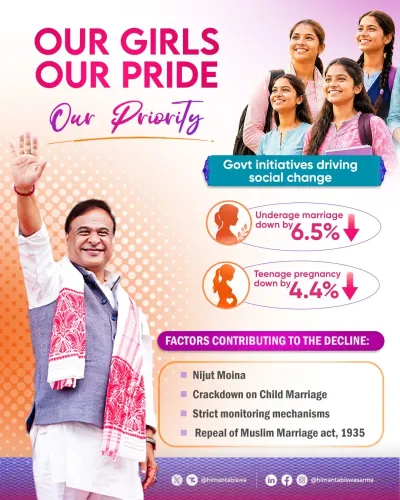
Assam has carried one of the country's highest child marriage burdens, with districts such as Dhubri and Barpeta historically recording rates well above the national average. The state's battle against the practice predates the current government, but it sharpened considerably after Sarma took office in May 2021. His administration built a reputation for aggressive, police-led enforcement under the Prohibition of Child Marriage Act — combining mass arrests of accused facilitators with district-level monitoring and community awareness drives.
The defining moment came in 2023, when Assam launched one of the most publicised state-level crackdowns on child marriage in recent memory, drawing national attention and fierce debate about the balance between legal enforcement and social sensitisation. Thousands of cases were registered across the state in a matter of weeks, targeting not just grooms but also parents, priests, and others alleged to have facilitated illegal unions.
The Signal in the Timing
Sarma's post carries a deliberate message: enforcement is not a calendar event, it is a continuous posture. By publicly noting that operations began before any announced date, the Chief Minister is putting would-be offenders — and local officials — on notice that there is no grace period. The accompanying video in the post underscores that ground-level action, not just policy announcements, is already visible.
For a state government that has staked significant political capital on tackling child marriage as both a legal and social reform priority, the early start is a statement of institutional intent. Adolescent girls in rural Assam — the primary victims of child marriage — remain the central stakeholders in whatever enforcement numbers eventually emerge from Assam Police's monthly statistics.
The specifics of the current drive — case counts, districts targeted, and the exact scope of operations — are yet to be confirmed through official statements. But the signal from the top is unmistakable: in Assam, the crackdown season has no off-switch.
Point of View
The government keeps child marriage enforcement in the public eye between formal drive announcements. The approach reflects a broader BJP-governed-state playbook of combining strict law enforcement with visible political ownership of social issues. Whether early enforcement translates into sustained reduction in prevalence — rather than a spike in registrations followed by a lull — will be the harder metric to watch.
NationPress
27 Oct 2026
Frequently Asked Questions
Has Assam started its child marriage crackdown in 2026?
Yes. Chief Minister Himanta Biswa Sarma confirmed on 27 October 2026 that enforcement operations are already underway, ahead of what had been anticipated as a November start.
What law does Assam use to prosecute child marriage cases?
Assam enforces the Prohibition of Child Marriage Act, under which police can register cases against grooms, parents, and anyone else who facilitates an illegal marriage involving a minor.
Which districts in Assam have the highest child marriage rates?
Districts such as Dhubri and Barpeta have historically recorded child marriage prevalence rates significantly above the national average, making them focal points of state enforcement drives.
What happened during Assam's 2023 child marriage crackdown?
In 2023, the Assam government launched a sweeping police-led drive that registered thousands of cases within weeks, targeting not only grooms but also parents, priests, and other facilitators of child marriages.
Why did CM Himanta Sarma announce the crackdown has 'already started'?
By signalling an early start publicly, Sarma aims to deter potential offenders and put local officials on notice that no grace period exists before enforcement begins — using the announcement itself as a preventive message.