CM Himanta Flags 6.5% Drop in Underage Marriages in Assam
Synopsis
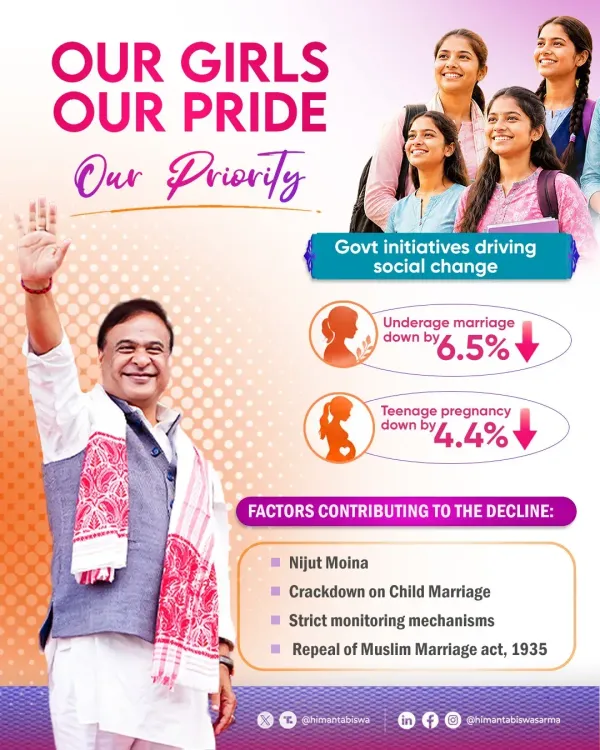
Assam Chief Minister Himanta Biswa Sarma has cited a 6.5 per cent decline in underage marriages and a fall in teenage pregnancies, crediting state government policies. He reaffirmed the administration's commitment to empowering women and girls as a continuing mission.
Key Takeaways
Assam CM Himanta Biswa Sarma announced a 6.5 per cent decline in underage marriages in the state.
A concurrent fall in teenage pregnancies has also been recorded, according to the Chief Minister.
The progress is attributed to 'numerous policy measures' by the Assam government under CM Sarma.
The state's efforts build on the national Beti Bachao Beti Padhao scheme launched in 2015 and the Prohibition of Child Marriage Act .
Assam has historically had elevated child marriage rates, making the reported decline particularly significant for the state's demographic outlook.
CM Sarma pledged the women's empowerment mission will continue, signalling it remains a core governance priority.
Assam Chief Minister Himanta Biswa Sarma on Friday, June 5, 2026, highlighted a 6.5 per cent decline in underage marriages and a concurrent fall in teenage pregnancies in the state, attributing the progress to a series of policy interventions by his government aimed at empowering women and girls.
Context
In a post on X, CM Sarma wrote: 'We have been relentless in our pursuit of empowering Assam's daughters and making them drivers of change and growth.' He cited the 6.5 per cent fall in underage marriages and the decline in teenage pregnancies as direct outcomes of multiple government measures, and pledged that 'this mission will continue.'
Assam has historically recorded among the higher rates of child marriage in India, making such a reported decline a significant claim. Adolescent girls and rural households across the state are the primary beneficiaries of these interventions.
Policy Backdrop
The state government's push sits within a broader national framework. The Beti Bachao Beti Padhao scheme, launched centrally in 2015, was designed to improve the child sex ratio, prevent child marriage, and promote the education of girls across India, including Assam.
Assam governments since 2016 have layered state-level schemes on female literacy, health access, and financial assistance to women on top of central programmes. These efforts also draw on the legislative foundation provided by the Prohibition of Child Marriage Act. The combined approach reflects a wider pattern across BJP-ruled northeastern states seeking to improve gender and demographic indicators.
Under CM Sarma, who has led the state since 2021, the administration has pursued enforcement measures alongside welfare schemes, including high-profile drives against child marriage that drew national attention.
Stakeholders and Impact
The reported improvement, if sustained and corroborated by independent survey data, would represent meaningful progress for adolescent girls in Assam, particularly in rural districts where child marriage rates have traditionally been highest. Early marriage is closely linked to school dropout rates, maternal health complications, and cycles of poverty.
A reduction in teenage pregnancies alongside the fall in underage marriages suggests the policy measures may be having compounding health and educational benefits for young women in the state. Civil society organisations working on women's rights and child welfare in the region will be watching subsequent health survey data closely for corroboration.
What's Next
The government has signalled that its focus on women's empowerment will remain a sustained policy priority rather than a one-time campaign. Independent verification of the 6.5 per cent figure is expected to come from forthcoming rounds of the National Family Health Survey or Assam-specific health data releases.
The trajectory of these indicators will be a key metric for assessing the on-ground effectiveness of the state's combined legislative, enforcement, and welfare approach to eliminating child marriage in Assam.
Point of View
Using a specific statistical claim to anchor a broader welfare narrative ahead of what remains a competitive political environment in the northeast. The emphasis on daughters as 'drivers of change and growth' frames a law-enforcement-heavy campaign — Assam's anti-child-marriage drives drew controversy for their mass-arrest approach — within a softer empowerment register. Connecting state action to measurable demographic outcomes is a deliberate attempt to shift the conversation from procedural criticism to policy results. Whether independent survey rounds validate the 6.5 per cent figure will determine how durable this political dividend proves to be.
NationPress
21 Oct 2026
Frequently Asked Questions
What did Assam CM Himanta Biswa Sarma say about child marriage?
CM Himanta Biswa Sarma stated on June 5, 2026, that government policies have led to a 6.5 per cent decline in underage marriages and a fall in teenage pregnancies in Assam, and pledged the mission would continue.
What is the 6.5% decline in underage marriages in Assam?
According to CM Sarma, Assam has recorded a 6.5 per cent fall in underage marriages as a result of multiple policy measures introduced by his government since 2021.
What schemes is Assam using to reduce child marriage?
Assam's efforts draw on the national Beti Bachao Beti Padhao scheme launched in 2015, state-level programmes on female literacy and financial assistance, and the legislative framework of the Prohibition of Child Marriage Act.
Has Assam taken action against child marriage before?
Yes. The Assam government under CM Sarma has conducted high-profile enforcement drives against child marriage, which attracted national attention, alongside welfare and education-focused schemes for adolescent girls.
How will the decline in child marriages in Assam be independently verified?
Independent corroboration is expected from forthcoming rounds of the National Family Health Survey or Assam-specific health data releases that track child marriage and teenage pregnancy trends over time.