CM Himanta Flags Sharp Drop in Assam MMR, IMR Over 5-6 Years

Synopsis
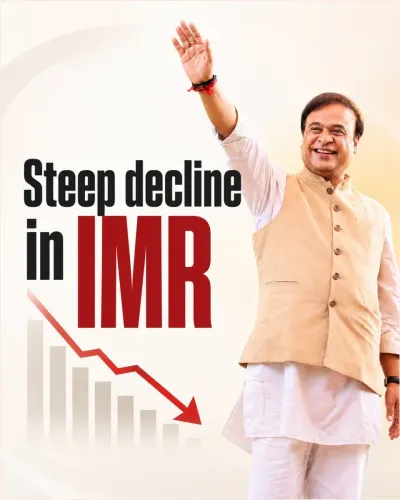
Assam Chief Minister Himanta Biswa Sarma says the state has drastically cut its Maternal Mortality Rate and Infant Mortality Rate from historic highs in the 400s, nearly wiped out child marriage, and contained its Total Fertility Rate — all within the last five to six years.
Key Takeaways
Assam CM Himanta Biswa Sarma claimed on 13 June 2026 that the state's MMR and IMR have fallen drastically from highs 'in the 400s.' He stated that child marriage has been 'almost wiped out' in Assam .
The Total Fertility Rate (TFR) has been 'contained,' according to Sarma .
The improvements were attributed to health-sector work done over the last 5-6 years .
Assam has been a high-focus state under the National Rural Health Mission since 2005 , targeting elevated maternal and infant mortality.
Verified state-level data is expected from the forthcoming NFHS-6 report and Sample Registration System bulletins.
Assam Chief Minister Himanta Biswa Sarma on Saturday, 13 June 2026, highlighted what he described as a dramatic improvement in the state's maternal and child health indicators, citing steep declines in the Maternal Mortality Rate (MMR) and Infant Mortality Rate (IMR) from historic highs, alongside near-elimination of child marriage and a contained Total Fertility Rate (TFR).
Context
Sarma posted on X that despite Assam's 'vast and diverse population,' the state has 'been able to bring down our MMR and IMR rates drastically from the highs of 400s.' He added that 'child marriage is also almost wiped out and TFR is also contained,' attributing these gains to work done 'in the last 5-6 years on the health front.' The remarks position the improvements as outcomes of concerted state-level action over roughly the period since the BJP government took office in 2016 and deepened its tenure from 2021 under Sarma's leadership.
Policy Backdrop
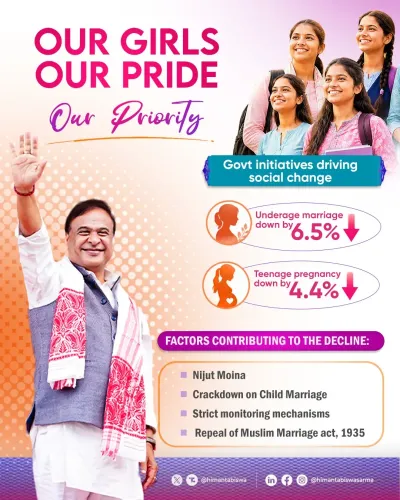
Assam has historically ranked among India's high-focus states under the National Rural Health Mission (NRHM), launched in 2005, which targeted elevated MMR and IMR through rural infrastructure upgrades, institutional delivery incentives, and community health worker outreach. The National Population Policy 2000 similarly set long-term benchmarks for TFR reduction and maternal health across states like Assam. Northeastern states have recorded steady gains in these metrics through successive central and state programmes focused on immunisation coverage and awareness campaigns. Assam-specific progress on child marriage has been a stated policy priority, with the state government having launched drives in 2023 to enforce laws against the practice, resulting in widespread awareness and legal action.
The claim of an MMR baseline 'in the 400s' aligns broadly with Assam's historically elevated maternal mortality compared to the national average, though precise verification of the exact figures and the attribution of reductions solely to the last five to six years awaits fresh official data from the Sample Registration System and the forthcoming NFHS-6 report.
Stakeholders and Impact
The primary beneficiaries of the trends cited by Sarma are Assam's mothers, newborns, and adolescent girls — groups that have historically faced compounded disadvantages in remote, ethnically diverse districts with limited healthcare access. A declining TFR has demographic implications for the state's dependency ratio and long-term resource planning. Progress on child marriage, if sustained, directly expands educational and economic opportunities for girls across the state's rural belt. Civil society groups and health administrators working on the ground in districts such as Barpeta, Dhubri, and Goalpara — historically among the most challenged — are key stakeholders in sustaining these gains.
What's Next
Independent verification of the scale of improvement will hinge on the next Sample Registration System bulletin and the NFHS-6 state-level findings, both of which are expected to provide granular MMR, IMR, and TFR data for Assam. Sustained momentum will require continued investment in last-mile healthcare delivery, trained personnel in remote areas, and enforcement of child marriage prevention laws. Sarma's public framing of these health gains signals that the state government intends to make this record a centrepiece of its governance narrative ahead of future electoral cycles.
Point of View
Framing health data as evidence of administrative competence at a moment when the BJP-led government in Assam is consolidating its record ahead of future electoral tests. By bundling MMR, IMR, TFR, and child marriage into a single narrative of transformation, he connects Assam's story to the broader national discourse on Sustainable Development Goals and demographic stabilisation — territory the Centre has increasingly claimed as a BJP-era achievement. The caveat is that independent verification through official data releases remains pending, making this a contested claim in the public domain until NFHS-6 and SRS figures are published. Regardless, the political optics of a northeastern chief minister citing health metrics positions NEDA's governance model as a template for the region.
NationPress
28 Oct 2026
Frequently Asked Questions
What has Assam CM Himanta Biswa Sarma said about MMR and IMR in Assam?
Assam CM Himanta Biswa Sarma said on 13 June 2026 that Assam has drastically reduced its Maternal Mortality Rate and Infant Mortality Rate from historic highs 'in the 400s,' attributing the decline to health-sector efforts over the last five to six years.
What is Assam's current MMR and IMR?
Exact current figures have not been officially released in the post; Sarma cited a fall 'from the highs of 400s' without specifying the current numbers. Verified state-level data is expected from the forthcoming NFHS-6 report and Sample Registration System bulletins.
Has child marriage been eliminated in Assam?
CM Sarma stated that child marriage has been 'almost wiped out' in Assam , reflecting sustained enforcement drives and awareness campaigns the state government has pursued, particularly since 2023 .
What is TFR and why does it matter for Assam?
Total Fertility Rate (TFR) measures the average number of children born per woman. Sarma said Assam's TFR has been 'contained,' which has positive implications for the state's demographic balance, healthcare planning, and long-term resource allocation.
What schemes helped improve maternal and child health in Assam?
The National Rural Health Mission (NRHM) , launched in 2005 , has been a key central scheme targeting high-focus states like Assam through institutional delivery incentives, immunisation drives, and community health worker deployment, complemented by state-level programmes.