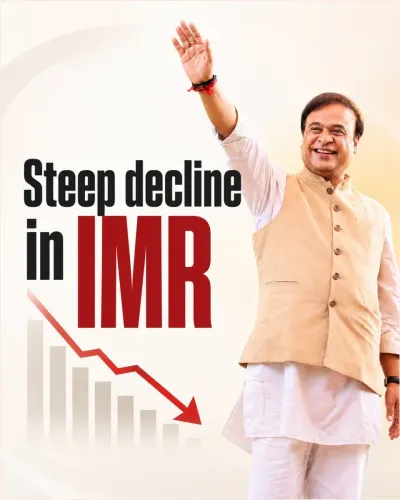
CM Himanta: Assam MMR now above national average

Synopsis
Chief Minister Himanta Biswa Sarma told the Assam Legislative Assembly on 26 May 2026 that the state has surpassed the national average in Maternal Mortality Ratio, reversing its historic position as one of India's worst-performing states on maternal health.
Key Takeaways
Himanta Biswa Sarma announced in the Assam Legislative Assembly on 26 May 2026 that Assam has surpassed the national average in Maternal Mortality Ratio (MMR) .
Assam's MMR was recorded at 237 per lakh live births in the 2014–16 SRS bulletin, among the highest in the country at the time.
The National Rural Health Mission (2005) and Janani Suraksha Yojana (2005) were key central schemes that supported Assam's maternal health improvement.
The state has shifted from being ranked at the bottom nationally to being described as among the top-performing states in India on MMR.
Independent verification will depend on the next Registrar General of India Sample Registration System statistical report.
The Sustainable Development Goal target for India is an MMR below 70 per lakh live births by 2030 .
The Chief Minister's Office of Assam announced on Tuesday, 26 May 2026 that Chief Minister Dr. Himanta Biswa Sarma told the Assam Legislative Assembly that the state has surpassed the national average in Maternal Mortality Ratio (MMR), marking what the government described as a remarkable transformation in the healthcare sector.
Addressing the assembly, Dr. Sarma stated that Assam, once ranked among the lowest-performing states nationally on maternal health indicators, has now emerged among the top-performing states in India. He described the shift as reflecting the government's 'steadfast commitment towards ensuring quality healthcare and comprehensive care for every mother.'
Context
Assam's maternal mortality record has historically been among the most challenging in the country. Registrar General of India Sample Registration System bulletins from 2014–16 recorded the state's MMR at 237 per lakh live births, placing it among the highest nationally. The national average at the time hovered significantly lower, making Assam a priority target for central health interventions. The Sustainable Development Goals, adopted in 2015, set a national MMR target of below 70 per lakh live births by 2030, pushing state governments to accelerate reforms. Assam's subsequent health action plans were calibrated against this benchmark.Policy Backdrop
The turnaround, if confirmed by official data, would represent the cumulative impact of over two decades of central and state investment. The National Rural Health Mission, launched in 2005, specifically targeted high-MMR states including Assam with additional funding for emergency obstetric care and primary health centre upgrades. The Janani Suraksha Yojana, a conditional cash transfer programme also started in 2005, incentivised institutional deliveries and was later supplemented by the Janani Shishu Suraksha Karyakram in 2011. These schemes collectively increased the share of facility-based births in Assam, a key driver of MMR reduction across high-burden states. Dr. Himanta Biswa Sarma, who served as Assam's Health and Finance Minister before becoming Chief Minister in May 2021, has consistently prioritised healthcare infrastructure as a policy anchor. His tenure has seen continued investment in free diagnostics, referral transport, and community health monitoring.Stakeholders and Impact
The primary beneficiaries of any sustained MMR improvement are expectant mothers in rural and semi-urban Assam, particularly in districts that historically lacked adequate obstetric facilities. Accredited Social Health Activists (ASHAs) and rural health workers have been central to bridging the gap between communities and institutional care. The broader pattern observed nationally shows that states combining National Health Mission funding with active community monitoring have achieved faster convergence toward the all-India average. Assam's claimed trajectory aligns with this trend, though independent verification through the next Sample Registration System statistical report will be essential to corroborate the assembly's claims.What's Next
The next Registrar General of India SRS bulletin will be the authoritative data point to validate whether Assam has indeed crossed the national MMR average. Health policy observers will also watch the state's upcoming budget allocations for signals on whether the government intends to consolidate these gains through sustained spending on primary and obstetric care. If the improvement is borne out by official statistics, it would place Assam's maternal health story among the more significant public-health turnarounds in northeastern India — and add weight to the government's case for its healthcare model ahead of future electoral cycles.Point of View
Assam's maternal health record, as a governance success story ahead of future electoral cycles. The claim fits a broader BJP-governed-state pattern of highlighting convergence with national health benchmarks as evidence of administrative competence. However, until the Registrar General of India publishes updated SRS data, the assertion remains a government claim rather than a verified statistical fact, and the gap between political announcements and official data releases has historically been significant in Indian public health discourse. The sharper policy question is whether the gains are structural — rooted in sustained primary health infrastructure — or driven by short-term facility upgrades that may not hold without continued budget commitment.
NationPress
10 Oct 2026
Frequently Asked Questions
Has Assam's Maternal Mortality Ratio improved in 2026?
Chief Minister Himanta Biswa Sarma stated in the Assam Legislative Assembly on 26 May 2026 that Assam has surpassed the national average in MMR, though official verification awaits the next Registrar General of India SRS bulletin.
What was Assam's MMR before the improvement?
According to Registrar General of India SRS bulletins, Assam's MMR stood at 237 per lakh live births in the 2014–16 reference period, placing it among the highest in the country at that time.
What schemes helped reduce maternal mortality in Assam?
Key central programmes include the National Rural Health Mission (2005) , the Janani Suraksha Yojana (2005) , which provides cash incentives for institutional deliveries, and the Janani Shishu Suraksha Karyakram (2011) , all implemented under the broader National Health Mission framework.
What is India's MMR target under the Sustainable Development Goals?
India's SDG target is to reduce the national MMR to below 70 per lakh live births by 2030 , a benchmark that has guided state-level health action plans including Assam's.
Who is Himanta Biswa Sarma and what is his role in Assam's health sector?
Dr. Himanta Biswa Sarma has been Chief Minister of Assam since May 2021 . Before that, he served as the state's Health and Finance Minister, making healthcare infrastructure a consistent policy priority throughout his tenure.