CM Himanta Highlights Assam's Falling MMR, IMR and Teen Pregnancies

Synopsis
Assam Chief Minister Himanta Biswa Sarma says the state's declining MMR is part of a broader health turnaround — falling IMR, fewer teenage pregnancies and more institutional births — crediting a holistic government approach and calling the results encouraging.
Key Takeaways
CM Himanta Biswa Sarma described Assam's falling MMR as part of a multi-indicator health improvement, not a standalone gain.
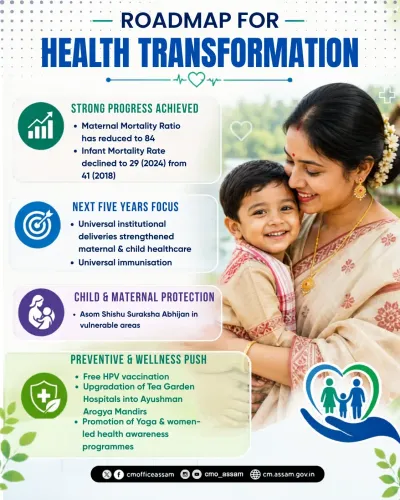
The state has simultaneously recorded a drop in IMR , a decline in teenage pregnancies and a rise in institutional births .
Assam has participated in the National Health Mission (NHM) since 2005 , with Janani Suraksha Yojana as a key lever for promoting institutional deliveries.
The improvements align with India's SDG targets 3.1 and 3.2 on reducing maternal and infant mortality.
The next Sample Registration System bulletin will provide independent verification of the state's claimed health gains.
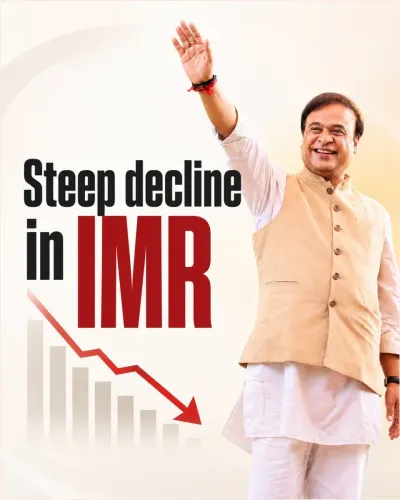
Assam Chief Minister Himanta Biswa Sarma on Sunday, 14 June 2026, highlighted a broad improvement in the state's maternal and child health indicators, pointing to a simultaneous decline in the maternal mortality ratio (MMR), infant mortality rate (IMR) and teenage pregnancies, alongside a rise in institutional births.
Context
In his post, CM Sarma stated that Assam's declining MMR 'is not an isolated improvement' but is 'complemented by a drop in IMR, a decline in teenage pregnancies and rising institutional births.' He described the state government's approach as 'holistic' and called the results 'encouraging.' The remarks signal the administration's intent to frame its health record as a systemic achievement rather than a single-metric gain.
Assam has historically carried one of the highest maternal mortality burdens among Indian states. Successive Sample Registration System (SRS) bulletins between 2014 and 2020 documented a steady fall from a very high baseline, a trend the current government says has continued under its watch since 2021.
Policy Backdrop
The gains are rooted in a policy architecture that stretches back to 2005, when Assam joined the National Rural Health Mission (NRHM) — later restructured as the National Health Mission (NHM). A central plank of that framework was the Janani Suraksha Yojana (JSY), a conditional cash-transfer scheme designed to incentivise institutional deliveries among low-income and rural mothers.
After 2014, increased central health allocations and tighter state-level monitoring frameworks accelerated progress across northeastern states. CM Sarma's government has layered additional interventions targeting teenage pregnancies — a driver of both maternal and infant mortality — by linking health services with education and social welfare departments.
The emphasis on multiple complementary indicators aligns with India's commitments under Sustainable Development Goal (SDG) targets 3.1 and 3.2, which set global benchmarks for reducing maternal and under-five mortality through expanded antenatal care and skilled birth attendance.
Stakeholders and Impact
The primary beneficiaries of these improvements are mothers and newborns across Assam, particularly in rural and tribal districts that historically recorded the worst outcomes. A fall in teenage pregnancies carries a generational dividend: younger mothers face disproportionately higher obstetric risks, so reducing adolescent fertility directly lowers both MMR and IMR.
Rising institutional births — deliveries conducted in government hospitals or accredited private facilities — reduce the risk of complications going unattended, and also generate reliable data that allows planners to target resources more precisely. For the NHM framework, Assam's trajectory is a reference point for other high-burden northeastern states still working to close the gap with national averages.
What's Next
The next Sample Registration System statistical bulletin, expected to carry updated state-wise MMR and IMR figures, will be the definitive test of the claims made by the Assam government. Analysts will also watch the tabling of the state's annual health budget and any new maternal-health scheme guidelines for indications of how CM Sarma's administration plans to sustain and deepen these gains. If the data bears out the trend, Assam could emerge as a model for integrated maternal and child health programming within the North-East Democratic Alliance (NEDA) bloc of states.
Point of View
IMR and teenage-pregnancy metrics, CM Sarma is making a political argument as much as a public-health one — positioning his administration's record as structurally superior to piecemeal improvements seen under earlier governments. The move fits a broader BJP pattern of using social-sector data to reinforce governance credibility in states where development optics matter for electoral consolidation. For the NEDA bloc, a demonstrable health turnaround in Assam could serve as a template and a talking point across the northeast. The proof, however, will rest with the next independent SRS bulletin rather than executive communication.
NationPress
22 Sept 2026
Frequently Asked Questions
What is Assam's current maternal mortality ratio (MMR)?
Precise 2025-2026 MMR figures for Assam have not yet been published in an official bulletin; CM Sarma's post confirms a declining trend, but the exact number will be available in the next Sample Registration System release.
What is the Janani Suraksha Yojana and how does it help Assam?
Janani Suraksha Yojana (JSY) is a central government conditional cash-transfer scheme that incentivises poor and rural women to deliver in hospitals or accredited facilities, directly raising institutional birth rates and reducing maternal deaths.
Why does teenage pregnancy affect maternal and infant mortality?
Adolescent mothers face higher obstetric risks including obstructed labour, anaemia and pre-eclampsia, making them more vulnerable to death during childbirth; their infants also face elevated mortality risks, so reducing teenage pregnancies lowers both MMR and IMR simultaneously.
What is the National Health Mission (NHM) and what role does it play in Assam?
The National Health Mission (NHM) is a central government programme that funds and frames maternal health, institutional deliveries and child survival across states; Assam has been part of the mission since 2005 and uses its framework to drive antenatal care and skilled birth attendance.
How does Assam's health improvement relate to India's SDG targets?
India's SDG targets 3.1 and 3.2 set global benchmarks for reducing maternal and under-five mortality; Assam's simultaneous fall in MMR , IMR and teenage pregnancies directly tracks these goals and is part of a broader national push across northeastern states.