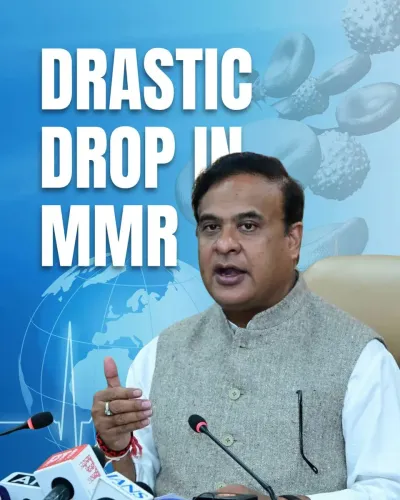
CM Himanta: Assam MMR drops to 84, below national average

Synopsis
Assam Chief Minister Himanta Biswa Sarma announced on May 26, 2026, that the state's Maternal Mortality Rate has dropped to 84 — below the national average of 88 — marking a historic first for Assam and reflecting over a decade of targeted maternal health interventions.
Key Takeaways
Assam's MMR has fallen to 84 per 1,00,000 live births , below the national average of 88 for the first time.
CM Himanta Biswa Sarma linked the improvement to work begun during his tenure as Assam's Health Minister before May 2021 .
Central schemes including Janani Suraksha Yojana and the National Rural Health Mission have underpinned Assam's maternal health push since 2005 .
Assam has historically recorded MMR levels well above the national average, making this convergence a significant policy milestone.
The SDG 3.1 global target requires an MMR of 70 or below by 2030 , meaning Assam still has ground to cover.
The next SRS bulletin covering 2023–25 estimates will be key to confirming the trend's durability.
Assam Chief Minister Himanta Biswa Sarma on Tuesday, May 26, 2026, announced a landmark public health milestone for the state: Assam's Maternal Mortality Rate (MMR) has fallen to 84, dipping below the national average of 88 for the first time in the state's recorded history. The Chief Minister described the moment as one that 'touched him very deeply' in a post on X.
Context
Assam has historically been among the states with an MMR significantly above the national average, a pattern documented across successive rounds of the Sample Registration System (SRS) surveys conducted by the Registrar General of India. High maternal mortality in the state has long been attributed to geographic remoteness, inadequate rural health infrastructure, and socio-economic barriers to institutional deliveries. The latest figures mark a decisive break from that pattern, placing Assam among states that have converged with — and now marginally outperformed — the national benchmark.
CM Sarma noted in his post that the turnaround began when he held the state's health portfolio, a reference to his tenure as Assam's Health Minister before assuming the Chief Ministership in May 2021. The announcement signals the cumulative effect of over a decade of targeted maternal health interventions at both the state and central levels.
Policy Backdrop
The reduction in Assam's MMR sits within a broader national policy architecture. The National Rural Health Mission (NRHM), launched in 2005, prioritised strengthening rural obstetric care and deploying Accredited Social Health Activist (ASHA) workers across high-burden states, with Northeastern India receiving focused attention given its distinct geographic and demographic challenges. The Janani Suraksha Yojana (JSY), also launched in 2005, provided conditional cash transfers to incentivise institutional deliveries among low-income pregnant women — a critical lever in states like Assam where home deliveries were common.
The Pradhan Mantri Surakshit Matritva Abhiyan (PMSMA), introduced in 2016, further reinforced the framework by guaranteeing assured antenatal check-ups on the ninth of every month at government health facilities. Together, these schemes created a continuum of care that health administrators in Assam have sought to leverage through improved district-level implementation and emergency obstetric referral networks.
Stakeholders and Impact
The most direct beneficiaries of the declining MMR are Assam's pregnant women, particularly those in rural and remote districts who previously faced the greatest risk. Frontline health workers — ASHA workers, auxiliary nurse midwives, and district health officers — are central to the operational achievement. Their expanded reach into villages and tea-garden communities has been a consistent feature of state health planning under successive governments.
The milestone also carries political weight for CM Sarma personally, given his long association with the health portfolio in Assam. For the BJP-led state government, the data point reinforces a governance narrative ahead of future electoral cycles. Nationally, Assam's trajectory adds to evidence that focused state-level execution of central health schemes can close longstanding regional disparities in maternal health outcomes.
What's Next
The global benchmark for maternal mortality is the Sustainable Development Goal (SDG) 3.1 target of an MMR of 70 or below per 1,00,000 live births by 2030. With Assam now at 84, the state is within measurable distance of that goal but will need to sustain and deepen investments in rural obstetric infrastructure, skilled birth attendance, and postnatal care. The next SRS statistical bulletin — expected to carry 2023–25 estimates — will be closely watched to confirm and contextualise the trend.
State budget allocations for health infrastructure upgrades and any new state-specific maternal health schemes announced by the Sarma government in the coming months will indicate whether Assam has a credible roadmap to reach the SDG 3.1 threshold before the decade ends.
Point of View
Crossing below the national average is both a public health achievement and a governance signal. CM Sarma's decision to frame the milestone in personal terms — connecting it to his earlier stint as Health Minister — is a deliberate narrative choice that ties long-term institutional work to individual political accountability. The milestone also illustrates how sustained implementation of central maternal health schemes, when reinforced by state-level operational focus, can produce measurable convergence even in geographically challenging regions. The harder test will be whether Assam can sustain momentum toward the SDG 3.1 target of 70 by 2030, which will require deepening rural health infrastructure rather than relying on the relatively easier gains already captured.
NationPress
20 Sept 2026
Frequently Asked Questions
What is Assam's current Maternal Mortality Rate?
According to an announcement by Chief Minister Himanta Biswa Sarma on May 26, 2026, Assam's Maternal Mortality Rate stands at 84 per 1,00,000 live births, which is below the national average of 88.
What is India's national average MMR?
The national average Maternal Mortality Rate cited by CM Sarma in his May 2026 announcement is 88 per 1,00,000 live births.
Why was Assam's maternal mortality rate historically high?
Assam's high MMR has been attributed to geographic remoteness, limited rural health infrastructure, socio-economic barriers, and lower rates of institutional deliveries, particularly in tea-garden and riverine communities.
What government schemes helped reduce MMR in Assam?
Key central schemes include the Janani Suraksha Yojana (2005), the National Rural Health Mission (2005), and the Pradhan Mantri Surakshit Matritva Abhiyan (2016), all of which incentivised institutional deliveries and improved antenatal care access in states like Assam.
What is the SDG target for maternal mortality?
The United Nations Sustainable Development Goal 3.1 sets a global target of reducing the Maternal Mortality Rate to 70 or below per 1,00,000 live births by 2030. Assam's current rate of 84 means the state is approaching but has not yet reached this benchmark.