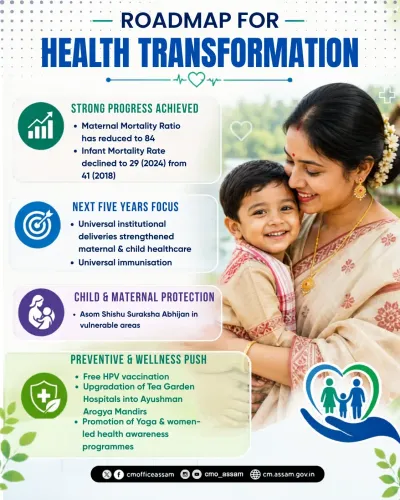
CM Himanta: Assam MMR drops from 480 to 84

Synopsis
Chief Minister Himanta Biswa Sarma has announced that maternal deaths in Assam have fallen from 480 to 84, marking a dramatic reduction attributed to sustained investment in rural obstetric care and institutional delivery programmes under both central and state health schemes.
Key Takeaways
The Chief Minister's Office of Assam announced on 27 June 2026 that maternal deaths in the state have dropped from 480 to 84 .
CM Himanta Biswa Sarma made the announcement, framing it as a major public health milestone for Assam .
Assam has historically had one of India's highest maternal mortality ratios, making this decline especially significant.
Central schemes including the National Rural Health Mission and Janani Suraksha Yojana , both launched in 2005 , have been key policy drivers behind rising institutional delivery rates in the state.
India's SDG 3 target requires a national MMR below 70 per 1,00,000 live births by 2030 ; Assam's stated trajectory suggests it may approach this benchmark ahead of schedule.
Independent confirmation is expected from the next Sample Registration System or NFHS data release.
The Chief Minister's Office of Assam announced on Saturday, 27 June 2026 that the state's maternal mortality figures have fallen sharply, with Chief Minister Himanta Biswa Sarma stating that maternal deaths in Assam have declined from 480 to 84 — a reduction of over 80 per cent.
Context
The post, shared by the official CMO Assam handle, quotes Chief Minister Himanta Biswa Sarma directly: 'অসমত ৪৮০ৰ পৰা ৮৪ লৈ হ্ৰাস পাইছে প্ৰসূতি মাতৃৰ মৃত্যুৰ সংখ্যা' — translated, 'The number of maternal deaths in Assam has declined from 480 to 84.' The announcement positions this as a landmark public health achievement for the state.
Assam has historically recorded maternal mortality ratios well above the national average, making it one of the priority states under successive central and state health programmes. A decline of this magnitude, if sustained, would represent one of the steepest drops in maternal mortality recorded by any Indian state.
Policy Backdrop
The improvement comes on the back of long-running interventions anchored in central schemes. The National Rural Health Mission (NRHM), launched in 2005, specifically targeted high-MMR states including Assam by upgrading first referral units, deploying skilled birth attendants, and strengthening emergency obstetric care infrastructure.
Simultaneously, the Janani Suraksha Yojana (JSY), also introduced in 2005, incentivised institutional deliveries among poor pregnant women through conditional cash transfers — a measure credited with driving up facility-based births across rural Assam. India's commitment to Sustainable Development Goal 3, adopted in 2015, set a national maternal mortality ratio target of below 70 per 1,00,000 live births by 2030, providing a policy framework that state governments have aligned their programmes with.
At the national level, Sample Registration System data documented a progressive fall in India's MMR from 212 (2007–09) to 97 (2018–20), and Assam's trajectory, as cited by the Chief Minister, suggests the state has been moving faster than the national average in recent years.
Stakeholders and Impact
The most direct beneficiaries of this trend are pregnant women in Assam's rural and semi-urban belts, where access to skilled obstetric care has historically been limited. Rural health workers — including ASHA workers and auxiliary nurse midwives — have been central to driving institutional delivery rates upward, and the stated decline reflects their expanded reach.
The Assam state health department has over recent years prioritised upgrading district hospitals and community health centres to handle obstetric emergencies, alongside referral transport schemes to reduce delays in reaching care. The CM's announcement signals that these investments are registering measurable outcomes at the population level.
What's Next
Independent verification of the 480 to 84 figures is expected when the next round of Sample Registration System data or the National Family Health Survey (NFHS) is released, which will provide state-level maternal mortality estimates against a standardised methodology. Analysts will watch whether Assam's state budget allocations for maternal health facilities are sustained or expanded to consolidate these gains.
If the figures hold under official measurement, Assam would be on a trajectory to meet the SDG 3 target of sub-70 MMR by 2030 ahead of schedule — a benchmark that would mark a generational shift in one of India's most challenging maternal health geographies.
Point of View
Which has consistently positioned health infrastructure as a flagship governance priority since taking office in 2021. A claimed reduction of over 80 per cent in maternal deaths — if corroborated by official measurement systems — would place Assam among the fastest-improving states on a metric that has long been a mark of developmental deficit in India's northeast. The timing, ahead of likely electoral cycles and SDG review windows, also serves to demonstrate that northeastern states can close longstanding health gaps with sustained central and state investment. Independent verification through the Sample Registration System will be the definitive test of whether the headline figure reflects a structural shift or a change in measurement methodology.
NationPress
25 Sept 2026
Frequently Asked Questions
What did CM Himanta Biswa Sarma say about maternal deaths in Assam?
CM Himanta Biswa Sarma stated that maternal deaths in Assam have declined from 480 to 84, describing it as a major health achievement for the state.
What is the current maternal mortality situation in Assam?
According to the Chief Minister's Office of Assam, maternal deaths in the state have fallen sharply from 480 to 84, reflecting improvements in institutional delivery rates and obstetric care infrastructure.
Which schemes helped reduce maternal mortality in Assam?
The National Rural Health Mission and Janani Suraksha Yojana, both launched in 2005, have been central to improving maternal healthcare access in Assam by upgrading facilities and incentivising institutional deliveries.
What is India's SDG target for maternal mortality?
India has committed under Sustainable Development Goal 3 to reduce the national maternal mortality ratio to below 70 per 1,00,000 live births by 2030.
How will the Assam maternal mortality figures be officially verified?
The figures are expected to be independently confirmed through the next round of Sample Registration System data or the National Family Health Survey, which provide standardised state-level maternal mortality estimates.