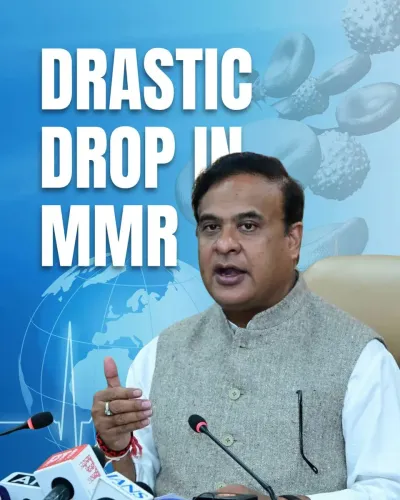
CM Himanta: Assam MMR fell from 490 to 84 per lakh births

Synopsis
Assam's Chief Minister Dr. Himanta Biswa Sarma has highlighted a landmark decline in the state's Maternal Mortality Ratio — from 490 per lakh live births in 2006 to just 84 in recent years — marking over 80 per cent reduction driven by NHM interventions, institutional delivery push, and ASHA worker outreach over two decades.
Key Takeaways
Assam's Maternal Mortality Ratio (MMR) has fallen from 490 per one lakh live births in 2006 to 84 in recent years , according to CM Dr.
Himanta Biswa Sarma.
The decline represents a reduction of more than 80 per cent over approximately 16 years .
Key policy drivers include the National Health Mission (NHM) launched in 2005 and the Janani Suraksha Yojana conditional cash transfer scheme.
ASHA workers and strengthened first-referral units, blood storage, and referral transport have been central to the improvement.
India's national MMR dropped from 212 (2007–09) to 97 (2018–20) ; the SDG 3.1 target is below 70 per lakh by 2030 .
Updated independent verification is expected from the next SRS report or NFHS-6 state-level data release.
The Chief Minister's Office of Assam on Friday, 26 June 2026 shared a statement by Chief Minister Dr. Himanta Biswa Sarma highlighting a dramatic decline in the state's Maternal Mortality Ratio, from 490 per one lakh live births in 2006 to 84 in recent years — a reduction of more than 80 per cent over two decades.
Context
Quoting CM Dr. Himanta Biswa Sarma directly, the post stated: 'Assam's Maternal Mortality Ratio has declined from 490 per 1 lakh live births in 2006 to just 84 in recent years.' The figure, if confirmed by official Sample Registration System data, would represent one of the steepest state-level MMR declines recorded in India. Assam has historically ranked among the states with the highest maternal mortality due to difficult terrain, sparse health infrastructure, and limited access to emergency obstetric care in remote districts.
Policy Backdrop
The turnaround coincides with two decades of sustained intervention under the National Health Mission (NHM), launched in 2005 as the National Rural Health Mission, which made maternal mortality reduction a core objective through skilled birth attendance and emergency obstetric services. The Janani Suraksha Yojana, a conditional cash transfer scheme also started in 2005, incentivised institutional deliveries among low-income and rural mothers — a key driver of MMR reduction nationally and in Assam specifically.
Assam supplemented central schemes by strengthening first-referral units, blood storage facilities, and referral transport networks under NHM across its high-burden districts. At the national level, India's MMR fell from 212 (2007–09) to 97 (2018–20) through scaled-up institutional delivery infrastructure — with northeastern states receiving additional central funding given geographic barriers. India has committed to meeting the Sustainable Development Goal 3.1 target of an MMR below 70 per lakh live births by 2030.
Stakeholders and Impact
The most direct beneficiaries of this trend are pregnant women and rural mothers across Assam, particularly in districts that previously had negligible access to skilled birth attendants or functional delivery facilities. ASHA (Accredited Social Health Activist) workers have played a frontline role in escorting women to health facilities and ensuring post-natal follow-up, and the MMR decline is broadly attributed to their community outreach alongside infrastructure upgrades.
Dr. Himanta Biswa Sarma, who held the health portfolio in Assam before becoming Chief Minister in May 2021, has consistently cited maternal and child health indicators as benchmarks of governance performance. The state's progress is also significant for central health planners, as Assam's improvement lifts the overall northeastern regional average, which has lagged behind peninsular and western Indian states.
What's Next
The next release of the Sample Registration System (SRS) statistical report or NFHS-6 state-factsheet data is expected to provide independently verified, updated MMR estimates for Assam that will either corroborate or contextualise the figure cited by the Chief Minister. Health budget allocations for 2025–26 and the district-level rollout of new maternal health facilities will determine whether the state can sustain this trajectory toward the SDG target of sub-70 MMR by 2030.
With roughly 16 years of data showing an 83 per cent reduction in maternal deaths per lakh live births, Assam's experience is increasingly cited as a reference point for other high-burden states seeking to replicate rapid MMR decline through a combination of central scheme funding, local infrastructure investment, and community health worker mobilisation.
Point of View
If validated by SRS or NFHS data, would place Assam among the fastest-improving states on maternal health, a striking turnaround for a region long treated as a laggard. The timing, ahead of potential NFHS-6 data releases, suggests the government is anchoring public expectations around health metrics as a political differentiator. Broader significance lies in whether Assam's model — combining central NHM funding with state-level referral infrastructure — can be institutionalised and extended to close the remaining gap toward the SDG sub-70 target by 2030.
NationPress
25 Sept 2026
Frequently Asked Questions
What is Assam's current Maternal Mortality Ratio?
According to CM Dr. Himanta Biswa Sarma, Assam's Maternal Mortality Ratio stands at 84 per one lakh live births in recent years, down from 490 in 2006. Independent verification is awaited from the next official SRS or NFHS-6 data release.
What was Assam's MMR in 2006?
Assam's Maternal Mortality Ratio was 490 per one lakh live births in 2006 , one of the highest in India at the time, reflecting poor access to emergency obstetric care and skilled birth attendants in remote districts.
Why was Assam's maternal mortality so high?
Assam historically had high maternal mortality due to difficult terrain, sparse health infrastructure , and limited access to skilled birth attendants and emergency obstetric services, particularly in rural and remote districts of the northeastern state.
What schemes reduced maternal mortality in Assam?
The National Health Mission (NHM) launched in 2005 and the Janani Suraksha Yojana conditional cash transfer scheme were the primary central-government programmes. Assam also strengthened referral transport, first-referral units, and blood storage facilities at the state level.
What is India's SDG target for maternal mortality?
India has committed to Sustainable Development Goal 3.1 , which sets a target of reducing the national Maternal Mortality Ratio to below 70 per one lakh live births by 2030 . India's national MMR was 97 in the 2018–20 reference period.