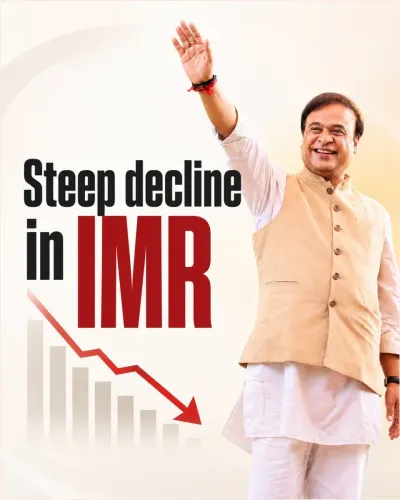
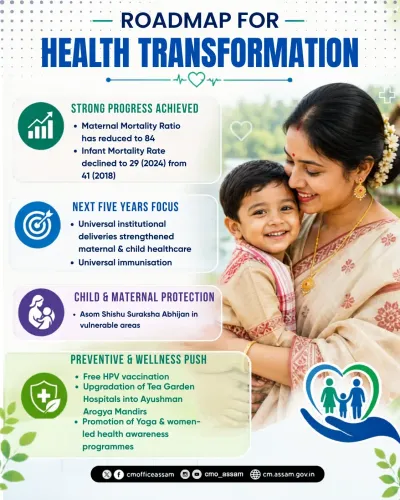
CM Himanta: Assam MMR drops from 480 to 84 under healthcare reforms
Synopsis
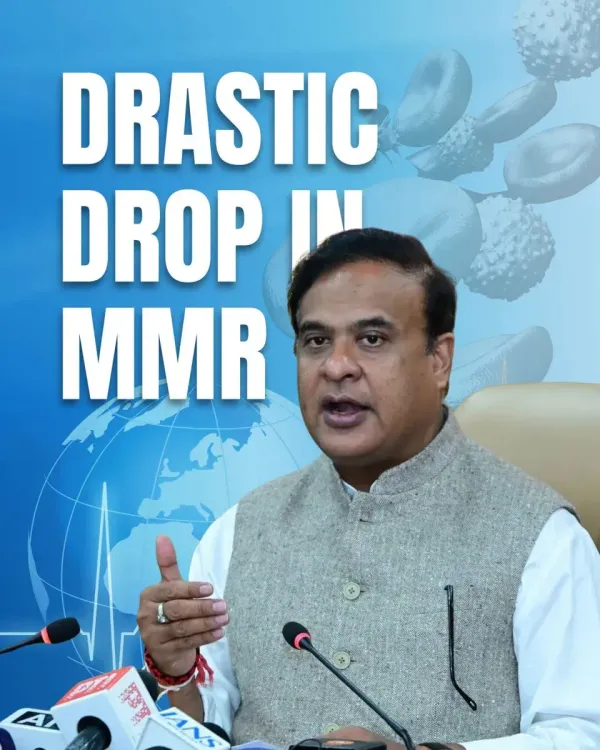
Assam Chief Minister Himanta Biswa Sarma on 15 July 2026 announced that the state's Maternal Mortality Ratio has plummeted from 480 to 84, with institutional deliveries exceeding 90 per cent. He credited holistic healthcare reforms and the 'Double Engine Government' for Assam surpassing national averages in most NFHS-6 health indicators.
Key Takeaways
Assam's MMR has reportedly fallen from 480 to 84 per one lakh live births, according to CM Himanta Biswa Sarma.
Institutional deliveries in the state now exceed 90 per cent , a key driver of reduced maternal deaths.
Assam has surpassed the national average in 'almost all major health indicators' in NFHS-6 , per CM Sarma's statement.
Central schemes including Janani Suraksha Yojana and the National Health Mission have underpinned the state's maternal health push since 2005.
The achievement is framed as a 'Double Engine Government' outcome, reflecting aligned BJP rule at the Centre and in Assam .
India's SDG target is an MMR below 70 per one lakh live births by 2030 ; Assam's reported figure of 84 places it close to that benchmark.
Assam Chief Minister Himanta Biswa Sarma on Wednesday, 15 July 2026, highlighted a dramatic improvement in the state's maternal health outcomes, citing a fall in the Maternal Mortality Ratio (MMR) from 480 to 84 per one lakh live births and institutional delivery coverage crossing 90 per cent. The Chief Minister also stated that Assam has surpassed the national average in nearly all major health indicators in the Sixth National Family Health Survey (NFHS-6), calling it a milestone of the 'Double Engine Government.'
Context
In his post, CM Sarma said: 'Assam's holistic healthcare reforms have driven a remarkable drop in MMR from 480 to 84, with over 90% institutional deliveries. In NFHS 6, we have surpassed national average in almost all major health indicators — a proud milestone of the Double Engine Government.' The claim marks one of the sharpest MMR declines reported by any Indian state and positions Assam as a turnaround story in maternal health.
Maternal mortality has historically been among the most stubborn public health challenges in Assam, with the state's remote geography, dispersed population, and limited health infrastructure contributing to elevated death rates among mothers. An MMR of 480 would have placed the state among the highest-burden regions in the country; a figure of 84 would bring it close to the national SDG target of below 70 per one lakh live births by 2030.
Policy Backdrop
The improvements cited by CM Sarma sit within a longer arc of central and state health policy. The Janani Suraksha Yojana (JSY), launched in 2005, incentivised institutional deliveries in high-burden states including Assam by providing cash transfers to mothers who delivered in government facilities. The scheme is widely credited with shifting delivery patterns across rural India.
The National Health Mission (NHM), also rolled out from 2005, provided dedicated funding for reproductive and child health infrastructure, with northeastern states receiving supplementary support owing to their geographic constraints. Together, these programmes built the delivery-point network and referral transport systems that underpin the institutional delivery rate now cited by the Chief Minister.
NFHS-6, conducted by the Ministry of Health and Family Welfare, is the most recent round of the periodic national survey tracking population health indicators. State-level fact sheets from the survey serve as the primary benchmark for comparing progress across indicators such as MMR, anaemia, child nutrition, and immunisation coverage.
Stakeholders and Impact
The most direct beneficiaries of the reported gains are pregnant women and rural mothers across Assam, particularly those in districts with historically weak health infrastructure. Higher institutional delivery rates reduce the risk of obstetric complications going unattended, a key driver of maternal deaths.
ASHA (Accredited Social Health Activist) workers have been central to mobilising communities for antenatal care and facility-based deliveries. Their role in bridging the gap between health facilities and remote households is considered a critical operational factor in states like Assam where last-mile connectivity remains a challenge.
The political framing of the achievement as a 'Double Engine Government' outcome reflects the BJP's broader electoral argument that concurrent party rule at the Centre and in states accelerates policy delivery — a narrative CM Sarma, as convenor of the North-East Democratic Alliance (NEDA), has consistently advanced across the northeastern region.
What's Next
Detailed state fact sheets from NFHS-6 are expected to provide granular, district-level data that will allow independent assessment of the indicators cited by CM Sarma. Sustained progress will depend on continued funding for delivery-point upgrades, referral transport networks, and retention of frontline health workers in Assam's remote areas.
With India's SDG 3.1 target of an MMR below 70 by 2030 still four years away, Assam's reported trajectory — if confirmed by published survey data — would place it among the states closest to achieving that benchmark, and could inform health policy replication across other northeastern states still lagging on maternal indicators.
Point of View
Reinforcing the BJP's argument that aligned Centre-state governance delivers measurable public goods ahead of future assembly cycles in the northeast. If NFHS-6 state fact sheets confirm the figures, Assam's MMR trajectory would represent one of the steepest declines recorded by any Indian state, validating years of NHM and JSY investment. The data, once published in full, will also serve as a benchmark test of how far coordinated federal health spending can compress entrenched regional disparities.
NationPress
14 Oct 2026
Frequently Asked Questions
What is Assam's current Maternal Mortality Ratio in 2026?
Chief Minister Himanta Biswa Sarma stated on 15 July 2026 that Assam's MMR has fallen to 84 per one lakh live births, down from a previous figure of 480 , citing holistic healthcare reforms as the driver.
What is NFHS-6 and what does it say about Assam?
NFHS-6 is the Sixth National Family Health Survey conducted by India's Ministry of Health and Family Welfare to track population health indicators. CM Sarma claimed Assam has surpassed the national average in almost all major health indicators in this latest round.
What is the Double Engine Government and how does it relate to Assam's health progress?
'Double Engine Government' is a BJP term for concurrent party rule at the Centre and in a state, enabling aligned policy implementation. CM Sarma credited this arrangement for accelerating Assam's health improvements.
What is India's MMR target under the Sustainable Development Goals?
India has adopted the SDG 3.1 target of reducing the national MMR to below 70 per one lakh live births by 2030 . Assam's reported MMR of 84 places it close to this benchmark.
What schemes helped reduce maternal mortality in Assam?
Central programmes including the Janani Suraksha Yojana (launched 2005) and the National Health Mission have incentivised institutional deliveries and built obstetric care infrastructure in Assam, supporting the decline in maternal deaths.